


The Fair Trade Commission should investigate if Apple Inc has abused its market power by requiring iPhone buyers to pay extra for adapters and earphones, the Consumers’ Foundation said yesterday.
The US smartphone brand stopped offering adapters and earpods to buyers in October last year when it launched the iPhone 12 series. Apart from the smartphone, buyers only receive a USB-C charger cable in the package.
Apple has announced that it is to launch its iPhone 13 series at 10am on Tuesday Pacific time.
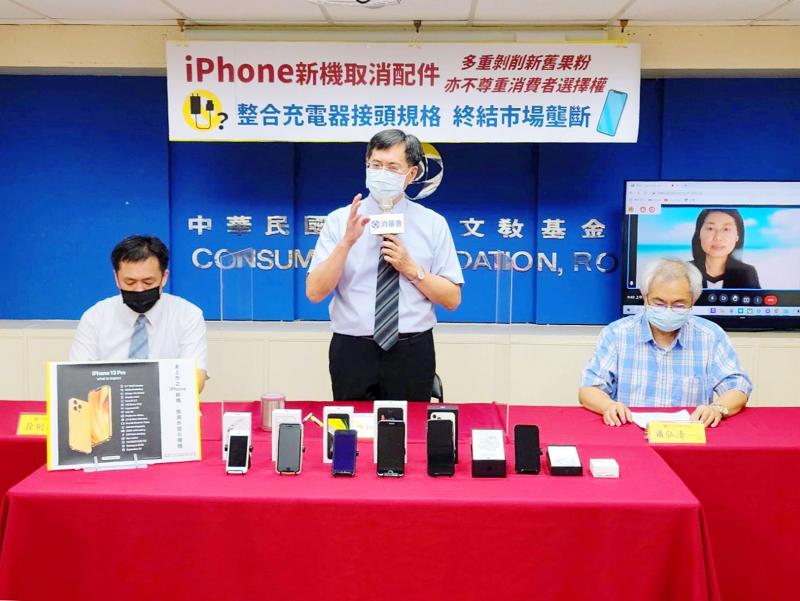
Photo courtesy of the Consumers’ Foundation via CNA
The EU has in recent years been pushing for a consolidation of various specifications for smartphone power chargers in a bid to reduce electronic waste, but Apple has been developing new specifications for iPhone accessories, foundation secretary-general Hsu Tse-yu (徐則鈺) said.
“Apple said that it stopped providing adapters and earpods to protect the environment. However, consumers cannot access the full functions of iPhones without these two accessories, so they must spend more to buy them,” Hsu said.
Not providing adapters and earpods does not make a new iPhone cheaper, he said.
“On the contrary, we see prices of new iPhones going even higher, and a reduction in manufacturing costs does not translate to a drop in the product’s retail price,” he said.
Foundation legal committee convener Tsai Pei-fen (蔡佩芬) said that Apple offers these two accessories when they sell new iPhones in France, adding that iPhones that do not include them should be sold at a lower price.
Fair Trade Commission Vice Chairman Andy Chen (陳志民) said the commission has not received the foundation’s official request for an investigation, and it would only consider taking up the case after it is ascertained through a market research that the issue might be related to market competition.
“We will examine the company’s market share and its market power before determining if its sales model would exclude market competition,” he said.
The Fair Trade Act (公平交易法) does not affect the way manufacturers set prices for products, he said.

The Centers for Disease Control (CDC) yesterday reported the first case of a new COVID-19 subvariant — BA.3.2 — in a 10-year-old Singaporean girl who had a fever upon arrival in Taiwan and tested positive for the disease. The girl left Taiwan on March 20 and the case did not have a direct impact on the local community, it said. The WHO added the BA.3.2 strain to its list of Variants Under Monitoring in December last year, but this was the first imported case of the COVID-19 variant in Taiwan, CDC Deputy Director-General Lin Ming-cheng (林明誠) said. The girl arrived in Taiwan on

South Korea is planning to revise its controversial electronic arrival card, a step Taiwanese officials said prompted them to hold off on planned retaliatory measures, a South Korean media report said yesterday. A Yonhap News Agency report said that the South Korean Ministry of Foreign Affairs is planning to remove the “previous departure place” and “next destination” fields from its e-arrival card system. The plan, reached after interagency consultations, is under review and aims to simplify entry procedures and align the electronic form with the paper version, a South Korean ministry official said. The fields — which appeared only on the electronic form

The Ministry of Foreign Affairs (MOFA) is suspending retaliation measures against South Korea that were set to take effect tomorrow, after Seoul said it is updating its e-arrival system, MOFA said today. The measures were to be a new round of retaliation after Taiwan on March 1 changed South Korea's designation on government-issued alien resident certificates held by South Korean nationals to "South Korea” from the "Republic of Korea," the country’s official name. The move came after months of protests to Seoul over its listing of Taiwan as "China (Taiwan)" in dropdown menus on its new online immigration entry system. MOFA last week
A bipartisan group of US senators has introduced a bill to enhance cooperation with Taiwan on drone development and to reduce reliance on supply chains linked to China. The proposed Blue Skies for Taiwan Act of 2026 was introduced by Republican US senators Ted Cruz and John Curtis, and Democratic US senators Jeff Merkley and Andy Kim. The legislation seeks to ease constraints on Taiwan-US cooperation in uncrewed aerial systems (UAS), including dependence on China-sourced components, limited access to capital and regulatory barriers under US export controls, a news release issued by Cruz on Wednesday said. The bill would establish a "Blue UAS


 RSS
RSS