


Only about one-quarter of sports associations that received government funding have met a deadline to turn in financial statements, as stipulated in a 2017 amendment to the National Sports Act (國民體育法), the New Power Party (NPP) said yesterday.
At a news conference in Taipei to mark National Sports Day, the party urged the government to continue sports reform, after Taiwanese athletes won two gold, four silver and six bronze medals at the Tokyo Olympics last month, the nation’s best performance since the 2004 Olympics in Athens.
It has been four years since the government started asking publicly funded sports associations to submit financial statements, but few of them have made their financial situations transparent, NPP caucus whip Chiu Hsien-chih (邱顯智) said.
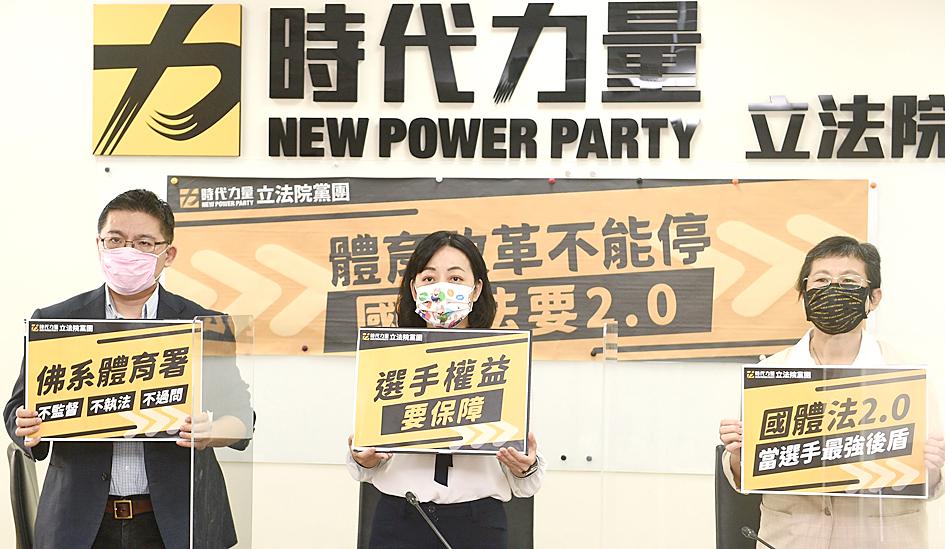
Photo: George Tsorng, Taipei Times
The Sports Administration allocates about NT$3.5 billion (US$126.12 million) annually to 71 sports associations, but only 17 of them filed financial statements before their deadline, Chiu said.
Moreover, some groups have failed to meet other standards, he added.
The management of baseball, tennis, badminton and swimming associations in February were convicted of manipulating board elections by collecting signatures and identification information from non-members, Chiu said.
Chief secretaries at ice hockey, tennis and badminton associations were convicted of fraud or forgery, he said, adding that Article 39 of the National Sports Act does not prevent convicted individuals from assuming management positions in sports associations.
The financial reporting of some associations was substandard, as, for example, the tennis association’s statement does not explain some obscure items, Chiu said.
NPP Legislator Claire Wang (王婉諭) called for a comprehensive review of a compensation program for athletes on national teams.
Professional athletes are compensated NT$30,000 per month, but other athletes only receive NT$15,500, with many being forced to take unpaid leave or quit their jobs to participate in training programs, Wang said.
“The meager government funding for non-full-time athletes should stop immediately,” she said, adding that many Olympic athletes are facing “financial difficulties.”
Associations offering athletes two-way contracts to protect their rights during training or international competitions are rare, Wang said.
Most athletes only sign an affidavit that stipulates their obligations and responsibilities, she said.
NPP Chairwoman and deputy caucus whip Chen Jiau-hua (陳椒華) said that the party would propose an amendment to Article 39 that would set a term limit for chairpersons and other key officials at sports associations.
This would prevent associations from being controlled by certain individuals, she said.
While the 2017 amendment states that chairpersons, board directors, supervisors and secretaries cannot use their positions for their own benefit or that of other stakeholders, the article is still too vague, she said.
“The Sports Administration should clearly stipulate criteria for a conflict of interest and legal consequences in case a sports association contravenes the regulations. It should also list the individuals with whom sports associations are prohibited from engaging in commercial transactions,” Chen said, referring to a case from 2019.
At the time, prosecutors launched an investigation into the softball association after Winner Express (運佳旅行社), a travel agency that helped arrange a trip of the national women’s softball team to the US, allegedly overcharged the association.
The firm was run by Tsai Yi-fan (蔡逸凡), a son of Chinese Taipei Olympic Committee vice chairman Tsai Szu-chuen (蔡賜爵).

The Centers for Disease Control (CDC) yesterday reported the first case of a new COVID-19 subvariant — BA.3.2 — in a 10-year-old Singaporean girl who had a fever upon arrival in Taiwan and tested positive for the disease. The girl left Taiwan on March 20 and the case did not have a direct impact on the local community, it said. The WHO added the BA.3.2 strain to its list of Variants Under Monitoring in December last year, but this was the first imported case of the COVID-19 variant in Taiwan, CDC Deputy Director-General Lin Ming-cheng (林明誠) said. The girl arrived in Taiwan on

South Korea is planning to revise its controversial electronic arrival card, a step Taiwanese officials said prompted them to hold off on planned retaliatory measures, a South Korean media report said yesterday. A Yonhap News Agency report said that the South Korean Ministry of Foreign Affairs is planning to remove the “previous departure place” and “next destination” fields from its e-arrival card system. The plan, reached after interagency consultations, is under review and aims to simplify entry procedures and align the electronic form with the paper version, a South Korean ministry official said. The fields — which appeared only on the electronic form

The Ministry of Foreign Affairs (MOFA) is suspending retaliation measures against South Korea that were set to take effect tomorrow, after Seoul said it is updating its e-arrival system, MOFA said today. The measures were to be a new round of retaliation after Taiwan on March 1 changed South Korea's designation on government-issued alien resident certificates held by South Korean nationals to "South Korea” from the "Republic of Korea," the country’s official name. The move came after months of protests to Seoul over its listing of Taiwan as "China (Taiwan)" in dropdown menus on its new online immigration entry system. MOFA last week

A bipartisan group of US senators has introduced a bill to enhance cooperation with Taiwan on drone development and to reduce reliance on supply chains linked to China. The proposed Blue Skies for Taiwan Act of 2026 was introduced by Republican US senators Ted Cruz and John Curtis, and Democratic US senators Jeff Merkley and Andy Kim. The legislation seeks to ease constraints on Taiwan-US cooperation in uncrewed aerial systems (UAS), including dependence on China-sourced components, limited access to capital and regulatory barriers under US export controls, a news release issued by Cruz on Wednesday said. The bill would establish a "Blue UAS


 RSS
RSS