

A second batch of 910,000 doses of the Pfizer-BioNTech COVID-19 vaccine arrived yesterday, the Central Epidemic Command Center (CECC) said.
The shipment — part of a donation of 15 million BioNTech doses purchased by Taiwan Semiconductor Manufacturing Co, Hon Hai Precision Industry Co’s Yonglin Foundation and the Buddhist Compassion Relief Tzu Chi Foundation — landed at Taiwan Taoyuan International Airport at 6:18am, the center said.
A first batch of about 930,000 doses arrived on Thursday last week. Together with yesterday’s doses, which expire on Jan. 17 next year, the nation has received about 1.84 million BioNTech doses.

Photo: CNA
Peopled aged 12 to 17 would be prioritized for the BioNTech vaccinations, while people aged 18 to 22 who have not yet been vaccinated, but have registered their willingness to do so, would have priority for the remaining doses, the center said.
Shots would be made available to other groups depending on the COVID-19 situation, the status of vaccinations and vaccine arrivals, it added.
Minister of Health and Welfare Chen Shih-chung (陳時中), who heads the CECC, thanked the private groups for their donation during a news conference in Taipei.
On Wednesday, 106,595 doses of COVID-19 vaccines were administered, consisting of 95,773 AstraZeneca, 2,682 Moderna and 8,140 Medigen doses, the center said.
The CECC said that 11,660,683 doses have been administered, 10,652,241 first doses and 1,008,442 second doses.
About 45.39 percent of the population has received at least one dose of a COVID-19 vaccine, Chen said.
Chen added that the CECC has been trying to hasten deliveries of Moderna vaccines.
In other news, a group of Democratic Progressive Party (DPP) legislators on Wednesday urged the Ministry of Health and Welfare to issue subsidies and cash rewards to clinics, a move that would honor earlier government promises, while helping to keep clinics afloat during the pandemic.
They said in a joint statement that the efforts of frontline healthcare workers during an outbreak that started in May contributed greatly to stabilizing the nation, but also caused the clinics to lose business.
The CECC on July 22 announced that it would increase clinic administrative fees to NT$100 for each person vaccinated and would offer cash rewards to clinics based on the number of people they have served, the legislators said.
However, bureaucratic procedures and administrative processes led to a delay in the funding being delivered to clinics, making it difficult for them to operate, the statement said.
Some clinics have shut down temporarily due to financial troubles, the legislators said, calling on the ministry to issue cash subsidies to the clinics soon.
The statement was issued by legislators Chen Ming-wen (陳明文), Liu Chao-hao (劉櫂豪), Lo Chih-cheng (羅致政), Su Chih-fen (蘇治芬), Chuang Jui-hsiung (莊瑞雄), Chiang Yung-chang (江永昌), Tsai Yi-yu (蔡易餘), Wang Mei-hui (王美惠), Wu Yu-chin (吳玉琴), Chiu Tai-yuan (邱泰源) and Kuan Bi-ling (管碧玲).
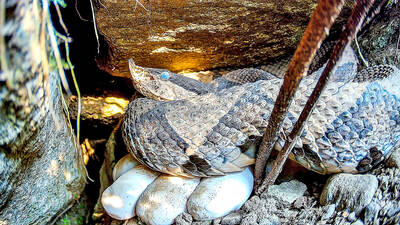
NATURE TAKES ITS COURSE: The agency’s head said he felt a sense of loss watching red-banded snakes eat the babies, as they had decided on non-intervention The Forestry and Nature Conservation Agency yesterday released a documentary on a hundred-pace viper that had incubated 16 eggs, all of which hatched, but only a baby viper escaped after they were attacked by red-banded snakes. The agency’s Taichung branch last year launched the viper reproduction monitoring project soon after forest rangers Lin Chun-yu (林俊佑) and Chou Chia-cheng (周家成) spotted a pregnant hundred-pace viper in a grass-covered burrow near a parking lot in Tbulan Village (松鶴部落). The Atayal village, in Taichung’s Heping District (和平), is headed by Ecyang Yapu, who was positive about the project and assisted in access control and power

The Coast Guard Administration (CGA) yesterday said that it had deployed vessels to “monitor” Chinese ships operating in waters off the east coast. The CGA said it dispatched vessels in response to a China Coast Guard announcement that it had carried out another “routine law-enforcement patrol” in waters off the east coast. “The CGA firmly rejects China’s cognitive warfare campaign of ‘law enforcement in name, jurisdictional expansion in practice,’” it said on X. As of 11am yesterday, two China Coast Guard ships were “loitering and drifting” about 105 nautical miles (195km) and 74 nautical miles east of Green Island (綠島) respectively, it said. It
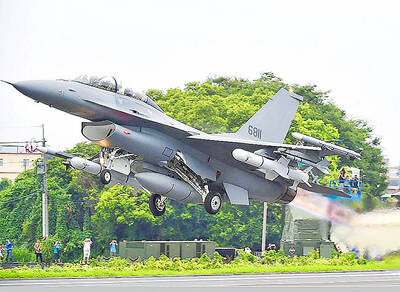
A sharp rise in compensation to be paid by air force officers who leave before completing their required service could indicate an increase in pilots leaving the military early, an analyst said on Friday, warning that the trend could worsen a shortage of experienced personnel. Chieh Chung (揭仲), a researcher at the Association for Strategic Foresight, issued the warning even though the number of volunteer military personnel is expected to increase next year. The planned headcount for volunteer military personnel, covering officers, noncommissioned officers (NCO) and enlisted soldiers, is 158,223 for next year, up 4,258 from 153,965 this year, Chieh said. The increase
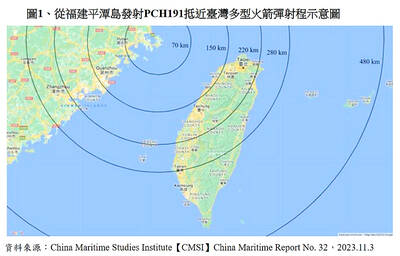
Potential improvements to munitions used by China’s long-range rocket-artillery units could extend their range to cover the entire Miyako Strait, which might give the Chinese People’s Liberation Army (PLA) the ability to secure the strategic waterway, the Mainland Affairs Council (MAC) said in a report. The PLA’s long-range rocket-artillery units deployed along the Taiwan Strait are concentrated along the coast of Fujian Province, including Changle, Pingtan and Shishi, the quarterly report on China said. The artillery brigades of the PLA’s 71st, 72nd and 73rd group armies have been deployed, with preparations for potential battlefield operations under way since August 2022, the report


 RSS
RSS