


The Central Epidemic Command Center (CECC) yesterday reported two locally transmitted COVID-19 infections, four imported cases and no deaths, adding that no new cases linked to an aircrew cluster have been found.
Minister of Health and Welfare Chen Shih-chung (陳時中), who heads the center, said the two local cases are a married couple — a man in his 40s and a woman in her 30s, who live in New Taipei City.
The man began experiencing a fever, headache, fatigue and coughing on Wednesday last week, sought treatment on Saturday and tested positive for COVID-19, he said.
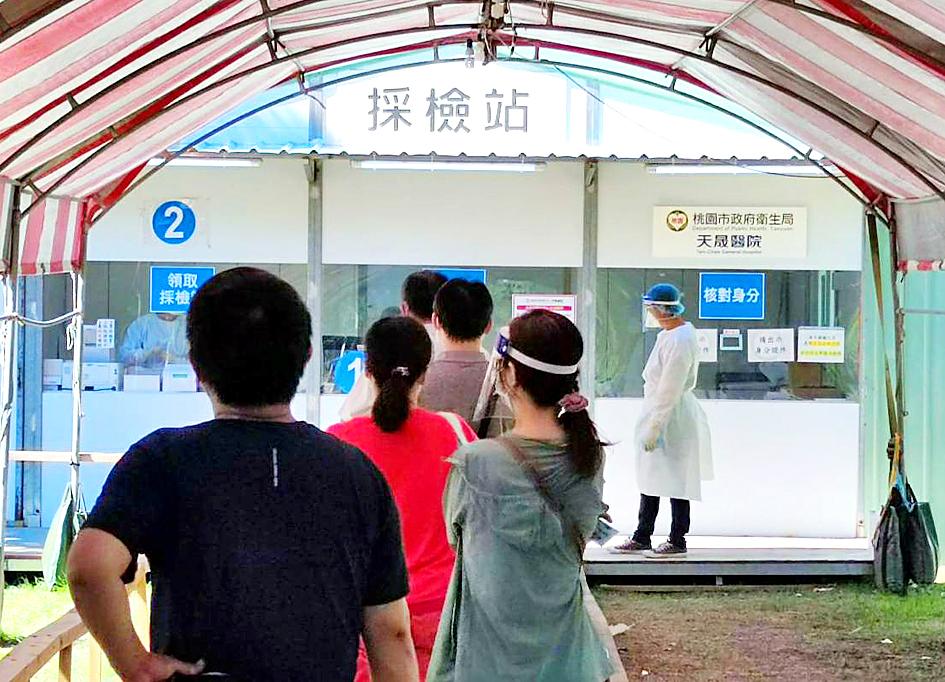
Photo: Lee Jung-ping, Taipei Times
The woman, a kindergarten teacher, experienced coughing and an abnormal sense of smell between Aug. 27 and Monday last week, Chen said, adding that she was placed under isolation and tested on Saturday after her husband tested positive.
Fifty close contacts of the couple have been put under home isolation, while the infection risk of a further 49 contacts of the 50 people is being evaluated, he said.
The four imported cases are from Burkina Faso, Japan, Serbia and the US, the center said.
Meanwhile, Chen said that testing on 315 close contacts of two previously confirmed vaccine breakthrough infections — Taiwan-based airline pilots who tested positive on Friday — has been completed.
One of the pilot’s sons tested positive last week, while 269 others tested negative and 45 are waiting for results, Chen said.
All 224 close contacts of the son and 2,656 students at his school also tested negative, he said.
The airline’s expanded testing on 283 crew members who had flown to Chicago in the past 14 days showed that 262 tested negative, eight were waiting for test results, and 13 are abroad and are to be tested when they return, Chen said.
CECC specialist advisory panel convener Chang Shan-chwen (張上淳) said that the panel’s earlier suggestion was that fully vaccinated airline crew members be tested for SARS-CoV-2 antibodies and receive follow-up tests every three months, and the tests showed that very few among them — seven people — did not produce antibodies.
He said that the panel and the Advisory Committee on Immunization Practices have been discussing whether the seven people should receive a vaccine booster shot.
Asked if the aircrew cluster could affect the CECC’s regulations on Mid-Autumn Festival activities, such as outdoor barbecuing, Chen said the center plans to monitor the local COVID-19 situation for seven days before making further decisions.

The Centers for Disease Control (CDC) yesterday reported the first case of a new COVID-19 subvariant — BA.3.2 — in a 10-year-old Singaporean girl who had a fever upon arrival in Taiwan and tested positive for the disease. The girl left Taiwan on March 20 and the case did not have a direct impact on the local community, it said. The WHO added the BA.3.2 strain to its list of Variants Under Monitoring in December last year, but this was the first imported case of the COVID-19 variant in Taiwan, CDC Deputy Director-General Lin Ming-cheng (林明誠) said. The girl arrived in Taiwan on

South Korea is planning to revise its controversial electronic arrival card, a step Taiwanese officials said prompted them to hold off on planned retaliatory measures, a South Korean media report said yesterday. A Yonhap News Agency report said that the South Korean Ministry of Foreign Affairs is planning to remove the “previous departure place” and “next destination” fields from its e-arrival card system. The plan, reached after interagency consultations, is under review and aims to simplify entry procedures and align the electronic form with the paper version, a South Korean ministry official said. The fields — which appeared only on the electronic form

The Ministry of Foreign Affairs (MOFA) is suspending retaliation measures against South Korea that were set to take effect tomorrow, after Seoul said it is updating its e-arrival system, MOFA said today. The measures were to be a new round of retaliation after Taiwan on March 1 changed South Korea's designation on government-issued alien resident certificates held by South Korean nationals to "South Korea” from the "Republic of Korea," the country’s official name. The move came after months of protests to Seoul over its listing of Taiwan as "China (Taiwan)" in dropdown menus on its new online immigration entry system. MOFA last week

A bipartisan group of US senators has introduced a bill to enhance cooperation with Taiwan on drone development and to reduce reliance on supply chains linked to China. The proposed Blue Skies for Taiwan Act of 2026 was introduced by Republican US senators Ted Cruz and John Curtis, and Democratic US senators Jeff Merkley and Andy Kim. The legislation seeks to ease constraints on Taiwan-US cooperation in uncrewed aerial systems (UAS), including dependence on China-sourced components, limited access to capital and regulatory barriers under US export controls, a news release issued by Cruz on Wednesday said. The bill would establish a "Blue UAS


 RSS
RSS