


The four candidates vying for the position of Chinese Nationalist Party (KMT) chairperson yesterday took part in a televised policy presentation appealing for party members’ support.
Incumbent KMT Chairman Johnny Chiang (江啟臣) pledged that he would not run for president on the party ticket in 2024 and would rather serve as a “kingmaker,” adding that voting for him to lead the party for a second term meant embracing the future.
There should be more options regarding the cross-strait issue, he said.
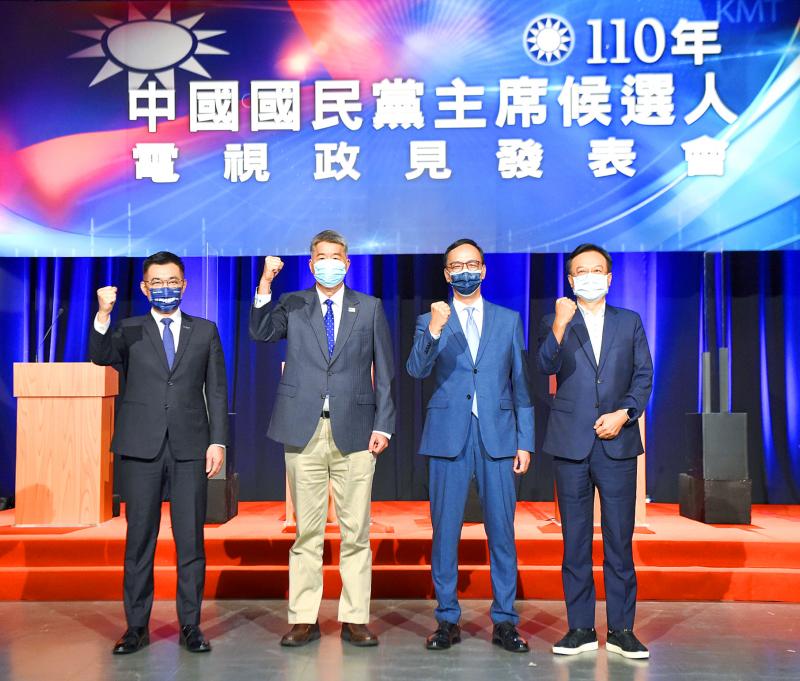
Photo: Fang Pin-chao, Taipei Times
Both sides of the Taiwan Strait need to find ways to sit and talk things over, Chiang said, adding that, most importantly, peace and safety should be maintained across the Strait.
The KMT needs to “walk the walk” and provide more opportunities for young people, he said.
The party culture of older members lecturing younger members needs to change, or else young people would find it difficult to accept the KMT, Chiang said.
Former New Taipei City mayor Eric Chu (朱立倫), who was elected KMT chairman in an unopposed by-election in January 2015 and resigned in January 2016 following the party’s losses in the presidential and legislative elections, said that the KMT needs a chairperson who can consolidate the party against the Democratic Progressive Party.
“No one can claim to be a ‘kingmaker’ in 2024; only a strong KMT can be a ‘kingmaker,’ whereas a weak KMT will only unmake kings,” he said, in apparent reference to Chiang’s remarks.
The KMT’s core tenets are the same as that of Sun Yat-sen (孫逸仙) and former president Chiang Ching-kuo (蔣經國), Chu said, adding that the KMT is the successor to the very spirit that founded and defended the Republic of China.
The KMT must resume cross-strait interactions as the KMT’s participation in such forums enable the public to see that the KMT is trying to foster regional peace, prosperity and safety for the next generation, he said.
Chu added that if he was elected, he would let young people know that the KMT loves Taiwan and supports freedom and democracy, adding that under his leadership, the KMT would create more opportunities for young people.
Sun Yat-sen School president Chang Ya-chung (張亞中) accused Chu and Chiang of making empty promises and not offering anything tangible.
Chang said that if elected, he would seek dialogue with Beijing regarding the signing of a peace treaty, as long as the KMT became the ruling party in 2024.
The KMT has lost its “soul” and “ideals,” with its leaders concerned only for themselves or their factions, he said, adding that only if the KMT moves forward would any young people consider joining.
Former Changhua County commissioner Cho Po-yuan (卓伯源) said the party chairperson must be professional and selfless, so that young people feel they are receiving the party’s attention and respect.
Cho said that if elected, he would invite Chinese President Xi Jinping (習近平) to visit Taiwan and hold a cross-strait political summit in Taiwan.
The KMT chairperson election is scheduled for Sept. 25, after being postponed from July 24 due to a COVID-19 outbreak.

The Centers for Disease Control (CDC) yesterday reported the first case of a new COVID-19 subvariant — BA.3.2 — in a 10-year-old Singaporean girl who had a fever upon arrival in Taiwan and tested positive for the disease. The girl left Taiwan on March 20 and the case did not have a direct impact on the local community, it said. The WHO added the BA.3.2 strain to its list of Variants Under Monitoring in December last year, but this was the first imported case of the COVID-19 variant in Taiwan, CDC Deputy Director-General Lin Ming-cheng (林明誠) said. The girl arrived in Taiwan on

South Korea is planning to revise its controversial electronic arrival card, a step Taiwanese officials said prompted them to hold off on planned retaliatory measures, a South Korean media report said yesterday. A Yonhap News Agency report said that the South Korean Ministry of Foreign Affairs is planning to remove the “previous departure place” and “next destination” fields from its e-arrival card system. The plan, reached after interagency consultations, is under review and aims to simplify entry procedures and align the electronic form with the paper version, a South Korean ministry official said. The fields — which appeared only on the electronic form

The Ministry of Foreign Affairs (MOFA) is suspending retaliation measures against South Korea that were set to take effect tomorrow, after Seoul said it is updating its e-arrival system, MOFA said today. The measures were to be a new round of retaliation after Taiwan on March 1 changed South Korea's designation on government-issued alien resident certificates held by South Korean nationals to "South Korea” from the "Republic of Korea," the country’s official name. The move came after months of protests to Seoul over its listing of Taiwan as "China (Taiwan)" in dropdown menus on its new online immigration entry system. MOFA last week
A bipartisan group of US senators has introduced a bill to enhance cooperation with Taiwan on drone development and to reduce reliance on supply chains linked to China. The proposed Blue Skies for Taiwan Act of 2026 was introduced by Republican US senators Ted Cruz and John Curtis, and Democratic US senators Jeff Merkley and Andy Kim. The legislation seeks to ease constraints on Taiwan-US cooperation in uncrewed aerial systems (UAS), including dependence on China-sourced components, limited access to capital and regulatory barriers under US export controls, a news release issued by Cruz on Wednesday said. The bill would establish a "Blue UAS


 RSS
RSS