


Nine legislators were on Wednesday named Outstanding Lawmakers for Animal Protection by a coalition of advocates for their efforts to improve animal protection regulations.
Protecting animals takes more than just words and social media posts, it takes concerted action to change policies, Taiwan Animal Protection Monitor Network secretary-general Ho Tsung-hsun (何宗?) told a ceremony at the Legislative Yuan in Taipei.
In the previous legislative session, more legislators proposed laws to protect animals than ever before, with 21 proposing 25 bills for deliberation, Ho said.
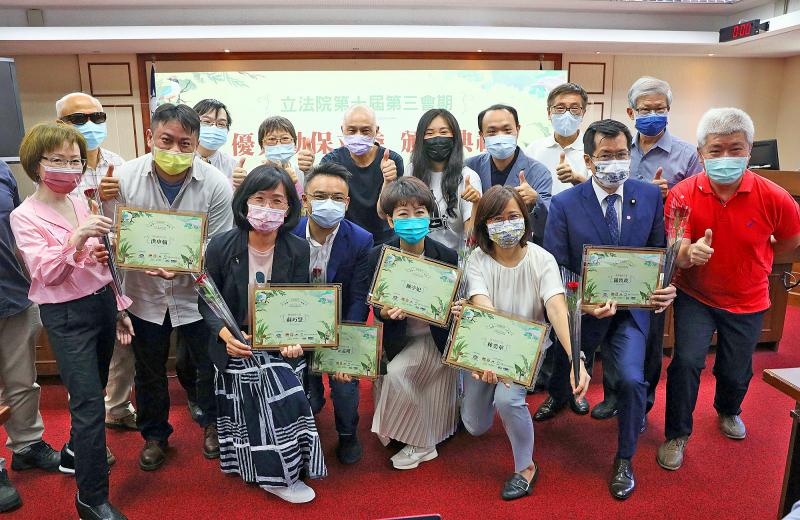
Photo: CNA
Candidates for the award, given by the Animal Protection Legislative Campaign Coalition, expressed concern for a range of issues, expanding beyond household pets and wildlife to include livestock, laboratory subjects, animal performers and more, he said.
Ho urged legislators to continue correcting discrepancies among different levels of regulation and prejudicial standards for different species, as well as improving mechanisms for enforcement.
The coalition recognized Democratic Progressive Party (DPP) legislators Chen Ting-fei (陳亭妃), Lo Chih-cheng (羅致政) and Su Chiao-hui (蘇巧慧), and Chinese Nationalist Party (KMT) Legislator Hung Meng-kai (洪孟楷) for their proposal to amend the Veterinarian Act (獸醫師法) to promote a system for veterinary assistants, which has passed a third reading.
Chen was also commended for proposing a food and agriculture education bill and facilitating an emergency medication system for pets.
The coalition also highlighted Hung for his concern over disease prevention among animals at Nantou County’s Cingjing Farm (清境農場), while Lo wrote a complete ban on animal traps into the Animal Protection Act (動物保護法).
New Power Party Chair Chen Jiau-hua (陳椒華) won the award for a number of actions, including her support for adding animal protections into the Constitution, instructing the Council of Agriculture’s Bureau of Animal and Plant Health Inspection and Quarantine to implement basic veterinary training for lab technicians, and looking out for the welfare of animals at Tainan’s Wanpi World Safari Zoo and Xpark in Taoyuan.
KMT Legislator Lin Yi-hua (林奕華) also advocated for the inclusion of the right to life for plants and animals in the Constitution, while also pushing for an investigation into the deaths of water buffalo on Yangmingshan (陽明山) and working to lift bans on pet ownership in apartment buildings.
DPP Legislator Tsai Shih-ying (蔡適應) paid special consideration to a ban on pet ownership in military multipurpose dormitories, for which he was given the award, in addition to his work promoting constitutional reform and the welfare of livestock, lab animals and marine life.
Also involved in the movement to enshrine animal rights in the Constitution is DPP Legislator Hung Sun-han (洪申翰), who was given a commendation for proposing an amendment to encourage technological alternatives to animal testing.
DPP Legislator Yang Yao (楊曜) was recognized for proposing an amendment to the Animal Protection Act requiring the regular disclosure of information regarding inspections of animal breeders and sellers.
The coalition was founded in February last year by members from animal rights organizations to lobby the Legislative Yuan to further animal rights.

Considering that most countries issue more than five denominations of banknotes, the central bank has decided to redesign all five denominations, the bank said as it prepares for the first major overhaul of the banknotes in more than 24 years. Central bank Governor Yang Chin-lung (楊金龍) is expected to report to the Legislative Yuan today on the bank’s operations and the redesign’s progress. The bank in a report sent to the legislature ahead of today’s meeting said it had commissioned a survey on the public’s preferences. Survey results showed that NT$100 and NT$1,000 banknotes are the most commonly used, while NT$200 and NT$2,000

The Centers for Disease Control (CDC) yesterday reported the first case of a new COVID-19 subvariant — BA.3.2 — in a 10-year-old Singaporean girl who had a fever upon arrival in Taiwan and tested positive for the disease. The girl left Taiwan on March 20 and the case did not have a direct impact on the local community, it said. The WHO added the BA.3.2 strain to its list of Variants Under Monitoring in December last year, but this was the first imported case of the COVID-19 variant in Taiwan, CDC Deputy Director-General Lin Ming-cheng (林明誠) said. The girl arrived in Taiwan on

South Korea is planning to revise its controversial electronic arrival card, a step Taiwanese officials said prompted them to hold off on planned retaliatory measures, a South Korean media report said yesterday. A Yonhap News Agency report said that the South Korean Ministry of Foreign Affairs is planning to remove the “previous departure place” and “next destination” fields from its e-arrival card system. The plan, reached after interagency consultations, is under review and aims to simplify entry procedures and align the electronic form with the paper version, a South Korean ministry official said. The fields — which appeared only on the electronic form

The Ministry of Foreign Affairs (MOFA) is suspending retaliation measures against South Korea that were set to take effect tomorrow, after Seoul said it is updating its e-arrival system, MOFA said today. The measures were to be a new round of retaliation after Taiwan on March 1 changed South Korea's designation on government-issued alien resident certificates held by South Korean nationals to "South Korea” from the "Republic of Korea," the country’s official name. The move came after months of protests to Seoul over its listing of Taiwan as "China (Taiwan)" in dropdown menus on its new online immigration entry system. MOFA last week


 RSS
RSS