


The National Space Organization (NSPO) plans to encourage technology transfers and spin-offs from within, in a bid to develop talent within the local space industry, NSPO Director-General Wu Jong-shinn (吳宗信) said in an interview with the Taipei Times on Aug. 23.
Nicknamed “Uncle Rocket,” the University of Michigan alumnus assumed the position on Aug. 2 amid a warm welcome from the local space industry.
Established in 1991, the NSPO has rarely offered job openings for the past 20 years. Discouraged by the lack of opportunities, few students would pursue doctorates or master’s degrees in aerospace fields, creating a situation in which talent could not be cultivated, Wu said.
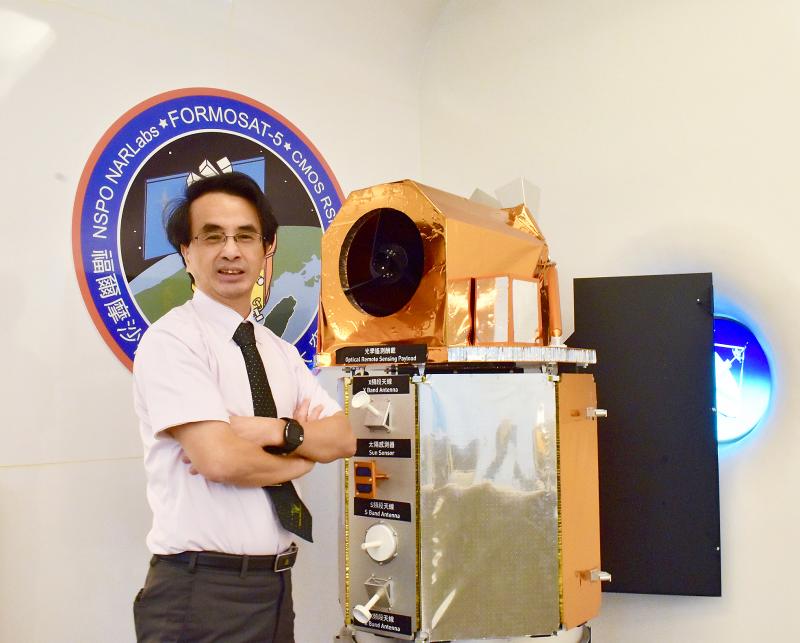
Photo: Lin Chia-nan, Taipei Times
Wu said he encourages the government to introduce state and private funds to help the NSPO spin off new companies to improve talent cultivation.
For example, a systems engineering company might require considerable capital and technical support, while a start-up featuring a single technology would only require five to 10 employees, he said.
As such, NSPO employees would be able to focus more on advanced projects in research and development, while transferring technologies to private companies in due course, he said.
The efficiencies of a government affiliate and a company are “totally different,” he said.
Before taking the NSPO’s helm, Wu had taught at National Chiao Tung University (now National Yang Ming Chiao Tung University) since 1998. In 2005, he participated in the government-led Hapith Project for developing launch rockets.
However, the project had not been finished, allegedly due to political factors.
In 2012, Wu founded the Advanced Rocket Research Center at the university, and raised NT$160 million (US$5.78 million) for the center from private investors and crowdfunding projects.
In 2015, he was the chief technology officer at GEOSAT Aerospace & Technology Inc. In August 2016, he founded Taiwan Innovative Space (TiSPACE), but left in 2018.
“I am quite confident that my expertise and understanding about local industries make me qualified for leading the NSPO,” Wu said when asked why he returned to the organization.
He had left the NSPO in 1998.
“I might harbor some criticisms toward the NSPO based on limited information,” he said. “Instead of acting like a dog barking at a passing train, now I want to drive the train myself.”
Wu expressed his hope that the NSPO would continue to fund research in “sounding rockets,” which are made to carry research instruments into sub-orbital flight as part of scientific experiments.
From 1997 to 2014, the NSPO commissioned 10 sounding rocket projects working with the military-affiliated Chungshan Institute of Science and Technology.
In 2016, the NSPO commissioned TiSPACE and National Cheng Kung University (NCKU) professor Chao Yei-chin’s (趙怡欽) team to develop hybrid-propellant rockets for scientific payloads to altitudes of at least 150km and 80km respectively.
Currently, TiSPACE is preparing test launches in Australia after its attempts in Taiwan failed. The NSPO is preparing a launch site in Pingtung County’s Syuhai Village (旭海), which could be used by Chao’s team.
The Syuhai site for short-term scientific use is expected to become available by the end of this year, as negotiations with local Aboriginal communities have been “very positive,” Wu said.
After the projects with TiSPACE and NCKU are finished, the NSPO would focus on working with academics in developing sounding rockets, he said.
“Students of aerospace departments would fall short of their majors if they do not learn to make rockets,” Wu said.
Asked about diplomatic pressures that hinder Taiwan’s rocket development, Wu said that the NSPO’s rockets would only serve “scientific” and peaceful purposes.
The rockets’ development would capitalize on technical advancement rather than what altitudes they could reach, he added.
The NSPO would stress the improvement of avionics, propulsion, communications technologies and overall structures of sounding rockets, while keeping their launches at lower altitudes for demonstration purposes only, he said.
Signing memorandums of understanding for ceremonial purposes is not his style, Wu said; he aims to develop more “solid” cooperation with other countries.
Technical cooperation for mutually beneficial purposes would be prioritized, he said, adding that some countries could help Taiwan apply for the use of satellite orbits.
In addition to reinforcing cooperation with US and Japanese agencies, Wu is eyeing new ties with the Indian Space Research Organisation, as well as other agencies in the Netherlands, Canada and elsewhere.
As the NSPO’s agency status is to be upgraded, Wu hopes to expand the number of employees from 220 to 600, and have its annual funding increased from NT$2.3 billion to about NT$5 billion by 2028.
The NSPO and its supervisor, the Ministry of Science and Technology, are working to retool the third-phase space technology development program to accommodate policies stipulated by the Space Development Act (太空發展法), including fostering a space economy and establishing a long-term launch site.

NATIONAL SECURITY: Authorities are working to confirm the identities of the military personnel involved and investigating possible illegal conduct and regulatory violations Authorities are probing possible national security implications after Kinmen police and immigration officers on Sunday found a Chinese woman allegedly posing as a tourist while engaging in prostitution involving more than 10 military personnel. The woman, surnamed Chen (陳), has since been deported, authorities said, adding that investigators are still working to confirm the identities of those implicated, as the records only listed code names and aliases. The case stemmed from a report received by the Kinmen District Prosecutors’ Office on Friday last week from the Jinhu Precinct of the Kinmen County Police Bureau. On Sunday, police, along with the National Immigration

GLOBALGIVING: ‘ Caving to external pressure is not acceptable for an organization that has cultivated justice reform and human rights for 30 years,’ one NGO said A slew of non-government organizations (NGOs) have withdrawn from the GlobalGiving fundraising platform after it announced it would use “Chinese Taipei” instead of “Taiwan” from next month. The Taiwan Good Rice Association wrote on Facebook on Friday that it was informed on April 28 via a teleconference call of the change, which was made because the platform wanted to operate in China. Taiwan Good Rice is to terminate all cooperative relationships with GlobalGiving in response to the platform’s “unilateral and non-negotiable” decision to remove references to Taiwan, the NGO said. “Taiwan is in the official name of Taiwan Good Rice Association and the

HEAVY WEATHER: Typhoon Jangmi is due to crash straight into the Ryukyus as airlines look to shift flights to larger aircraft or cancel flights to Okinawa entirely Taiwan’s international air carriers announced flight adjustments over the weekend as Typhoon Jangmi is forecast to hit the Ryukyu Islands today and tomorrow. The Central Weather Administration (CWA) upgraded Jangmi from a tropical storm to a typhoon at 8am yesterday, with the eye located 580km south of Naha city. It was moving north at 19kph. Today, China Airlines’ CI-120, CI-121, CI-122 and CI-123 flights between Taoyuan and Naha, Okinawa, have been canceled as well as CI-132 and CI-133 between Kaohsiung and Naha. EVA Air’s BR-112, BR-113, BR-186 and BR-185 flights between Taoyuan and Naha are also canceled. Low-cost carrier Tigerair Taiwan canceled IT-230,
MULTIPRONGED APPROACH: China has sought to pressure Palau across a number of fronts, but the island nation has staunchly resisted overtures to ditch Taiwan Palau has been firm in backing Taiwan despite Chinese pressure that uses tourism economics, cyberattacks and criminal infiltration as tools to threaten the Pacific ally into renouncing its recognition of Taiwan as a sovereign state. The Presidential Office yesterday announced that Vice President Hsiao Bi-khim (蕭美琴) would visit Palau from Saturday to Wednesday next week at the invitation of Palauan President Surangel Whipps Jr. Whipps in April said in an interview that China had outspokenly asked Palau to “denounce Taiwan.” “And we have said: ‘We have no enemies, but nobody tells us who our friends are,’” he said. Whipps has told reporters multiple times


 RSS
RSS