


The National Space Organization (NSPO) plans to encourage technology transfers and spin-offs from within, in a bid to develop talent within the local space industry, NSPO Director-General Wu Jong-shinn (吳宗信) said in an interview with the Taipei Times on Aug. 23.
Nicknamed “Uncle Rocket,” the University of Michigan alumnus assumed the position on Aug. 2 amid a warm welcome from the local space industry.
Established in 1991, the NSPO has rarely offered job openings for the past 20 years. Discouraged by the lack of opportunities, few students would pursue doctorates or master’s degrees in aerospace fields, creating a situation in which talent could not be cultivated, Wu said.
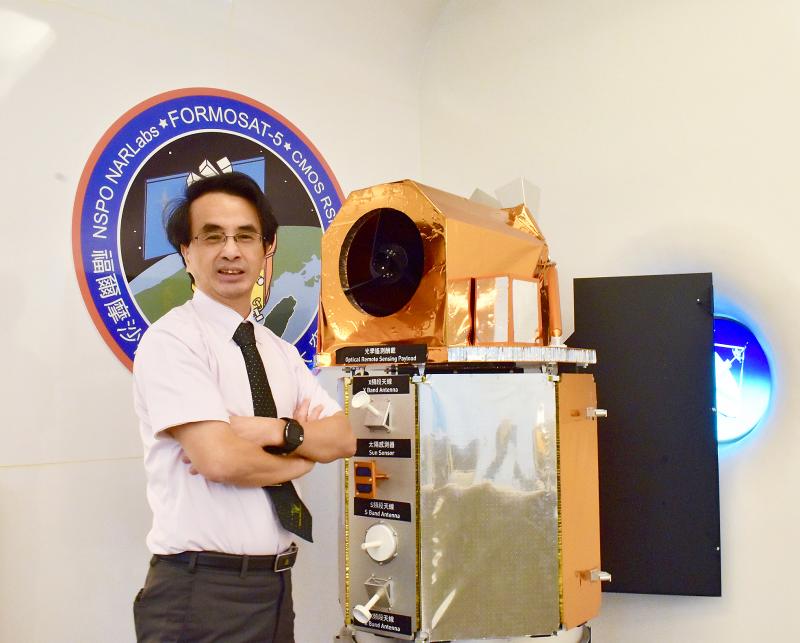
Photo: Lin Chia-nan, Taipei Times
Wu said he encourages the government to introduce state and private funds to help the NSPO spin off new companies to improve talent cultivation.
For example, a systems engineering company might require considerable capital and technical support, while a start-up featuring a single technology would only require five to 10 employees, he said.
As such, NSPO employees would be able to focus more on advanced projects in research and development, while transferring technologies to private companies in due course, he said.
The efficiencies of a government affiliate and a company are “totally different,” he said.
Before taking the NSPO’s helm, Wu had taught at National Chiao Tung University (now National Yang Ming Chiao Tung University) since 1998. In 2005, he participated in the government-led Hapith Project for developing launch rockets.
However, the project had not been finished, allegedly due to political factors.
In 2012, Wu founded the Advanced Rocket Research Center at the university, and raised NT$160 million (US$5.78 million) for the center from private investors and crowdfunding projects.
In 2015, he was the chief technology officer at GEOSAT Aerospace & Technology Inc. In August 2016, he founded Taiwan Innovative Space (TiSPACE), but left in 2018.
“I am quite confident that my expertise and understanding about local industries make me qualified for leading the NSPO,” Wu said when asked why he returned to the organization.
He had left the NSPO in 1998.
“I might harbor some criticisms toward the NSPO based on limited information,” he said. “Instead of acting like a dog barking at a passing train, now I want to drive the train myself.”
Wu expressed his hope that the NSPO would continue to fund research in “sounding rockets,” which are made to carry research instruments into sub-orbital flight as part of scientific experiments.
From 1997 to 2014, the NSPO commissioned 10 sounding rocket projects working with the military-affiliated Chungshan Institute of Science and Technology.
In 2016, the NSPO commissioned TiSPACE and National Cheng Kung University (NCKU) professor Chao Yei-chin’s (趙怡欽) team to develop hybrid-propellant rockets for scientific payloads to altitudes of at least 150km and 80km respectively.
Currently, TiSPACE is preparing test launches in Australia after its attempts in Taiwan failed. The NSPO is preparing a launch site in Pingtung County’s Syuhai Village (旭海), which could be used by Chao’s team.
The Syuhai site for short-term scientific use is expected to become available by the end of this year, as negotiations with local Aboriginal communities have been “very positive,” Wu said.
After the projects with TiSPACE and NCKU are finished, the NSPO would focus on working with academics in developing sounding rockets, he said.
“Students of aerospace departments would fall short of their majors if they do not learn to make rockets,” Wu said.
Asked about diplomatic pressures that hinder Taiwan’s rocket development, Wu said that the NSPO’s rockets would only serve “scientific” and peaceful purposes.
The rockets’ development would capitalize on technical advancement rather than what altitudes they could reach, he added.
The NSPO would stress the improvement of avionics, propulsion, communications technologies and overall structures of sounding rockets, while keeping their launches at lower altitudes for demonstration purposes only, he said.
Signing memorandums of understanding for ceremonial purposes is not his style, Wu said; he aims to develop more “solid” cooperation with other countries.
Technical cooperation for mutually beneficial purposes would be prioritized, he said, adding that some countries could help Taiwan apply for the use of satellite orbits.
In addition to reinforcing cooperation with US and Japanese agencies, Wu is eyeing new ties with the Indian Space Research Organisation, as well as other agencies in the Netherlands, Canada and elsewhere.
As the NSPO’s agency status is to be upgraded, Wu hopes to expand the number of employees from 220 to 600, and have its annual funding increased from NT$2.3 billion to about NT$5 billion by 2028.
The NSPO and its supervisor, the Ministry of Science and Technology, are working to retool the third-phase space technology development program to accommodate policies stipulated by the Space Development Act (太空發展法), including fostering a space economy and establishing a long-term launch site.
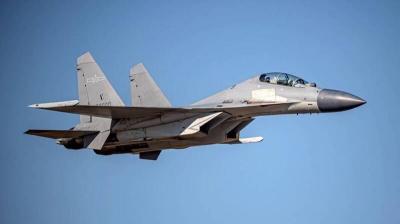
Eight Chinese naval vessels and 24 military aircraft were detected crossing the median line of the Taiwan Strait between 6am yesterday and 6am today, the Ministry of National Defense said this morning. The aircraft entered Taiwan’s northern, central, southwestern and eastern air defense identification zones, the ministry said. The armed forces responded with mission aircraft, naval vessels and shore-based missile systems to closely monitor the situation, it added. Eight naval vessels, one official ship and 36 aircraft sorties were spotted in total, the ministry said.
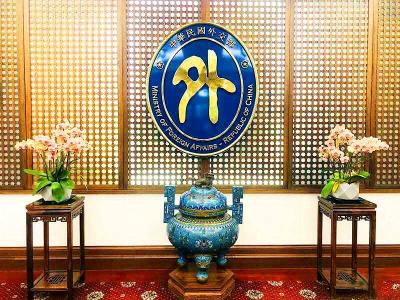
The Ministry of Foreign Affairs (MOFA) today said that if South Korea does not reply appropriately to its request to correct Taiwan’s name on its e-Arrival card system before March 31, it would take corresponding measures to alter how South Korea is labeled on the online Taiwan Arrival Card system. South Korea’s e-Arrival card system lists Taiwan as “China (Taiwan)” in the “point of departure” and “next destination” fields. The ministry said that it changed the nationality for South Koreans on Taiwan’s Alien Resident Certificates from “Korea” to “South Korea” on March 1, in a gesture of goodwill and based on the
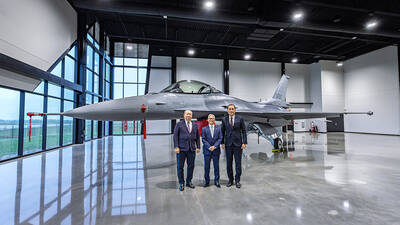
Taiwanese officials were shown the first of 66 F-16V fighter jets purchased by Taiwan from the United States, the Ministry of National Defense said yesterday, adding the aircraft has completed an initial flight test and is expected to be delivered later this year. A delegation led by Deputy Minister of National Defense Hsu Szu-chien (徐斯儉) visited Lockheed Martin’s F-16 C/D Block 70 (also known as F-16V) assembly line in South Carolina on March 16 to view the aircraft. The jet will undergo a final acceptance flight in the US before being delivered to Taiwan, the
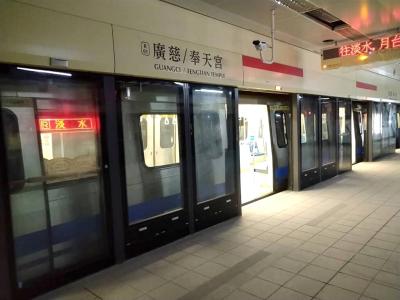
The New Taipei Metro's Sanyin Line and the eastern extension of the Taipei Metro's Tamsui-Xinyi Line (Red Line) are scheduled to begin operations in June, the National Development Council said today. The Red Line, which terminates at Xiangshan Station, would be connected by the 1.4km extension to a new eastern terminal, Guangci/Fengtian Temple Station, while the Sanyin Line would link New Taipei City's Tucheng and Yingge stations via Sanxia District (三峽). The council gave the updates at a council meeting reviewing progress on public construction projects for this year. Taiwan's annual public infrastructure budget would remain at NT$800 billion (US$25.08 billion), with NT$97.3


 RSS
RSS