


The Central Epidemic Command Center (CECC) yesterday reported three local COVID-19 cases, one imported case and one death. It also said that tests conducted on the close contacts of a breakthrough infection were negative.
Minister of Health and Welfare Chen Shih-chung (陳時中), who heads the center, said none of the local cases tested positive during isolation.
The infection sources of two of the cases are unclear and one is still being investigated, he said.
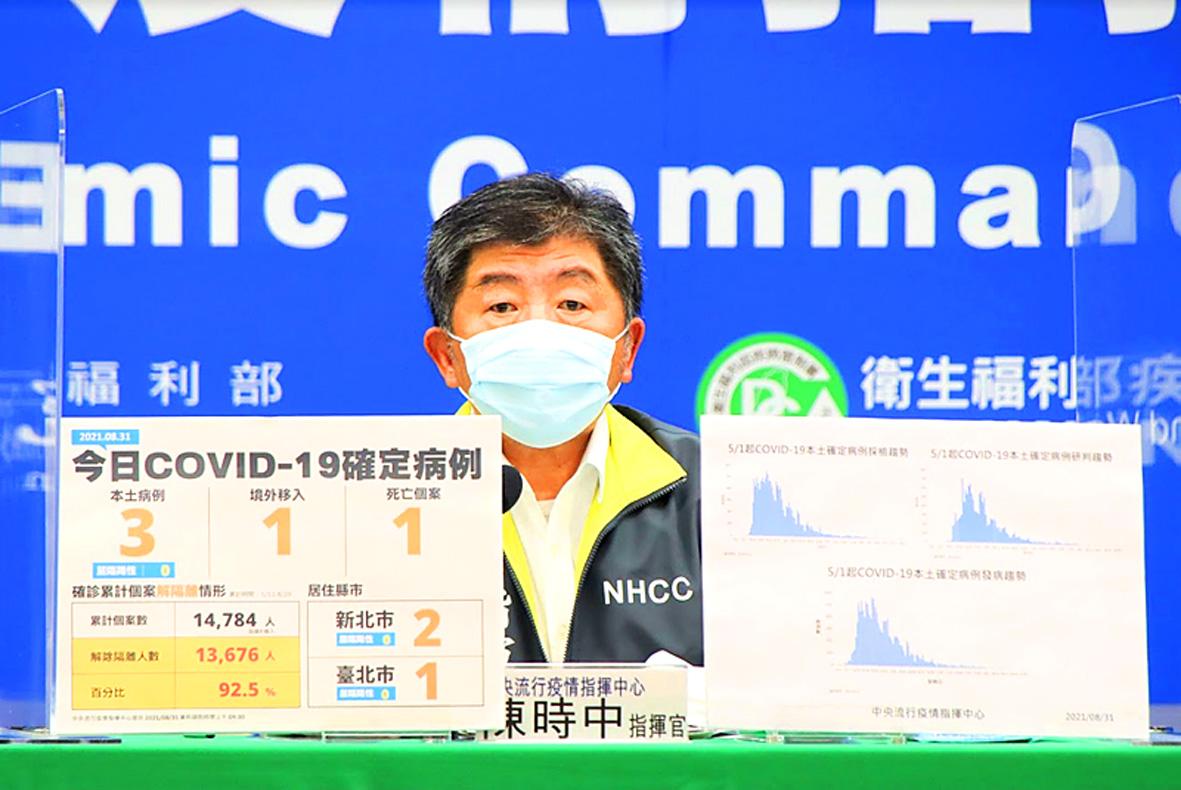
Photo courtesy of the Central Epidemic Command Center
Two of the cases were reported in New Taipei City and the other in Taipei, he said, adding that they are two men and one woman aged 30 to 70.
The deceased was a Taiwanese man in his 60s who tested positive in Vietnam on Aug. 8, Chen said.
He returned to Taiwan for treatment on a medical charter flight on Saturday and died on Monday, CECC data showed.
The imported case is a British man who reported having tested positive in the UK in June. He presented a negative polymerase chain reaction (PCR) test result obtained within three days of his arrival for work on Aug. 17.
He tested positive upon ending quarantine yesterday, CECC data showed.
Chen also provided an update about the breakthrough infection — a pilot at a Taiwanese airline who received two doses of the AstraZeneca COVID-19 vaccine.
At least 14 days had passed after he received his second dose before he tested positive for COVID-19 on Saturday.
Chen said all 26 close contacts of the pilot tested negative in PCR testing.
Separately, a suspected case of COVID-19 was reported in Hsinchu County’s Paoshan Township (寶山) on Monday.
The case, a woman in her 80s, tested positive for COVID-19 at a hospital following a traffic accident, prompting health officials to conduct rapid testing on nearly 200 people in the township.
As the woman’s cycle threshold (CT) value was near the level that determines a positive case, the local government asked the CECC for help in assessing her case.
Chen yesterday said the woman tested positive twice and negative twice in Hsinchu, all with high CT values.
He said the Centers for Disease Control’s Kunyang Laboratory ran tests on two specimens collected from the woman, and they both came back negative, so she is not considered a confirmed COVID-19 case.

The Centers for Disease Control (CDC) yesterday reported the first case of a new COVID-19 subvariant — BA.3.2 — in a 10-year-old Singaporean girl who had a fever upon arrival in Taiwan and tested positive for the disease. The girl left Taiwan on March 20 and the case did not have a direct impact on the local community, it said. The WHO added the BA.3.2 strain to its list of Variants Under Monitoring in December last year, but this was the first imported case of the COVID-19 variant in Taiwan, CDC Deputy Director-General Lin Ming-cheng (林明誠) said. The girl arrived in Taiwan on

South Korea is planning to revise its controversial electronic arrival card, a step Taiwanese officials said prompted them to hold off on planned retaliatory measures, a South Korean media report said yesterday. A Yonhap News Agency report said that the South Korean Ministry of Foreign Affairs is planning to remove the “previous departure place” and “next destination” fields from its e-arrival card system. The plan, reached after interagency consultations, is under review and aims to simplify entry procedures and align the electronic form with the paper version, a South Korean ministry official said. The fields — which appeared only on the electronic form

The Ministry of Foreign Affairs (MOFA) is suspending retaliation measures against South Korea that were set to take effect tomorrow, after Seoul said it is updating its e-arrival system, MOFA said today. The measures were to be a new round of retaliation after Taiwan on March 1 changed South Korea's designation on government-issued alien resident certificates held by South Korean nationals to "South Korea” from the "Republic of Korea," the country’s official name. The move came after months of protests to Seoul over its listing of Taiwan as "China (Taiwan)" in dropdown menus on its new online immigration entry system. MOFA last week

A bipartisan group of US senators has introduced a bill to enhance cooperation with Taiwan on drone development and to reduce reliance on supply chains linked to China. The proposed Blue Skies for Taiwan Act of 2026 was introduced by Republican US senators Ted Cruz and John Curtis, and Democratic US senators Jeff Merkley and Andy Kim. The legislation seeks to ease constraints on Taiwan-US cooperation in uncrewed aerial systems (UAS), including dependence on China-sourced components, limited access to capital and regulatory barriers under US export controls, a news release issued by Cruz on Wednesday said. The bill would establish a "Blue UAS


 RSS
RSS