


Saying the nation’s climate governance is “on life support,” youth environmental groups yesterday issued an urgent call for policy reform with the goal of reaching net-zero emissions by 2045.
A day after Premier Su Tseng-chang (蘇貞昌) urged the Environmental Protection Administration to mandate net-zero emissions by 2050, the Central Climate Youth Coalition and other groups held a news conference at the Legislative Yuan in Taipei, turning to music to convey the urgency of reform.
A response to the “code red for humanity” issued by the UN last month requires more immediate action than the government has promised, the groups said.
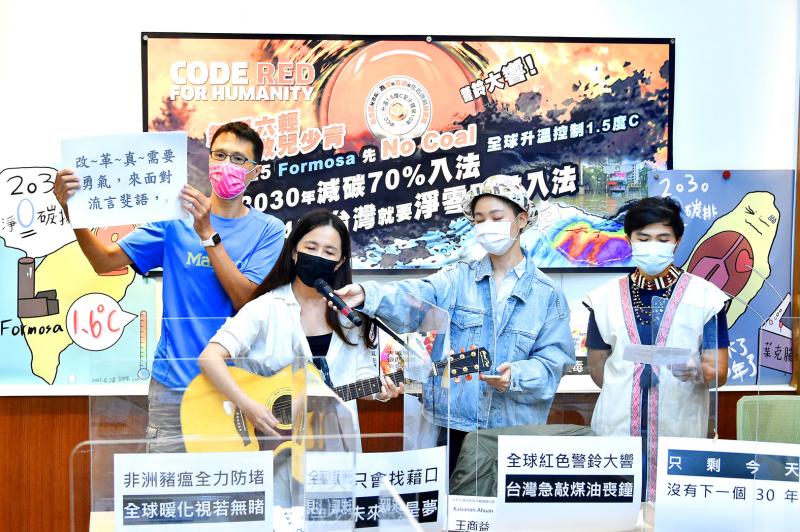
Photo: Tu Chien-jung, Taipei Times
As well as advancing net-zero carbon emissions to 2045, the nation should decommission all coal-fired units at the Taichung Power Plant by 2030 and include protections for vulnerable groups in its environmental policies, they said.
With Taiwan’s climate governance “already on life support,” Su’s plan to target 2050 for net-zero emissions in an amendment to the Greenhouse Gas Reduction and Management Act (溫室氣體減量及管理法) does not show enough urgency, the coalition said.
The government should pledge mid-term as well as long-term goals for carbon reduction, it said, suggesting a cut in emissions of at least 70 percent by 2030, 80 percent by 2035 and 90 percent by 2040, before cutting emissions entirely by 2045.
“We cannot wait another 30 years,” it added.
The groups also called for all 10 coal-fired generators at the Taichung Power Plant to be decommissioned by 2030, five years earlier than the legislature’s current plan and 16 years earlier than Taiwan Power Co’s proposal.
At the same time, Formosa Plastics Group should ensure that all 16 cogeneration sets at its naphtha cracker complex in Yunlin County’s Mailiao Township (麥寮) replace coal with natural gas by 2025, they added.
As for climate legislation, the groups called for the inclusion of an article on “climate human rights,” which should cover intergenerational justice, pluralism and social justice, with provisions protecting Aborigines, women, children and other groups particularly vulnerable to extreme weather.
Academia Sinica data show that the average annual temperature in Taiwan has risen by 1.6°C over the past 100 years, Taichung Special Education School teacher Yueh Hsiang-wen (岳祥文) said.
Winters are half as long, but if carbon emissions are not reduced soon, Taiwan might not have winter by 2060, he said.
The government plans to follow international standards and aim for net-zero emissions by 2050, “but in Taiwan, where temperatures have already risen past 1.5°C, do we still have 30 years?” Yueh asked.
Yueh’s fellow teacher Liao Li-ting (廖莉婷) said that pollution is so bad in Taichung that the city’s signature souvenir is no longer sun cakes, but lung cancer.
The Mailiao complex in 2019 emitted 49.25 million tonnes of carbon dioxide, accounting for 19 percent of the nation’s total emissions that year, Liao said.
The complex burns one-third less coal than is burned at the Taichung Power Plant, but the Taichung plant is the fourth-largest coal-fired power plant in the world, she said.
“Do we really want to raise our children in such a horrible environment?” Liao asked.
Additional reporting by Lu Yi-hui

The Centers for Disease Control (CDC) yesterday reported the first case of a new COVID-19 subvariant — BA.3.2 — in a 10-year-old Singaporean girl who had a fever upon arrival in Taiwan and tested positive for the disease. The girl left Taiwan on March 20 and the case did not have a direct impact on the local community, it said. The WHO added the BA.3.2 strain to its list of Variants Under Monitoring in December last year, but this was the first imported case of the COVID-19 variant in Taiwan, CDC Deputy Director-General Lin Ming-cheng (林明誠) said. The girl arrived in Taiwan on

South Korea is planning to revise its controversial electronic arrival card, a step Taiwanese officials said prompted them to hold off on planned retaliatory measures, a South Korean media report said yesterday. A Yonhap News Agency report said that the South Korean Ministry of Foreign Affairs is planning to remove the “previous departure place” and “next destination” fields from its e-arrival card system. The plan, reached after interagency consultations, is under review and aims to simplify entry procedures and align the electronic form with the paper version, a South Korean ministry official said. The fields — which appeared only on the electronic form

The Ministry of Foreign Affairs (MOFA) is suspending retaliation measures against South Korea that were set to take effect tomorrow, after Seoul said it is updating its e-arrival system, MOFA said today. The measures were to be a new round of retaliation after Taiwan on March 1 changed South Korea's designation on government-issued alien resident certificates held by South Korean nationals to "South Korea” from the "Republic of Korea," the country’s official name. The move came after months of protests to Seoul over its listing of Taiwan as "China (Taiwan)" in dropdown menus on its new online immigration entry system. MOFA last week

A bipartisan group of US senators has introduced a bill to enhance cooperation with Taiwan on drone development and to reduce reliance on supply chains linked to China. The proposed Blue Skies for Taiwan Act of 2026 was introduced by Republican US senators Ted Cruz and John Curtis, and Democratic US senators Jeff Merkley and Andy Kim. The legislation seeks to ease constraints on Taiwan-US cooperation in uncrewed aerial systems (UAS), including dependence on China-sourced components, limited access to capital and regulatory barriers under US export controls, a news release issued by Cruz on Wednesday said. The bill would establish a "Blue UAS


 RSS
RSS