


Colleges can ask new students to be tested for COVID-19 before they move into their dorms next month, according to government guidelines obtained exclusively by the Liberty Times (the Taipei Times’ sister newspaper).
The Ministry of Education’s guidelines on the prevention and management of COVID-19 on college campuses are expected to be released in the next few days.
To protect the health and safety of faculty members and students, schools may include polymerase chain reaction (PCR) tests or rapid screening for COVID-19 in their health exams for new students, in accordance with the School Health Act (學校衛生法), the guidelines say.
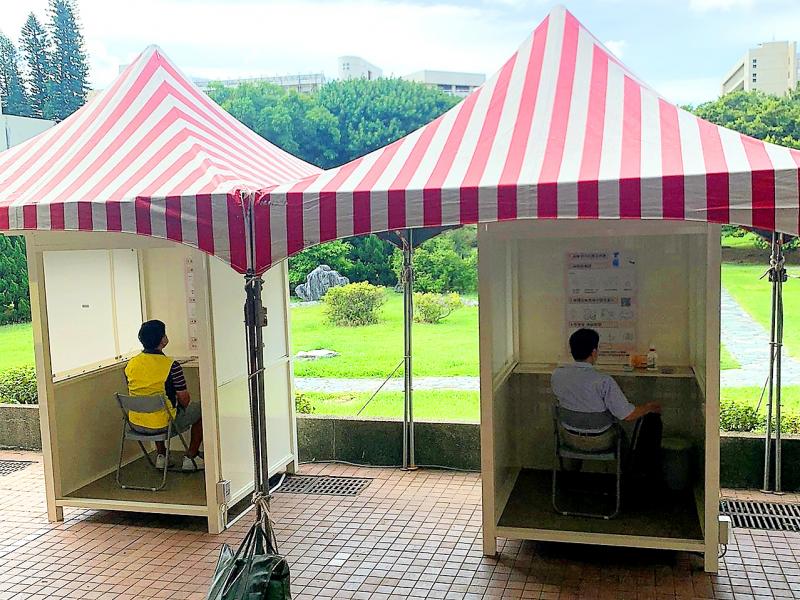
Photo courtesy of National Yang Ming Chiao Tung University
However, those tests cannot be used as a requirement for students to be admitted, they say.
During their health examination, new students would be checked for fever, coughing, shortness of breath or other respiratory symptoms, as well as diarrhea and loss of smell or taste.
To prevent cluster infections, students may also be asked to undergo a PCR or rapid screening test before they move into their dorms, the guidelines say, adding that colleges would assist in reporting positive cases and arranging medical treatment.
Colleges would be allowed to hold online classes, while in-person classes would be limited to a maximum of 80 people, who would have to sit in assigned seats and wear a mask at all times, the guidelines say, adding that classrooms must be well-ventilated.
Social distancing must be observed in physical education, music and swimming classes, as well as practicums.
Students in swimming classes would be required to wear a mask except when they are in the water, while those in practicums or labs would be assigned fixed groups to avoid contamination of equipment.
Indoor and outdoor sports venues may fill up to 50 percent of their total capacity, the guidelines say.
Restaurants on campuses would be open for on-site eating, with diners required to leave their contact information and be separated by dividers, they say.
While faculty members at elementary, junior-high and high schools would be required to have PCR or rapid screening tests if they have not been vaccinated against COVID-19, the same would not be required for faculty at colleges, as they have not been listed as a priority group for vaccination, the guidelines say.
Although universities nationwide are expected to open from Sept. 13 to Sept. 27, several colleges have tentatively decided to adopt distance learning for the first two weeks of classes due to fears about the Delta variant of SARS-CoV-2.
Additional reporting by Wu Po-hsuan

The Centers for Disease Control (CDC) yesterday reported the first case of a new COVID-19 subvariant — BA.3.2 — in a 10-year-old Singaporean girl who had a fever upon arrival in Taiwan and tested positive for the disease. The girl left Taiwan on March 20 and the case did not have a direct impact on the local community, it said. The WHO added the BA.3.2 strain to its list of Variants Under Monitoring in December last year, but this was the first imported case of the COVID-19 variant in Taiwan, CDC Deputy Director-General Lin Ming-cheng (林明誠) said. The girl arrived in Taiwan on

South Korea is planning to revise its controversial electronic arrival card, a step Taiwanese officials said prompted them to hold off on planned retaliatory measures, a South Korean media report said yesterday. A Yonhap News Agency report said that the South Korean Ministry of Foreign Affairs is planning to remove the “previous departure place” and “next destination” fields from its e-arrival card system. The plan, reached after interagency consultations, is under review and aims to simplify entry procedures and align the electronic form with the paper version, a South Korean ministry official said. The fields — which appeared only on the electronic form

The Ministry of Foreign Affairs (MOFA) is suspending retaliation measures against South Korea that were set to take effect tomorrow, after Seoul said it is updating its e-arrival system, MOFA said today. The measures were to be a new round of retaliation after Taiwan on March 1 changed South Korea's designation on government-issued alien resident certificates held by South Korean nationals to "South Korea” from the "Republic of Korea," the country’s official name. The move came after months of protests to Seoul over its listing of Taiwan as "China (Taiwan)" in dropdown menus on its new online immigration entry system. MOFA last week

A bipartisan group of US senators has introduced a bill to enhance cooperation with Taiwan on drone development and to reduce reliance on supply chains linked to China. The proposed Blue Skies for Taiwan Act of 2026 was introduced by Republican US senators Ted Cruz and John Curtis, and Democratic US senators Jeff Merkley and Andy Kim. The legislation seeks to ease constraints on Taiwan-US cooperation in uncrewed aerial systems (UAS), including dependence on China-sourced components, limited access to capital and regulatory barriers under US export controls, a news release issued by Cruz on Wednesday said. The bill would establish a "Blue UAS


 RSS
RSS