


The government should reduce the gap in funding for Paralympic athletes compared with Olympic athletes to promote equality and fairness for athletes with disabilities, Chinese Nationalist Party (KMT) lawmakers said yesterday
They made the comments at a news conference at the Legislative Yuan hosted by KMT legislative caucus whip Alex Fai (費鴻泰) and other lawmakers.
Taiwan’s Paralympics program receives only a fraction of the resources of the nation’s Olympics program, he said.
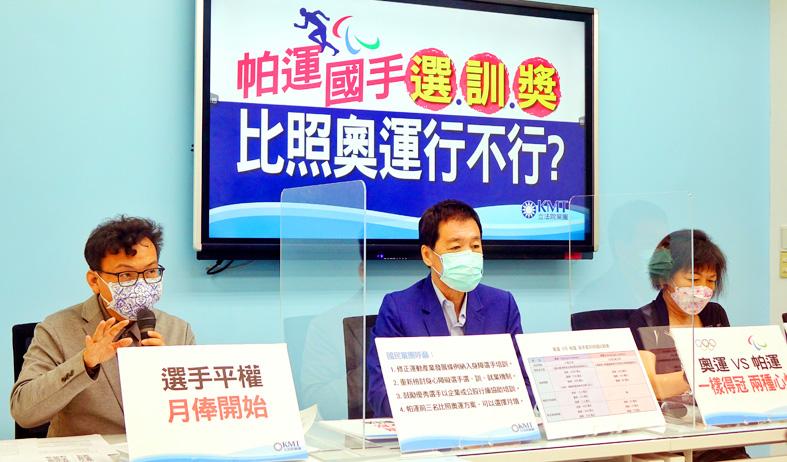
Photo: Liu Hsin-de, Taipei Times
The Paralympics program has a training budget of NT$60 million (US$2.15 million) per month, while the bonus for an athlete who wins a gold medal is NT$4 million, compared with the Olympics program’s funding of NT$400 million and bonus of NT$20 million, he said.
The disparity is even greater for Paralympic coaches, who are paid 4 percent of their counterparts in the Olympic teams, he said.
The KMT proposes that the Sports Industry Development Act (運動產業發展條例) be amended to include funding for the training of Paralympic athletes, he said.
The selection, training and career programs for Paralympic athletes should be reviewed comprehensively, while private and state-owned enterprises should take a larger role in funding Paralympic training programs, he said.
Paralympic athletes winning gold, silver or bronze should receive bonuses every month, as Olympians do, to show equal respect and treatment, he added.
KMT Legislator Cheng Cheng-chien (鄭正鈐) said the Sports Industry Development Act should also apply to the Paralympics program.
Raising the bonuses for Paralympians would help combat discrimination against people with disabilities, she said.
If the Sports Administration cannot protect the rights of people with disabilities, then the Ministry of Health and Welfare should step in, KMT Legislator Yeh Yu-lan (葉毓蘭) said, citing the Disabilities Rights Protection Act (身心障礙者權益保障法).

Considering that most countries issue more than five denominations of banknotes, the central bank has decided to redesign all five denominations, the bank said as it prepares for the first major overhaul of the banknotes in more than 24 years. Central bank Governor Yang Chin-lung (楊金龍) is expected to report to the Legislative Yuan today on the bank’s operations and the redesign’s progress. The bank in a report sent to the legislature ahead of today’s meeting said it had commissioned a survey on the public’s preferences. Survey results showed that NT$100 and NT$1,000 banknotes are the most commonly used, while NT$200 and NT$2,000

The Centers for Disease Control (CDC) yesterday reported the first case of a new COVID-19 subvariant — BA.3.2 — in a 10-year-old Singaporean girl who had a fever upon arrival in Taiwan and tested positive for the disease. The girl left Taiwan on March 20 and the case did not have a direct impact on the local community, it said. The WHO added the BA.3.2 strain to its list of Variants Under Monitoring in December last year, but this was the first imported case of the COVID-19 variant in Taiwan, CDC Deputy Director-General Lin Ming-cheng (林明誠) said. The girl arrived in Taiwan on

South Korea is planning to revise its controversial electronic arrival card, a step Taiwanese officials said prompted them to hold off on planned retaliatory measures, a South Korean media report said yesterday. A Yonhap News Agency report said that the South Korean Ministry of Foreign Affairs is planning to remove the “previous departure place” and “next destination” fields from its e-arrival card system. The plan, reached after interagency consultations, is under review and aims to simplify entry procedures and align the electronic form with the paper version, a South Korean ministry official said. The fields — which appeared only on the electronic form

The Ministry of Foreign Affairs (MOFA) is suspending retaliation measures against South Korea that were set to take effect tomorrow, after Seoul said it is updating its e-arrival system, MOFA said today. The measures were to be a new round of retaliation after Taiwan on March 1 changed South Korea's designation on government-issued alien resident certificates held by South Korean nationals to "South Korea” from the "Republic of Korea," the country’s official name. The move came after months of protests to Seoul over its listing of Taiwan as "China (Taiwan)" in dropdown menus on its new online immigration entry system. MOFA last week


 RSS
RSS