


None of the COVID-19 vaccines that have received emergency use authorization in Taiwan contain pig cells, the Central Epidemic Command Center (CECC) said yesterday, as it reported four local and 14 imported COVID-19 cases, and zero deaths.
Minister of Health and Welfare Chen Shih-chung (陳時中), who heads the center, said some people are concerned about getting vaccinated due to religious reasons, including restrictions on the consumption of pork.
“The COVID-19 vaccines being administered now and those that are about to be imported into Taiwan, including the AstraZeneca, Moderna, Medigen and Pfizer-BioNTech vaccines, all do not contain cells from pigs,” he said.
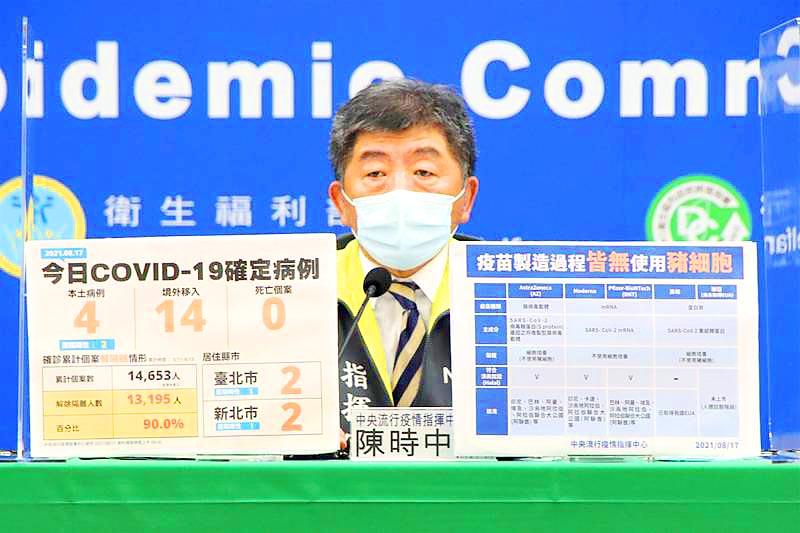
Photo courtesy of the Central Epidemic Command Center
Chen said that aside from Taiwan’s Medigen vaccine, which just received emergency use authorization last month, the other three vaccines have been widely administered and certified as halal in several Muslim countries.
On Monday, 49,152 COVID-19 vaccine doses were administered, bringing the nation’s vaccination coverage to 39.21 percent, he said.
Chen also urged people who are eligible to receive a first shot of the Medigen vaccine between Monday and Sunday next week, to book an appointment as soon as possible, as the reservation deadline ends at 12pm today.
The four local cases reported yesterday tested positive during isolation, and the infection sources for two of them are still unclear, the CECC said.
Taipei and New Taipei City each reported two of the local cases, Chen said.
Of the 14 imported cases, nine had returned to Taiwan on a charter flight from Myanmar, while two had returned from the US, two from the UK and one from Australia, he said.
The people who arrived on the charter flight were taken to a centralized quarantine facility in Yilan County after arrival, and those who tested positive were hospitalized.
Centers for Disease Control Deputy Director-General Chuang Jen-hsiang (莊人祥), the CECC’s spokesperson, said that four of the imported cases were fully vaccinated: Two had received the Pfizer-BioNTech vaccine and two had received the AstraZeneca vaccine.
Meanwhile, Chen said its was suggested at a meeting of the CECC’s legal affairs division on Monday that introducing a COVID-19 vaccination passport would not yet be suitable, as the nation’s vaccination rate is not high enough, and it might mislead people to think they need the passport to enter some venues.
Asked about a younger person in the ninth vaccination priority group — people who have a high-risk disease, a rare disease or catastrophic illness — who was told by a doctor to get the Moderna vaccine, but has still not had a chance to be vaccinated, Chen said that people of all ages in the ninth priority group are eligible for the AstraZeneca and the Medigen vaccines, but the Moderna vaccine has only been offered to people aged 53 or older in the ninth priority group.
Eligibility might be extended to younger people in the ninth group when more Moderna doses arrive, he said.
If people have a condition or urgently need to receive the Moderna vaccine, they can contact the CECC or a local health department, he added.
As the COVID-19 “travel bubble” between Taiwan and Palau resumed last week and many travelers planned to get a second dose of vaccine in Palau, Chen was asked if people should receive a second dose of the Johnson & Johnson’s vaccine, as Palau announced it would stop offering the Moderna vaccine from tomorrow.
Chen said Johnson & Johnson’s COVID-19 vaccine has not been approved for use in Taiwan yet, so there are no guidelines for mixing a first dose of the AstraZeneca vaccine with a second dose of Johnson & Johnson’s vaccine.
The CECC would not recommend it, he added.

The Centers for Disease Control (CDC) yesterday reported the first case of a new COVID-19 subvariant — BA.3.2 — in a 10-year-old Singaporean girl who had a fever upon arrival in Taiwan and tested positive for the disease. The girl left Taiwan on March 20 and the case did not have a direct impact on the local community, it said. The WHO added the BA.3.2 strain to its list of Variants Under Monitoring in December last year, but this was the first imported case of the COVID-19 variant in Taiwan, CDC Deputy Director-General Lin Ming-cheng (林明誠) said. The girl arrived in Taiwan on

South Korea is planning to revise its controversial electronic arrival card, a step Taiwanese officials said prompted them to hold off on planned retaliatory measures, a South Korean media report said yesterday. A Yonhap News Agency report said that the South Korean Ministry of Foreign Affairs is planning to remove the “previous departure place” and “next destination” fields from its e-arrival card system. The plan, reached after interagency consultations, is under review and aims to simplify entry procedures and align the electronic form with the paper version, a South Korean ministry official said. The fields — which appeared only on the electronic form

The Ministry of Foreign Affairs (MOFA) is suspending retaliation measures against South Korea that were set to take effect tomorrow, after Seoul said it is updating its e-arrival system, MOFA said today. The measures were to be a new round of retaliation after Taiwan on March 1 changed South Korea's designation on government-issued alien resident certificates held by South Korean nationals to "South Korea” from the "Republic of Korea," the country’s official name. The move came after months of protests to Seoul over its listing of Taiwan as "China (Taiwan)" in dropdown menus on its new online immigration entry system. MOFA last week

A bipartisan group of US senators has introduced a bill to enhance cooperation with Taiwan on drone development and to reduce reliance on supply chains linked to China. The proposed Blue Skies for Taiwan Act of 2026 was introduced by Republican US senators Ted Cruz and John Curtis, and Democratic US senators Jeff Merkley and Andy Kim. The legislation seeks to ease constraints on Taiwan-US cooperation in uncrewed aerial systems (UAS), including dependence on China-sourced components, limited access to capital and regulatory barriers under US export controls, a news release issued by Cruz on Wednesday said. The bill would establish a "Blue UAS


 RSS
RSS