


Much of the Taichung Fire Bureau’s personal protective equipment has exceeded its service life, Taichung city councilors said.
Taichung City Councilors Chen Shu-hua (陳淑華), Hsiao Lung-tse (蕭隆澤) and Chiu Su-chen (邱素貞) of the Democratic Progressive Party were speaking at a council session on Friday, citing information from the National Audit Office’s Taichung division.
According to the office, the expired equipment includes 55.96 percent of all protective clothing, 65.73 percent of masks, 56.82 percent of oxygen tanks, 76.12 percent of thermal imagers and 95.33 percent of personal alert safety systems (PASS), Chen said.
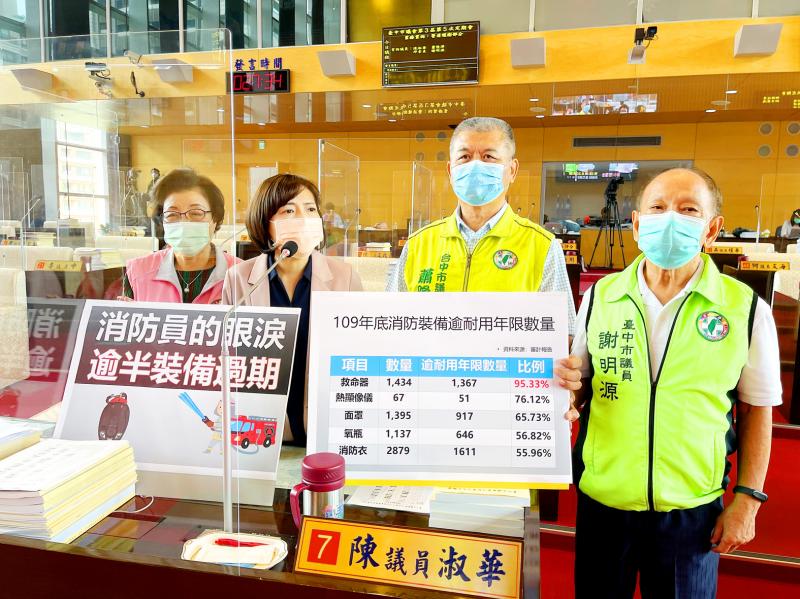
Photo: Su Meng-chuan, Taipei Times
“That basic safety equipment as crucial as PASS units was not replaced shows that the city government has a disregard for the lives of firefighters,” she said.
PASS devices are motion sensors that firefighters activate when entering hazardous environments and emit a warning sound if no movement occurs after a certain amount of time, indicating that a user is in distress.
Taichung firefighters respond to a fire in 62.82 seconds on average, lower than the national average of 41.6 seconds and the slowest among firefighters in the six special municipalities, the city councilors said.
There are 232 vehicles in the city’s fire truck fleet, or just four more than the legally mandated minimum for the jurisdiction, they said, adding that 32.16 percent are more than 15 years old.
The councilors called on the city to replace worn-out equipment and that which has exceeded its service life.
Taichung Fire Bureau Director-General Tseng Chin-tsai (曾進財) said that most of the expired equipment has been kept in working order by being repaired, and that replacing old or broken equipment is a budget priority for the bureau.
The bureau has made significant increases to the budget for replacing aging fire trucks over the past two years and is asking for NT$110 million (US$3.95 million) for that purpose next year, he said.
Taichung firefighters collect intelligence and assess the situation prior to dispatching personnel, unlike other fire departments that carry out assessments after fire trucks arrive at a fire, he said.
This results in a longer response time, but is more effective and safer, he said.

The Centers for Disease Control (CDC) yesterday reported the first case of a new COVID-19 subvariant — BA.3.2 — in a 10-year-old Singaporean girl who had a fever upon arrival in Taiwan and tested positive for the disease. The girl left Taiwan on March 20 and the case did not have a direct impact on the local community, it said. The WHO added the BA.3.2 strain to its list of Variants Under Monitoring in December last year, but this was the first imported case of the COVID-19 variant in Taiwan, CDC Deputy Director-General Lin Ming-cheng (林明誠) said. The girl arrived in Taiwan on

South Korea is planning to revise its controversial electronic arrival card, a step Taiwanese officials said prompted them to hold off on planned retaliatory measures, a South Korean media report said yesterday. A Yonhap News Agency report said that the South Korean Ministry of Foreign Affairs is planning to remove the “previous departure place” and “next destination” fields from its e-arrival card system. The plan, reached after interagency consultations, is under review and aims to simplify entry procedures and align the electronic form with the paper version, a South Korean ministry official said. The fields — which appeared only on the electronic form

The Ministry of Foreign Affairs (MOFA) is suspending retaliation measures against South Korea that were set to take effect tomorrow, after Seoul said it is updating its e-arrival system, MOFA said today. The measures were to be a new round of retaliation after Taiwan on March 1 changed South Korea's designation on government-issued alien resident certificates held by South Korean nationals to "South Korea” from the "Republic of Korea," the country’s official name. The move came after months of protests to Seoul over its listing of Taiwan as "China (Taiwan)" in dropdown menus on its new online immigration entry system. MOFA last week

A bipartisan group of US senators has introduced a bill to enhance cooperation with Taiwan on drone development and to reduce reliance on supply chains linked to China. The proposed Blue Skies for Taiwan Act of 2026 was introduced by Republican US senators Ted Cruz and John Curtis, and Democratic US senators Jeff Merkley and Andy Kim. The legislation seeks to ease constraints on Taiwan-US cooperation in uncrewed aerial systems (UAS), including dependence on China-sourced components, limited access to capital and regulatory barriers under US export controls, a news release issued by Cruz on Wednesday said. The bill would establish a "Blue UAS


 RSS
RSS