


A group of 148 people departed from Taiwan Taoyuan International Airport yesterday morning as Taiwan’s suspended travel bubble with Palau resumed.
A China Airlines flight took off at about 10:30am under a program in which the Pacific island country is offering up to 2,000 doses of COVID-19 vaccines to arrivals from Taiwan.
The “travel bubble,” which allows Taiwanese to visit Palau under eased protocols, was initially launched on April 1, but was suspended in the middle of May after a surge of COVID-19 cases in Taiwan.
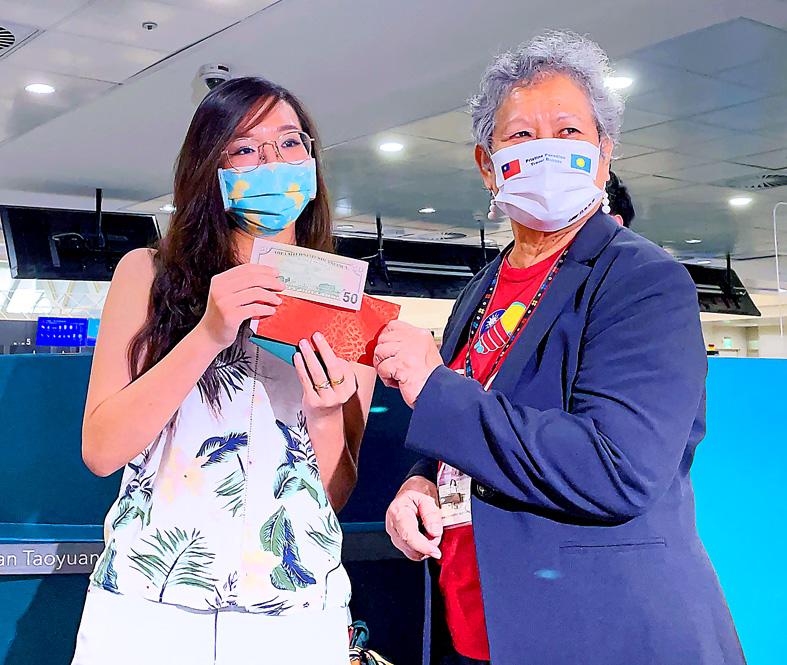
Photo: Chu Pei-hsiung, Taipei Times
While Taiwan has contained the outbreak, it still faces a shortage of vaccines.
The first group in the program arrived at the airport at about 4am yesterday and from 5am underwent polymerase chain reaction (PCR) tests for COVID-19.
By 8:30am, the tests had all come back negative, Taoyuan International Airport Corp president Jerry Dan (但昭璧) said.
The airport has streamlined procedures for administering the tests, which allowed them to finish ahead of schedule, Dan said.
In accordance with disease prevention protocols, participants in the travel bubble will be isolated upon their return to Taiwan, he said.
Palauan Ambassador to Taiwan Dilmei Olkerii was at the airport to see the flight off and gave each passenger US$50 of travel vouchers to use in Palau.
Olkerii expressed gratitude to the Central Epidemic Command Center (CECC) for allowing the program to resume.
She cited Palauan President Surangel Whipps Jr as saying that while Taiwan has continued to report domestic COVID-19 cases, it has done well to contain the virus.
Earlier this week, Alex Lei, the director of the Palau Visitors Authority’s Taiwan office, said that Palau would provide 2,000 doses of COVID-19 vaccines to Taiwanese travelers in view of the countries’ “long-standing friendly ties.”
Palau — which has doses of the Pfizer, Moderna and Johnson & Johnson vaccines — will offer the shots, along with proof of vaccination documents, to Taiwanese on the day of their arrival, Lei said.
People who have already confirmed their travel plans can reserve a jab by contacting the Taiwan office by e-mail, he said.
Many of the first group of tourists on yesterday’s flight were planning to receive their first COVID-19 vaccine shot in Palau, while others who had already received one vaccination in Taiwan were hoping to receive a jab from another brand there.
Travelers returning from Palau have to undergo five days of enhanced self-health management, either at a quarantine hotel or at home, if they can keep one person to a room, the CECC has said.
On the fifth day after their return, they are required to take a PCR test, and with a negative result they will be allowed to follow standard self-health management protocols until the 14th day, it said.
Separately yesterday, Minister of Health and Welfare Chen Shih-chung (陳時中), who heads the CECC, said that the government is drafting a protocol on the recognition of COVID-19 vaccination records from abroad.
Currently, if people who have been vaccinated against the virus abroad are asked for their record, they can use a certificate issued to them in the country where they were vaccinated, because there are no bilateral agreements on recognition of COVID-19 vaccination records yet, Chen said.
However, the planned protocol would only recognize records that show vaccination with a product that has emergency use authorization from the Food and Drug Administration (FDA), while a certificate declaring that they are to be inoculated abroad would also be required, he said.
COVID-19 vaccines developed by AstraZeneca and Moderna, which have been part of Taiwan’s vaccine program since March 22, would be recognized, and the FDA has authorized the Pfizer-BioNTech and the one developed locally by Medigen Vaccine Biologics Corp, he said.

The Centers for Disease Control (CDC) yesterday reported the first case of a new COVID-19 subvariant — BA.3.2 — in a 10-year-old Singaporean girl who had a fever upon arrival in Taiwan and tested positive for the disease. The girl left Taiwan on March 20 and the case did not have a direct impact on the local community, it said. The WHO added the BA.3.2 strain to its list of Variants Under Monitoring in December last year, but this was the first imported case of the COVID-19 variant in Taiwan, CDC Deputy Director-General Lin Ming-cheng (林明誠) said. The girl arrived in Taiwan on

South Korea is planning to revise its controversial electronic arrival card, a step Taiwanese officials said prompted them to hold off on planned retaliatory measures, a South Korean media report said yesterday. A Yonhap News Agency report said that the South Korean Ministry of Foreign Affairs is planning to remove the “previous departure place” and “next destination” fields from its e-arrival card system. The plan, reached after interagency consultations, is under review and aims to simplify entry procedures and align the electronic form with the paper version, a South Korean ministry official said. The fields — which appeared only on the electronic form

The Ministry of Foreign Affairs (MOFA) is suspending retaliation measures against South Korea that were set to take effect tomorrow, after Seoul said it is updating its e-arrival system, MOFA said today. The measures were to be a new round of retaliation after Taiwan on March 1 changed South Korea's designation on government-issued alien resident certificates held by South Korean nationals to "South Korea” from the "Republic of Korea," the country’s official name. The move came after months of protests to Seoul over its listing of Taiwan as "China (Taiwan)" in dropdown menus on its new online immigration entry system. MOFA last week
A bipartisan group of US senators has introduced a bill to enhance cooperation with Taiwan on drone development and to reduce reliance on supply chains linked to China. The proposed Blue Skies for Taiwan Act of 2026 was introduced by Republican US senators Ted Cruz and John Curtis, and Democratic US senators Jeff Merkley and Andy Kim. The legislation seeks to ease constraints on Taiwan-US cooperation in uncrewed aerial systems (UAS), including dependence on China-sourced components, limited access to capital and regulatory barriers under US export controls, a news release issued by Cruz on Wednesday said. The bill would establish a "Blue UAS


 RSS
RSS