


Chinese Nationalist Party (KMT) legislators Hung Meng-kai (洪孟楷) and Wan Mei-ling (萬美玲) yesterday called for the upgrading of the Sports Administration into a ministry to ensure proper funding and management of national sports.
The Sports Administration, now governed by the Ministry of Education, has a staff of about 100, making it even smaller than the Taipei Department of Sports, which has a staff of about 250, Hung told a news conference in Taipei.
The organization of the agency has to be reformed to give the entity the authority and resources needed to promote Taiwanese sports, he said.
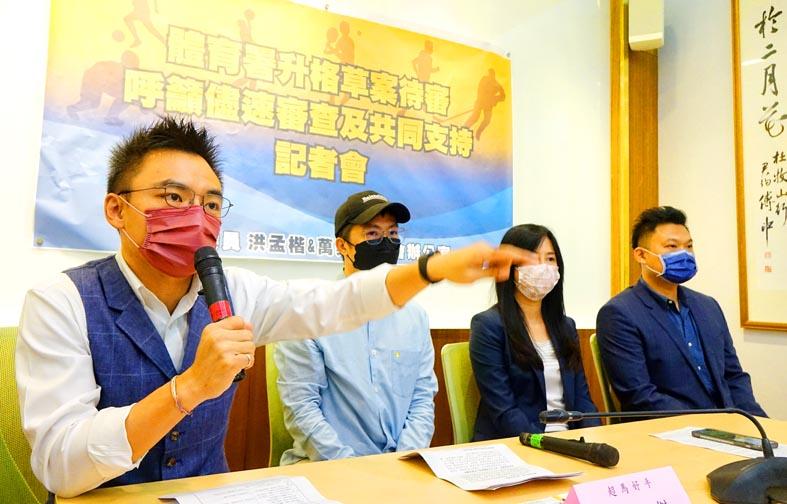
Photo: Liu Hsin-de, Taipei Times
“Taiwan’s outstanding performance in the Tokyo Olympics has united the nation behind sports reform, for which there is political consensus across the aisle,” he said.
The Sports Administration is understaffed and underfunded, and employs educational officials who do not truly understand competitive sports, Wan said.
“The agency’s policies have often become a stumbing block to the initiatives of other departments and made little contribution to sports,” she said.
Wan said she had proposed a draft amendment to the Sports Industry Development Act (運動產業發展條例) that would give a 250 percent tax credit for enterprises that donate to sports-related causes.
However, the bill died due to opposition by the education ministry and the Ministry of Finance, she said.
Sports and physical education are distinct spheres of activity and the authorities governing them should be kept separate, retired ultramarathoner Kevin Lin (林義傑) said.
Sports involve the integrated management of competitive sports, the sports industry and legal affairs connected to athletes, he said.
The country needs to create an entrepreneurial environment where atheletes and coaches can build viable professional careers after the Olympics, he said.
The private sector has been calling on the government to direct and coordinate the development of the sports industry, which is needed to give athletes and coaches a professional career outside of the Olympics, he said.
Charles Yu (余宗龍), a professor of sports and health management at National Chung Hsing University, said that a sports ministry would have more power in getting resources or cooperation from the nation’s foreign affairs officials.
In related news, Premier Su Tseng-chang (蘇貞昌) had accepted the resignation of Chang Shao-hsi (張少熙) as Sports Administration director-general, the education ministry said in a statement yesterday.
Chang tendered his resignation last month after a public uproar over the flight arrangements for Taiwanese athletes attending the Tokyo Olympics.
Su praised Chang for having the courage to take responsibility, saying that Chang would be returning to teaching after he accompanied athletes to meet President Tsai Ing-wen (蔡英文), the education ministry said.

The military has spotted two Chinese warships operating in waters near Penghu County in the Taiwan Strait and sent its own naval and air forces to monitor the vessels, the Ministry of National Defense (MND) said. Beijing sends warships and warplanes into the waters and skies around Taiwan on an almost daily basis, drawing condemnation from Taipei. While the ministry offers daily updates on the locations of Chinese military aircraft, it only rarely gives details of where Chinese warships are operating, generally only when it detects aircraft carriers, as happened last week. A Chinese destroyer and a frigate entered waters to the southwest

The eastern extension of the Taipei MRT Red Line could begin operations as early as late June, the Taipei Department of Rapid Transit Systems said yesterday. Taipei Rapid Transit Corp said it is considering offering one month of free rides on the new section to mark its opening. Construction progress on the 1.4km extension, which is to run from the current terminal Xiangshan Station to a new eastern terminal, Guangci/Fengtian Temple Station, was 90.6 percent complete by the end of last month, the department said in a report to the Taipei City Council's Transportation Committee. While construction began in October 2016 with an

NON-RED SUPPLY: Boosting the nation’s drone industry is becoming increasingly urgent as China’s UAV dominance could become an issue in a crisis, an analyst said Taiwan’s drone exports to Europe grew 41.7-fold from 2024 to last year, with demand from Ukraine’s fight against Russian aggression the most likely driver of growth, a study showed. The Institute for Democracy, Society and Emerging Technology (DSET) in a statement on Wednesday said it found that many of Taiwan’s uncrewed aerial vehicle (UAV) sales were from Poland and the Czech Republic. These countries likely transferred the drones to Ukraine to aid it in its fight against the Russian invasion that started in 2022, it said. Despite the gains, Taiwan is not the dominant drone exporter to these markets, ranking second and fourth

Japanese Prime Minister Sanae Takaichi’s comment last year on Tokyo’s potential reaction to a Taiwan-China conflict has forced Beijing to rewrite its invasion plans, a retired Japanese general said. Takaichi told the Diet on Nov. 7 last year that a Chinese naval blockade or military attack on Taiwan could constitute a “survival-threatening situation” for Japan, potentially allowing Tokyo to exercise its right to collective self-defense. Former Japan Ground Self-Defense Force general Kiyofumi Ogawa said in a recent speech that the remark has been interpreted as meaning Japan could intervene in the early stages of a Taiwan Strait conflict, undermining China’s previous assumptions


 RSS
RSS