


Sports Administration Director-General Chang Shao-hsi’s (張少熙) resignation yesterday drew mixed reactions from Democratic Progressive Party (DPP) legislators, with some saying that he made up for his errors by helping the nation to its best Olympic performance in Tokyo.
Chang tendered a request to quit soon after it was reported that the agency arranged for athletes to fly to the Tokyo Olympics in economy class, while government officials were in business class, despite President Tsai Ing-wen (蔡英文) and Premier Su Tseng-chang (蘇貞昌) previously assuring the public that all national team athletes would be in business class.
The July 19 travel arrangements for Taiwan’s Tokyo Olympics delegation became an issue after badminton player Tai Tzu-ying (戴資穎) posted a photograph on Instagram of herself sitting in economy class on a China Airlines charter flight to Tokyo.
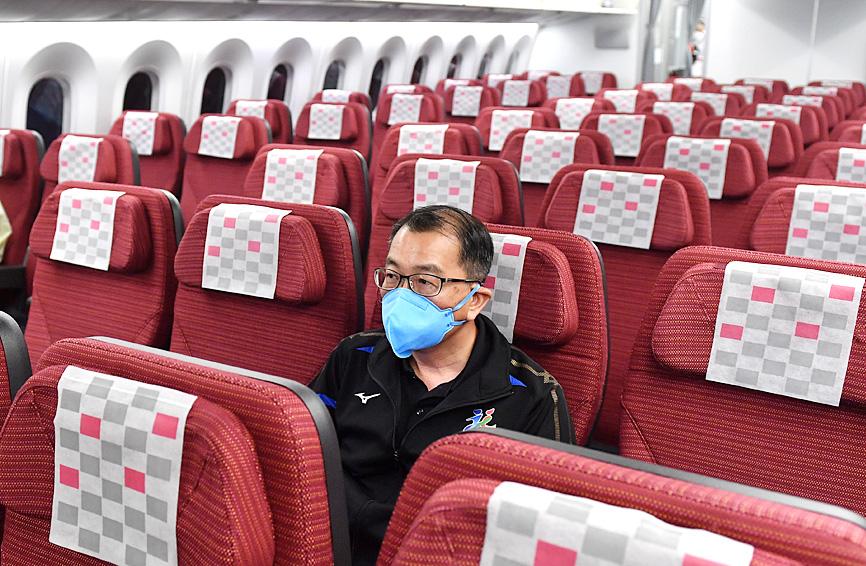
Photo: Lin Cheng-kung, Taipei Times
The flight was carrying a delegation of 134 people — athletes, officials and support staff — on the three-hour flight to Tokyo, the Sports Administration said.
The government officials, coaches and team doctors flew business class on the A330 aircraft, while the 50 athletes were seated in alternating rows in the front section of the economy cabin, it said.
That arrangement was necessary to allow social distancing between the athletes, which would not have been possible in business class, as there are only 36 seats in that section, it said.
It flew all Taiwanese athletes in business class on their return from Tokyo after the Games.
After submitting his request to resign, Chang was told to first go to Tokyo to handle matters related to the athletes.
“Now that I have completed my task and turned in impressive results, my plan is to return to National Taiwan Normal University to teach,” he wrote in a statement on Tuesday night.
Chang denied that he was mobilizing people in the sports industry to petition for him to stay at the Sports Administration, adding that people should leave an industry veteran like him with some dignity.
DPP Legislator Hsu Chih-chieh (許智傑) said that Chang should not have had to resign.
“If a majority of coaches and athletes affirm the Sports Administration’s contribution and performance during the Olympic Games, Chang can be considered to have atoned for his mistakes with meritorious service,” Hsu said, adding that the agency needs to be reminded to handle things more carefully next time.
DPP caucus secretary-general Lo Chih-cheng (羅致政) said that somebody has to take full responsibility for letting athletes sit in economy class, as it was a mission handed down by the president and the premier.
The Executive Yuan is yet to decide whether to approve Chang’s resignation.

The Centers for Disease Control (CDC) yesterday reported the first case of a new COVID-19 subvariant — BA.3.2 — in a 10-year-old Singaporean girl who had a fever upon arrival in Taiwan and tested positive for the disease. The girl left Taiwan on March 20 and the case did not have a direct impact on the local community, it said. The WHO added the BA.3.2 strain to its list of Variants Under Monitoring in December last year, but this was the first imported case of the COVID-19 variant in Taiwan, CDC Deputy Director-General Lin Ming-cheng (林明誠) said. The girl arrived in Taiwan on

South Korea is planning to revise its controversial electronic arrival card, a step Taiwanese officials said prompted them to hold off on planned retaliatory measures, a South Korean media report said yesterday. A Yonhap News Agency report said that the South Korean Ministry of Foreign Affairs is planning to remove the “previous departure place” and “next destination” fields from its e-arrival card system. The plan, reached after interagency consultations, is under review and aims to simplify entry procedures and align the electronic form with the paper version, a South Korean ministry official said. The fields — which appeared only on the electronic form
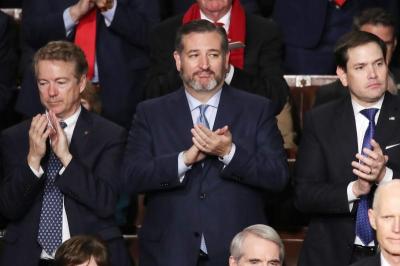
A bipartisan group of US senators has introduced a bill to enhance cooperation with Taiwan on drone development and to reduce reliance on supply chains linked to China. The proposed Blue Skies for Taiwan Act of 2026 was introduced by Republican US senators Ted Cruz and John Curtis, and Democratic US senators Jeff Merkley and Andy Kim. The legislation seeks to ease constraints on Taiwan-US cooperation in uncrewed aerial systems (UAS), including dependence on China-sourced components, limited access to capital and regulatory barriers under US export controls, a news release issued by Cruz on Wednesday said. The bill would establish a "Blue UAS

The Ministry of Foreign Affairs (MOFA) is suspending retaliation measures against South Korea that were set to take effect tomorrow, after Seoul said it is updating its e-arrival system, MOFA said today. The measures were to be a new round of retaliation after Taiwan on March 1 changed South Korea's designation on government-issued alien resident certificates held by South Korean nationals to "South Korea” from the "Republic of Korea," the country’s official name. The move came after months of protests to Seoul over its listing of Taiwan as "China (Taiwan)" in dropdown menus on its new online immigration entry system. MOFA last week


 RSS
RSS