


Taiwan People’s Party (TPP) lawmakers yesterday said that stimulus checks, not the Executive Yuan’s proposed “quintuple stimulus voucher” program, are what Taiwan’s economy needs to recover amid the COVID-19 pandemic.
TPP Legislator Jang Chyi-lu (張其祿) told a news conference in Taipei that Premier Su Tseng-chang’s (蘇貞昌) claim that last year’s Triple Stimulus Voucher program added NT$100 billion (US$3.59 billion) to the economy is “a canned statement unsupported by any evidence.”
The TPP caucus demands that the Cabinet determine which industries were hardest hit by the outbreak and exactly how much money they need before proposing a policy, Jang said.
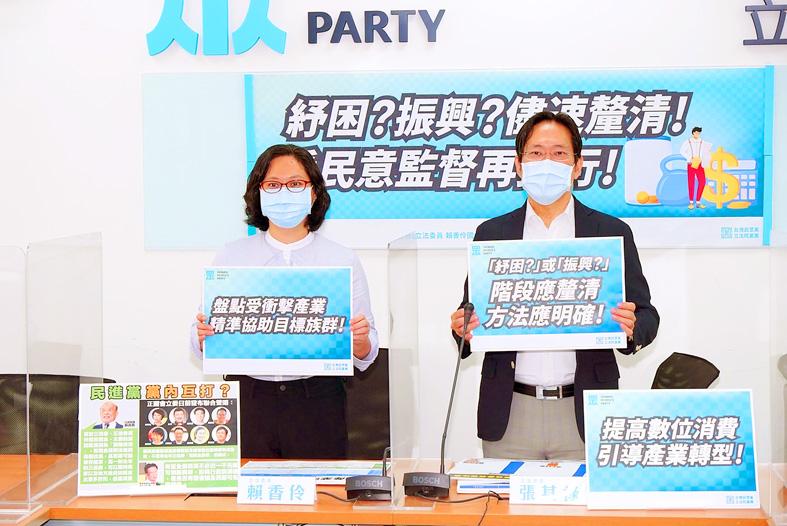
Photo: Chen Yun, Taipei Times
A comprehensive and objective review of the Triple Stimulus Voucher program’s effectiveness should be conducted, he said.
Taking the digitization of the service industry seriously, the government should guide the industry’s transition to e-commerce and help businesses implement disease prevention measures, he said.
Online retail revenue rose 3.2 percent since the beginning of the pandemic, showing that the digital transformation is vital for businesses that focus on satisfying domestic demand, he added.
The planned quintuple stimulus vouchers would not benefit Taiwanese families that urgently need money to survive, TPP Legislator Lai Hsiang-ling (賴香伶) said, adding that many Democratic Progressive Party lawmakers also oppose the voucher plan.
Checks boost the economy better than vouchers and efficiency should matter to the government, as it has spent NT$679.5 billion of the NT$840 billion COVID-19 relief budget, she said.
The nation’s employment outlook is gloomy, she said, adding that an unemployment rate of 4.8 percent in June meant that 570,000 people were out of work, while 57,000 people have been placed on unpaid leave since late last month.
The government needs to be more generous with relief money, broaden eligibility standards and stop agencies from repackaging pre-pandemic programs as relief measures, she said.
Many subsidies have been too small to allow recipients to pay for daily expenses, she said.

UPGRADE: The Kang Ding-class frigate is replacing its Chaparall missiles with Tien Chien II and Hua Yang VLS, which would provide it with long-range, 360° air defense Taiwan plans to produce 1,200 to 1,376 Hai Chien II missiles (海劍二, Sea Sword II) — also known as TC-2N — to serve as the standard air defense system of the navy’s surface combatant fleet, a source said yesterday. Last week, the Hai Chien II, the naval version of the Tien Kung II missile (天劍二, Sky Sword II), completed a live-fire test in waters off the National Chungshan Institute of Science and Technology’s Jiupeng facility (九鵬) in Pingtung County’s Manjhou Township (滿州). The MIM72 Chaparral and other dated air defense missiles that currently arm Taiwanese ships have inadequate range to combat Chinese

REASONS FOR TRAVEL: An assistant professor said that proposed amendments to penalize drivers if they used drugs overseas would not deter people from traveling People who operate a motor vehicle under the influence of marijuana would have their driver’s license revoked, even if they used the substance while overseas, the Ministry of Transportation and Communications said yesterday, citing proposed amendments to the Road Traffic Management and Penalty Act (道路交通管理處罰條例). The amendments would also authorize the government to revoke the licenses of people determined to have used Category 1 or Category 2 narcotics, even if they were not operating a vehicle while under the influence of drugs, as well as ban them from taking the license test for three years, the ministry said. People aged 18 or

GLOBALGIVING: ‘ Caving to external pressure is not acceptable for an organization that has cultivated justice reform and human rights for 30 years,’ one NGO said A slew of non-government organizations (NGOs) have withdrawn from the GlobalGiving fundraising platform after it announced it would use “Chinese Taipei” instead of “Taiwan” from next month. The Taiwan Good Rice Association wrote on Facebook on Friday that it was informed on April 28 via a teleconference call of the change, which was made because the platform wanted to operate in China. Taiwan Good Rice is to terminate all cooperative relationships with GlobalGiving in response to the platform’s “unilateral and non-negotiable” decision to remove references to Taiwan, the NGO said. “Taiwan is in the official name of Taiwan Good Rice Association and the

HEAVY WEATHER: Typhoon Jangmi is due to crash straight into the Ryukyus as airlines look to shift flights to larger aircraft or cancel flights to Okinawa entirely Taiwan’s international air carriers announced flight adjustments over the weekend as Typhoon Jangmi is forecast to hit the Ryukyu Islands today and tomorrow. The Central Weather Administration (CWA) upgraded Jangmi from a tropical storm to a typhoon at 8am yesterday, with the eye located 580km south of Naha city. It was moving north at 19kph. Today, China Airlines’ CI-120, CI-121, CI-122 and CI-123 flights between Taoyuan and Naha, Okinawa, have been canceled as well as CI-132 and CI-133 between Kaohsiung and Naha. EVA Air’s BR-112, BR-113, BR-186 and BR-185 flights between Taoyuan and Naha are also canceled. Low-cost carrier Tigerair Taiwan canceled IT-230,


 RSS
RSS