


A proposed “quintuple stimulus voucher program” is unlikely to expire before some time next year, the Ministry of Economic Affairs (MOEA) said yesterday, adding that internal discussions continue to look at maximizing the vouchers’ effects.
After successfully controling the spread of COVID-19 for most of last year, the outbreak in May had a significant effect on domestic consumption, with the retail sector and the food and beverage sector especially hard-hit.
As the COVID-19 situation is brought under control, the government has been lining up the quintuple stimulus voucher program, modeled on last year’s Triple Stimulus Voucher program, an unnamed source in the ministry told the Central News Agency (CNA) yesterday.
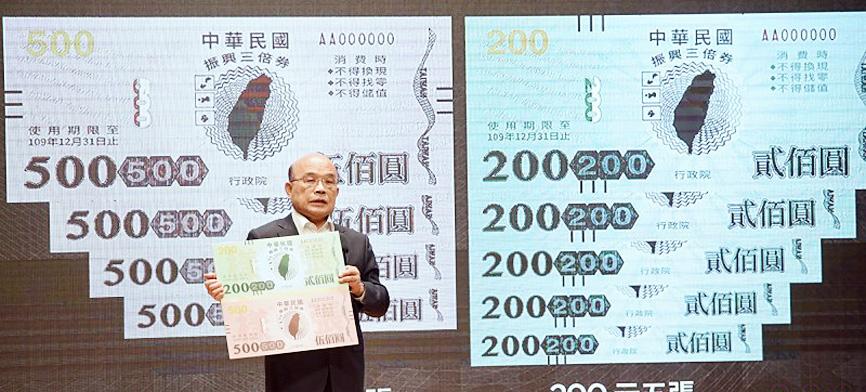
Photo: Lee Hsin-fang, Taipei Times
Under last year’s program, Taiwanese, and later foreign residents, could purchase NT$3,000 in vouchers for NT$1,000.
More than 23.32 million people received the Triple Stimulus Vouchers last year, the ministry said.
However, the vouchers, which were distributed from July last year, had to be used by the end of the year and could not be exchanged for cash, as the government wanted to encourage the public to consume and stimulate the economy, not save the money.
The planned quintuple stimulus voucher program would be similar, while the total sum is to be higher, to reflect the seriousness of the outbreak, compared with the initial wave of COVID-19 infections last year.
However, this year’s program “still has too much uncertainty,” Department of Commerce Deputy Director-General Chen Mi-shun (陳秘順) said.
“We are still in the process of figuring out how to execute this round of stimulus,” Chen said. “There were criticisms of the last round that need to be considered.”
Some retailers, including department stores, are calling for the vouchers to be valid through the Lunar New Year holiday to help spur consumption, CNA reported.
In other news, data released yesterday by the Ministry of Labor showed the number of furloughed workers fell by 1,355 in the first week of August from a week earlier, as employment in the food and beverage, wholesale and retail sectors improved.
As of Friday, the number of workers on unpaid leave was 55,332, down from 56,687 on Aug. 2, the ministry’s data showed.
However, the number of employers who last week implemented unpaid leave programs increased from 4,388 to 4,447.
The increase did not include the food and beverage or accommodation sectors, where the number of businesses implementing furloughs fell by about 10 percent last week, Department of Labor Standards and Equal Employment Director Huang Wei-chen (黃維琛) said.
The travel and tourism industry saw a sharp increase in furloughed workers last week, up by about 2,000 from the previous week, as the government’s COVID-19 relief subsidies to businesses in that sector ended on July 31, Huang said.
While the number of furloughed workers and employers adopting unpaid leave programs would likely fluctuate this month, the labor outlook is expected to improve as some businesses have resumed operations since Taiwan lowered its COVID-19 alert to level 2 on July 27, he said.

Eight restaurants in Taiwan yesterday secured a one-star rating from the Michelin Guide Taiwan for the first time, while three one-star restaurants from last year’s edition were promoted to two stars. Forty-three restaurants were awarded one star this year, including 34 in Taipei, five in Taichung and four in Kaohsiung. Hosu (好嶼), Chuan Ya (川雅), Sushi Kajin (鮨嘉仁), aMaze (心宴), La Vie by Thomas Buhner, Yuan Yi (元一) and Frassi in Taipei and Front House (方蒔) in Kaohsiung received a one-star rating for the first time. Hosu is known for innovative Taiwanese dishes, while Chuan Ya serves Sichuan cuisine and aMaze specializes
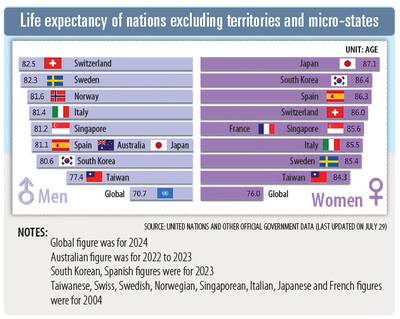
STATS: Taiwan’s average life expectancy of 80.77 years was lower than that of Japan, Singapore and South Korea, but higher than in China, Malaysia and Indonesia Taiwan’s average life expectancy last year increased to 80.77 years, but was still not back to its pre-COVID-19 pandemic peak of 81.32 years in 2020, the Ministry of the Interior said yesterday. The average life expectancy last year increased the 0.54 years from 2023, the ministry said in a statement. For men and women, the average life expectancy last year was 77.42 years and 84.30 years respectively, up 0.48 years and 0.56 years from the previous year. Taiwan’s average life expectancy peaked at 81.32 years in 2020, as the nation was relatively unaffected by the pandemic that year. The metric

Taiwan High Speed Rail Corp. (THSRC) plans to ease strained capacity during peak hours by introducing new fare rules restricting passengers traveling without reserved seats in 2026, company Chairman Shih Che (史哲) said Wednesday. THSRC needs to tackle its capacity issue because there have been several occasions where passengers holding tickets with reserved seats did not make it onto their train in stations packed with individuals traveling without a reserved seat, Shih told reporters in a joint interview in Taipei. Non-reserved seats allow travelers maximum flexibility, but it has led to issues relating to quality of service and safety concerns, especially during

A magnitude 5.1 earthquake struck Chiayi County at 4:37pm today, the Central Weather Administration (CWA) said. The hypocenter was 36.3km southeast of Chiayi County Hall at a depth of 10.4km, CWA data showed. There were no immediate reports of damage resulting from the quake. The intensity of the quake, which gauges the actual effect of a seismic event, measured 4 in Chiayi County, Tainan and Kaohsiung on Taiwan's seven-tier intensity scale, the data showed. The quake had an intensity of 3 in Chiayi City and Yunlin County, while it was measured as 2 in Pingtung, Taitung, Hualien, Changhua, Nantou and Penghu counties, the data


 RSS
RSS