


Taiwanese are spending more years of their life in poor health, Ministry of Health and Welfare data showed.
The population’s average disability-adjusted life years was 8.41 years in 2019, nearly a month longer than in 2018, the data showed.
Disability-adjusted life years measure the time a person spends in poor health, has a disability or dies before reaching a population’s average life expectancy.
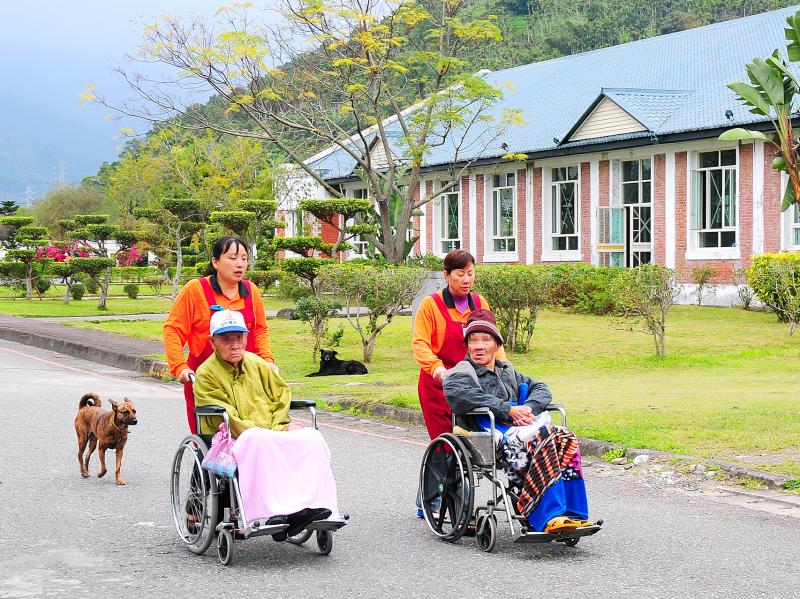
Taipei Times file photo
Health experts introduced the measure in 1990 to express the overall health in a country and gauge public healthcare costs.
Chiu Hung-yi (邱弘毅), a public health professor at Taipei Medical University, said that the measure primarily expresses the social effects of chronic diseases.
Due to the COVID-19 pandemic, the measure for last year and this year is expected to be higher, as disease prevention lifestyles might have led to a greater number of people experiencing poor health, Chiu said, adding that the numbers would be released next year.
“The COVID-19 pandemic has required many to stay at home and not exercise,” he said. “People with chronic diseases might have postponed visits to clinics and hospitals, which might have made it difficult to control their conditions.”
Linkou Chang Gung Memorial Hospital Director Chen Ying-ren (陳英仁) said that while many people have not exercised much and postponed appointments for medical treatment, fewer people contracted influenza, pneumonia and the common cold — diseases that mostly affect middle-aged people and the elderly — because they followed disease prevention measures that were imposed to control the spread of COVID-19.
“Whether this year’s disability-adjusted life years are to increase requires further observation,” Chen said.
Deputy Minister of Health and Welfare Shih Chung-liang (石崇良) said that there are two ways to address the issue.
“On the one hand, Taiwan needs to implement measures introduced by the Health Promotion Administration to help people stay healthy as they age,” he said. “On the other hand, the authorities need to enforce the Patient Right to Autonomy Act (病人自主權利法) to reduce the number of unnecessary visits to hospitals.”
People who have a terminal disease could be encouraged to draft wills, where they indicate whether they wish to deny medical treatment under certain conditions,” he said. “This would reduce the life years affected by disability.”

The Centers for Disease Control (CDC) yesterday reported the first case of a new COVID-19 subvariant — BA.3.2 — in a 10-year-old Singaporean girl who had a fever upon arrival in Taiwan and tested positive for the disease. The girl left Taiwan on March 20 and the case did not have a direct impact on the local community, it said. The WHO added the BA.3.2 strain to its list of Variants Under Monitoring in December last year, but this was the first imported case of the COVID-19 variant in Taiwan, CDC Deputy Director-General Lin Ming-cheng (林明誠) said. The girl arrived in Taiwan on

South Korea is planning to revise its controversial electronic arrival card, a step Taiwanese officials said prompted them to hold off on planned retaliatory measures, a South Korean media report said yesterday. A Yonhap News Agency report said that the South Korean Ministry of Foreign Affairs is planning to remove the “previous departure place” and “next destination” fields from its e-arrival card system. The plan, reached after interagency consultations, is under review and aims to simplify entry procedures and align the electronic form with the paper version, a South Korean ministry official said. The fields — which appeared only on the electronic form

A bipartisan group of US senators has introduced a bill to enhance cooperation with Taiwan on drone development and to reduce reliance on supply chains linked to China. The proposed Blue Skies for Taiwan Act of 2026 was introduced by Republican US senators Ted Cruz and John Curtis, and Democratic US senators Jeff Merkley and Andy Kim. The legislation seeks to ease constraints on Taiwan-US cooperation in uncrewed aerial systems (UAS), including dependence on China-sourced components, limited access to capital and regulatory barriers under US export controls, a news release issued by Cruz on Wednesday said. The bill would establish a "Blue UAS

The Ministry of Foreign Affairs (MOFA) is suspending retaliation measures against South Korea that were set to take effect tomorrow, after Seoul said it is updating its e-arrival system, MOFA said today. The measures were to be a new round of retaliation after Taiwan on March 1 changed South Korea's designation on government-issued alien resident certificates held by South Korean nationals to "South Korea” from the "Republic of Korea," the country’s official name. The move came after months of protests to Seoul over its listing of Taiwan as "China (Taiwan)" in dropdown menus on its new online immigration entry system. MOFA last week


 RSS
RSS