


Despite the government’s rallying call to bolster the local space industry, many industrial representatives at an online forum yesterday questioned authorities’ capacity to do so.
While the Space Development Act (太空發展法) has been promulgated, its supervising agency, the Ministry of Science and Technology, did not present a clear road map for space development, forum organizer and Democratic Progressive Party Legislator Chung Chia-pin (鍾佳濱) said.
The primary goal is to make the nation an internationally valued actor in space and next-generation satellites, particularly in low-orbit satellites and ground station equipment, National Space Organization (NSPO) Director-General Wu Jong-shinn (吳宗信) said.
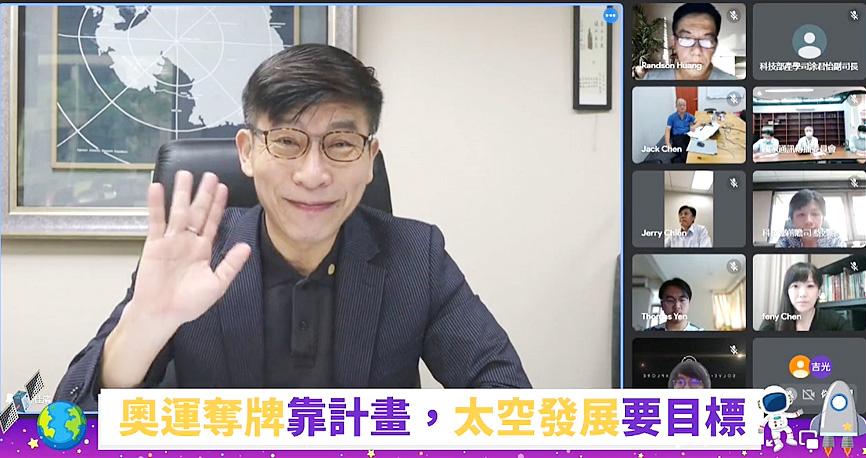
Screen grab by Chien Hui-ju, Taipei Times
The NSPO would boost partnerships with local firms and provide testing platforms for domestically developed components, Wu said, adding that a planned science park in Pingtung County would be a new hub for industrial innovation and the space industry.
Some local businesses have asked whether promoting industrial development is the NSPO’s primary concern, Metal Industries Research and Development Center analyst Chen Ching-hui (陳靖惠) said, asking if the Ministry of Economic Affairs would be more qualified to lead the task.
The NSPO mainly works on government missions, but does not actively explore business opportunities for local firms, Liscotech System Co general manager Jack Chen (陳良豐) said.
Developing advanced components for satellites takes a long time, but many businesses cannot get funding until the end of a project, he said.
The government imposes strict limits on funding applications, which is unfavorable for small and medium-sized firms if they aim to engage in long-term research and development, Odysseus Space executive business assistant Eric Hsu (許閔荏) said.
Established by Jordan Vannitsen in Taiwan in 2016, the company had to shift its research and development base to Luxembourg, which provides more legal and financial support for start-ups, Hsu added.
Amending the Government Procurement Act (政府採購法) might not be easy, but the government could consider extending its funding duration for start-ups, he said.
The government vowed to develop “six core strategic industries” that include defense and space supply chains, but it is questionable whether it has devoted National Development Fund or capital from state-run banks to those sectors, Geosat Aerospace & Technology Inc chairman Lo Cheng-fang (羅正方) said.
It should seek opportunities in international cooperation for the local space industry, and develop launch vehicles to help other countries get small satellites and cubesats into space, he said.
Taiwan’s warming relations with Europe present a good opportunity to do that, Lo said.
Letscom International general manager Randson Huang (黃文杰) asked whether the NSPO is assisting or competing with local firms, and whether it would transfer technologies to them.
As Taiwan is not a UN member, previous negotiations over satellite communications frequency use in low-Earth orbits had been done through non-government and amateur radio channels or with another country’s help, Huang said, asking how the government plans to develop satellites for commercial use.

The Centers for Disease Control (CDC) yesterday reported the first case of a new COVID-19 subvariant — BA.3.2 — in a 10-year-old Singaporean girl who had a fever upon arrival in Taiwan and tested positive for the disease. The girl left Taiwan on March 20 and the case did not have a direct impact on the local community, it said. The WHO added the BA.3.2 strain to its list of Variants Under Monitoring in December last year, but this was the first imported case of the COVID-19 variant in Taiwan, CDC Deputy Director-General Lin Ming-cheng (林明誠) said. The girl arrived in Taiwan on

South Korea is planning to revise its controversial electronic arrival card, a step Taiwanese officials said prompted them to hold off on planned retaliatory measures, a South Korean media report said yesterday. A Yonhap News Agency report said that the South Korean Ministry of Foreign Affairs is planning to remove the “previous departure place” and “next destination” fields from its e-arrival card system. The plan, reached after interagency consultations, is under review and aims to simplify entry procedures and align the electronic form with the paper version, a South Korean ministry official said. The fields — which appeared only on the electronic form

A bipartisan group of US senators has introduced a bill to enhance cooperation with Taiwan on drone development and to reduce reliance on supply chains linked to China. The proposed Blue Skies for Taiwan Act of 2026 was introduced by Republican US senators Ted Cruz and John Curtis, and Democratic US senators Jeff Merkley and Andy Kim. The legislation seeks to ease constraints on Taiwan-US cooperation in uncrewed aerial systems (UAS), including dependence on China-sourced components, limited access to capital and regulatory barriers under US export controls, a news release issued by Cruz on Wednesday said. The bill would establish a "Blue UAS

The Ministry of Foreign Affairs (MOFA) is suspending retaliation measures against South Korea that were set to take effect tomorrow, after Seoul said it is updating its e-arrival system, MOFA said today. The measures were to be a new round of retaliation after Taiwan on March 1 changed South Korea's designation on government-issued alien resident certificates held by South Korean nationals to "South Korea” from the "Republic of Korea," the country’s official name. The move came after months of protests to Seoul over its listing of Taiwan as "China (Taiwan)" in dropdown menus on its new online immigration entry system. MOFA last week


 RSS
RSS