


The last Taiwanese official at the nation’s representative office in Hong Kong was forced home on Friday afternoon after Hong Kong authorities refused to extend his visa.
Taiwan’s Mainland Affairs Council (MAC) wrote on Facebook that Economy Division Director Ni Bo-chia (倪伯嘉) of the Taipei Economic and Cultural Office (TECO) in Hong Kong returned to Taipei at 3:25pm, leaving the office with only local staff.
The council, which administers the office, said in a separate statement that the office’s operations have not been affected, and that the government had drafted a plan in preparation for such a scenario.
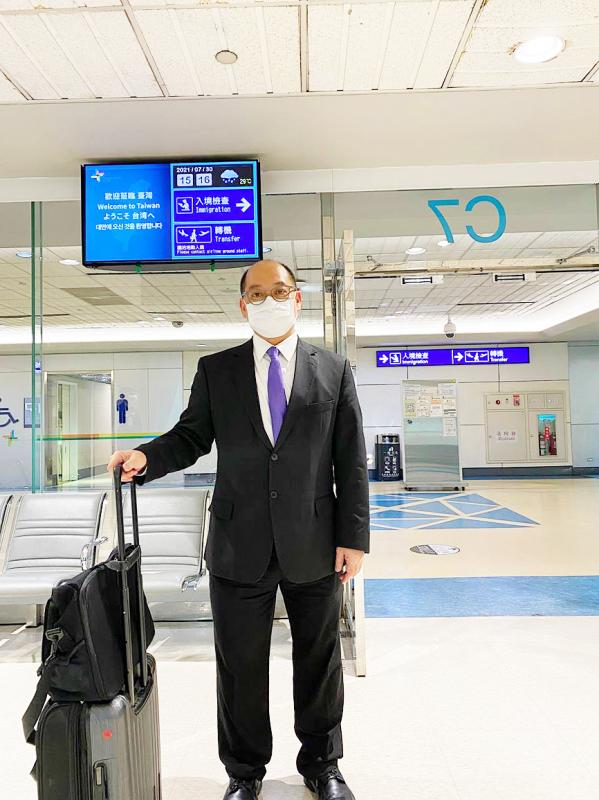
Photo courtesy of the Mainland Affairs Council
The MAC urged “relevant parties” to consider the welfare of Taiwanese and Hong Kongers, and stop political actions that would harm long-term relations between Taiwan and the territory.
“TECO Hong Kong plays an important part in the positive development of Taiwan-Hong Kong relations,” the MAC said. “Both Taiwanese and Hong Kongers would hate to see the office incapacitated due to unnecessary political considerations.”
TECO, which represents Taiwan’s interests in the territory, normally has 19 Taiwanese staffers from various government agencies. They have been forced to return one after another in the past few years, after Hong Kong refused to extend their visas and would not issue visas to their successors.
Last month, MAC Minister Chiu Tai-san (邱太三) confirmed media reports that the Hong Kong government in July 2018 started asking Taiwanese officials to sign an affidavit recognizing Beijing’s “one China” principle as a precondition for a visa.
“Taiwan will not accept such a political condition,” Chiu said at the time.
Taiwan-Hong Kong relations began to sour in 2014 during the “Umbrella movement,” after the Hong Kong government accused Taiwan of supporting protesters and political dissidents in the territory.
The situation worsened in 2019, when Hong Kong authorities said they were unhappy with Taiwan’s support for the months-long pro-democracy movement.
The Hong Kong government closed its office in Taiwan in May.
A similar situation is playing out in Macau, where as of last month TECO had only four Taiwanese staffers, with the longest visa among them valid until October next year.

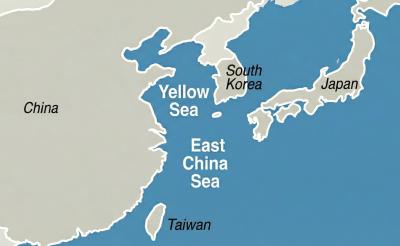
China has reserved offshore airspace in the Yellow Sea and East China Sea from March 27 to May 6, issuing alerts usually used to warn of military exercises, although no such exercises have been announced, the Wall Street Journal (WSJ) reported yesterday. Reserving such a large area for 40 days without explanation is an “unusual step,” as military exercises normally only last a few days, the paper said. These alerts, known as Notice to Air Missions (Notams), “are intended to inform pilots and aviation authorities of temporary airspace hazards or restrictions,” the article said. The airspace reserved in the alert is
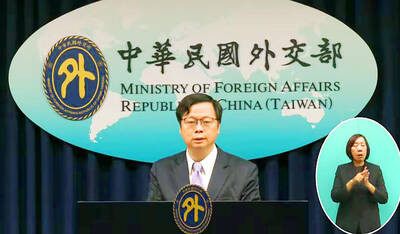
NAMING SPAT: The foreign ministry called on Denmark to propose an acceptable solution to the erroneous nationality used for Taiwanese on residence permits Taiwan has revoked some privileges for Danish diplomatic staff over a Danish permit that lists “Taiwan” as “China,” Eric Huang (黃鈞耀), head of the Ministry of Foreign Affairs’ Department of European Affairs, told a news conference in Taipei yesterday. Reporters asked Huang whether the Danish government had responded to the ministry’s request that it correct the nationality on Danish residence permits of Taiwanese, which has been listed as “China” since 2024. Taiwan’s representative office in Denmark continues to communicate with the Danish government, and the ministry has revoked some privileges previously granted to Danish representatives in Taiwan and would continue to review
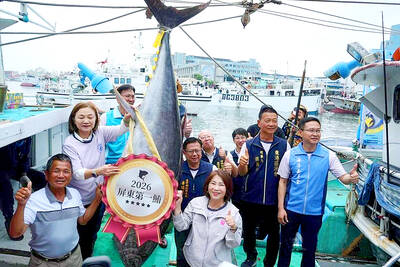
The first bluefin tuna of the season, brought to shore in Pingtung County and weighing 190kg, was yesterday auctioned for NT$10,600 (US$333.5) per kilogram, setting a record high for the local market. The auction was held at the fish market in Donggang Fishing Harbor, where the Siaoliouciou Island-registered fishing vessel Fu Yu Ching No. 2 delivered the “Pingtung First Tuna” it had caught for bidding. Bidding was intense, and the tuna was ultimately jointly purchased by a local restaurant and a local company for NT$10,600 per kilogram — NT$300 ,more than last year — for a total of NT$2.014 million. The 67-year-old skipper

China has reserved offshore airspace over the Yellow Sea and East China Sea from March 27 to May 6, issuing alerts that are usually used to warn of military exercises, although no such exercises have been announced, the Wall Street Journal (WSJ) reported on Sunday. Reserving such a large area for 40 days without explanation is an “unusual step,” as military exercises normally only last a few days, the paper said. The alerts, known as notice to air missions (NOTAMs), “are intended to inform pilots and aviation authorities of temporary airspace hazards or restrictions,” the article said. The airspace reserved in the alert


 RSS
RSS