


President Tsai Ing-wen (蔡英文) yesterday led an entourage of top-ranking government officials to pay their respects to former president Lee Teng-hui (李登輝), who passed away one year ago at the age of 97.
“We look back at Taiwan’s winding path to democracy tread by forerunners and treasure the free air that we enjoy,” Tsai wrote on Facebook after leading the group to Lee’s grave at the Wuzhi Mountain Military Cemetery in New Taipei City’s Sijhih District (汐止).
“Every era brings new challenges as we continue deepening Taiwan’s democracy,” she wrote. “What lies ahead of us is deepening Taiwan’s democracy, bringing [the country] to the world and defending democratic values with friends in the international community.”
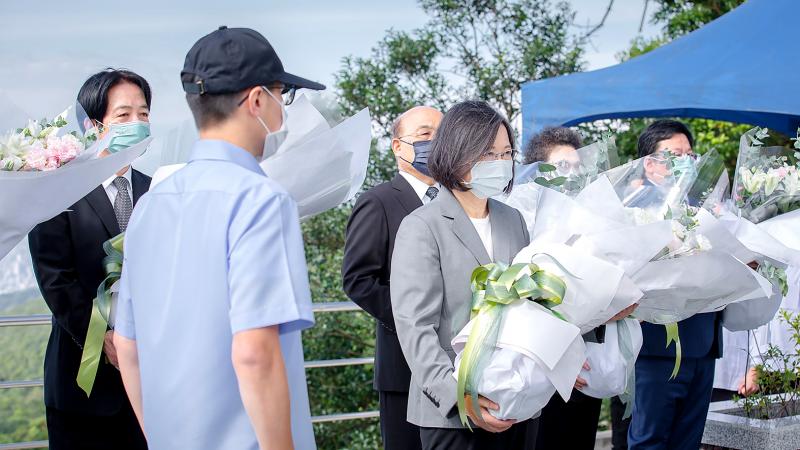
Photo provided by the Presidential Office via CNA
“We will travel on the path of Taiwan’s democracy with determination,” she wrote.
Vice President William Lai (賴清德) wrote on Facebook that on the trip to the cemetery, he had reminisced about his meetings with Lee in Tainan.
Lee never hesitated to share his thoughts and spoke many times about the importance of humility, equanimity and the ability to endure in life and politics, Lai wrote.
Lee would be moved and gladdened by the performance of Taiwanese athletes at the Tokyo Olympics and the acknowledgment of the national team by television anchors in Japan, he wrote.
“Lee’s spirit will be forever with us after the departure of his body and we thank him for creating a diverse, democratic and vital Taiwan,” he wrote. “Lee bound his life to the nation’s destiny. He brought immense wisdom and courage to bear at a crucial moment in Taiwanese history that contributed to the nation’s smooth transition to democracy.”
“We hope to usher an era of pride and happiness for Taiwanese on the foundation Lee laid down, for the country to obtain more dignity and self-respect,” he added.
Separately, the Japan-Taiwan Exchange Association, Japan’s de facto embassy in Taiwan, said that its library has put 100 Japanese-language books formerly in Lee’s personal collection on permanent display.
Lee was a voracious reader and academic whose books would provide guidance to the library’s users and bear testimony to the shared history between Taiwan and Japan, the association wrote on Facebook.
The books were donated to the association by the Lee Teng-hui Foundation, it wrote.
“We hope that Lee would bless the friendship between Taiwan and Japan from above so that it will last in perpetuity,” it added.
Meanwhile, Japanese Minister of Defense Nobuo Kishi thanked Lee for contributing to the friendship between Taiwan and Japan.
Lee is the father of democracy in Taiwan and he should be thanked for his achievements in developing Taiwan and furthering its relationship with Japan, Kishi wrote on Facebook and Twitter.
“I again express my heartfelt sorrow at his passing and my belief that his undiminished spirit is being carried on by people all around the world,” he wrote.
“We will continue to forge our path with comrades who share our values of democracy and human rights,” he added.
In August last year, Kishi and former Japanese prime minister Yoshiro Mori traveled to Taiwan to pay tribute to Lee with a Japanese delegation.
Kishi did not accompany Mori with a second delegation the following month, as by then he had been made defense minster.
Additional reporting by Lin Tsuei-yi

Considering that most countries issue more than five denominations of banknotes, the central bank has decided to redesign all five denominations, the bank said as it prepares for the first major overhaul of the banknotes in more than 24 years. Central bank Governor Yang Chin-lung (楊金龍) is expected to report to the Legislative Yuan today on the bank’s operations and the redesign’s progress. The bank in a report sent to the legislature ahead of today’s meeting said it had commissioned a survey on the public’s preferences. Survey results showed that NT$100 and NT$1,000 banknotes are the most commonly used, while NT$200 and NT$2,000

The Centers for Disease Control (CDC) yesterday reported the first case of a new COVID-19 subvariant — BA.3.2 — in a 10-year-old Singaporean girl who had a fever upon arrival in Taiwan and tested positive for the disease. The girl left Taiwan on March 20 and the case did not have a direct impact on the local community, it said. The WHO added the BA.3.2 strain to its list of Variants Under Monitoring in December last year, but this was the first imported case of the COVID-19 variant in Taiwan, CDC Deputy Director-General Lin Ming-cheng (林明誠) said. The girl arrived in Taiwan on

South Korea is planning to revise its controversial electronic arrival card, a step Taiwanese officials said prompted them to hold off on planned retaliatory measures, a South Korean media report said yesterday. A Yonhap News Agency report said that the South Korean Ministry of Foreign Affairs is planning to remove the “previous departure place” and “next destination” fields from its e-arrival card system. The plan, reached after interagency consultations, is under review and aims to simplify entry procedures and align the electronic form with the paper version, a South Korean ministry official said. The fields — which appeared only on the electronic form

The Ministry of Foreign Affairs (MOFA) is suspending retaliation measures against South Korea that were set to take effect tomorrow, after Seoul said it is updating its e-arrival system, MOFA said today. The measures were to be a new round of retaliation after Taiwan on March 1 changed South Korea's designation on government-issued alien resident certificates held by South Korean nationals to "South Korea” from the "Republic of Korea," the country’s official name. The move came after months of protests to Seoul over its listing of Taiwan as "China (Taiwan)" in dropdown menus on its new online immigration entry system. MOFA last week


 RSS
RSS