


The Taipei City Government is considering raising NT$8 billion (US$285.2 million) to purchase a third dose of vaccines against SARS-CoV-2 variants, Taipei Mayor Ko Wen-je (柯文哲) said on Sunday on the political talk show Taiwan Apocalypse (台灣啟示錄).
“Right now, the priority for Taiwan is for everyone to get their first two shots,” but the city should also look into procuring enough vaccines for a third shot, which might be necessary to deal with SARS-CoV-2 variants, he said.
Asked to elaborate, Ko yesterday said that the city government’s annual budget would not be approved until the end of the year.
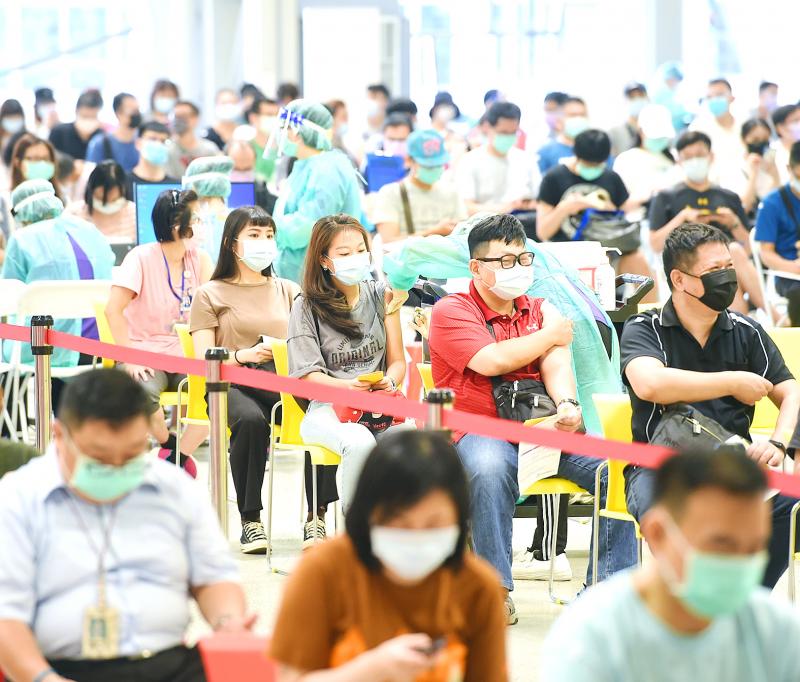
Photo: Fang Pin-chao, Taipei Times
“However, we should start thinking about it now. We will continue to look at the situation over the next six months” to decide whether Taipei needs to prepare vaccines on its own, he told reporters.
Chinese Nationalist Party (KMT) Chairman Johnny Chiang (江啟臣) yesterday expressed his support for the idea and said the KMT would work with Ko to speak with President Tsai Ing-wen (蔡英文) about the issue.
The government should “not stand in the way,” he added.
“Ko’s thinking on the matter reflects how everyone feels — that Taiwan does not have enough vaccines, and the supply is unstable. Everyone is in consensus on this,” Chiang said. “The question is whether we can get [President] Tsai on board.”
Saying the central government had previously obstructed local governments’ efforts to procure vaccines on their own, Chiang said he hoped the government would not stop Ko from procuring vaccines for third doses.
KMT Taipei City Councilor Wang Hsin-yi (王欣儀) said that she and other KMT councilors had in May called for Taipei to procure vaccines on its own, which she said reflected the will of the city’s residents and would protect their health and safety.
Wang said she hoped Ko would go ahead and purchase vaccines as soon as possible.
KMT Legislator Chiang Wan-an (蔣萬安) also expressed his support, saying that Taiwan lags behind other countries that have already administered two doses to the majority of their populations.
Taiwan should follow other countries, which are mulling administering third doses to help combat SARS-CoV-2 variants, he said.
“Taipei was one of the hardest-hit areas in the nation during this recent outbreak, yet we are unable to reach a safe level of vaccination,” he said. “Giving the city the funds to procure more vaccines would be less costly than enduring the economic impact of an outbreak.”
The government should put politics aside and let local governments, individuals and organizations procure more vaccines, he said.
Asked whether he agreed with Ko on the procurement of vaccines for a third dose, New Taipei City Mayor Hou You-yi (侯友宜) said that he had made such a call three weeks ago, urging the central government to prepare to let the public receive a third dose.
The issue had first come to his attention when the first cases of the Delta variant of SARS-CoV-2 appeared in Taiwan, he said.
Additional reporting by Lai Hsiao-tung

The Centers for Disease Control (CDC) yesterday reported the first case of a new COVID-19 subvariant — BA.3.2 — in a 10-year-old Singaporean girl who had a fever upon arrival in Taiwan and tested positive for the disease. The girl left Taiwan on March 20 and the case did not have a direct impact on the local community, it said. The WHO added the BA.3.2 strain to its list of Variants Under Monitoring in December last year, but this was the first imported case of the COVID-19 variant in Taiwan, CDC Deputy Director-General Lin Ming-cheng (林明誠) said. The girl arrived in Taiwan on

South Korea is planning to revise its controversial electronic arrival card, a step Taiwanese officials said prompted them to hold off on planned retaliatory measures, a South Korean media report said yesterday. A Yonhap News Agency report said that the South Korean Ministry of Foreign Affairs is planning to remove the “previous departure place” and “next destination” fields from its e-arrival card system. The plan, reached after interagency consultations, is under review and aims to simplify entry procedures and align the electronic form with the paper version, a South Korean ministry official said. The fields — which appeared only on the electronic form

The Ministry of Foreign Affairs (MOFA) is suspending retaliation measures against South Korea that were set to take effect tomorrow, after Seoul said it is updating its e-arrival system, MOFA said today. The measures were to be a new round of retaliation after Taiwan on March 1 changed South Korea's designation on government-issued alien resident certificates held by South Korean nationals to "South Korea” from the "Republic of Korea," the country’s official name. The move came after months of protests to Seoul over its listing of Taiwan as "China (Taiwan)" in dropdown menus on its new online immigration entry system. MOFA last week
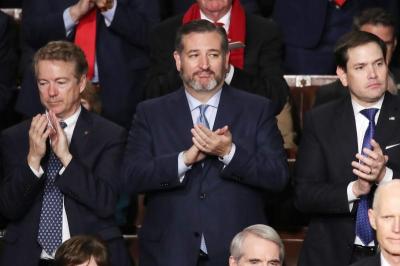
A bipartisan group of US senators has introduced a bill to enhance cooperation with Taiwan on drone development and to reduce reliance on supply chains linked to China. The proposed Blue Skies for Taiwan Act of 2026 was introduced by Republican US senators Ted Cruz and John Curtis, and Democratic US senators Jeff Merkley and Andy Kim. The legislation seeks to ease constraints on Taiwan-US cooperation in uncrewed aerial systems (UAS), including dependence on China-sourced components, limited access to capital and regulatory barriers under US export controls, a news release issued by Cruz on Wednesday said. The bill would establish a "Blue UAS


 RSS
RSS