


The government should release information about its vaccine procurement budget, Chinese Nationalist Party (KMT) Chairman Johnny Chiang (江啟臣) said yesterday.
In a video recording, Chiang accused the government of attempting to avoid oversight, saying that in principle the information should be made available to the public.
The National Audit Office has said that the government’s budget for the procurement of COVID-19 vaccines is not classified, he added.
Citing the Freedom of Government Information Act (政府資訊公開法), Chiang said if information is in the public interest it should be made available, and the government cannot refuse to provide information on the grounds that it has signed a confidentiality agreement.
Taiwan has signed contracts to purchase about 20 million vaccine doses from abroad, including 5.05 million doses from Moderna, 10 million doses from AstraZeneca and 4.76 million unspecified brands through the COVAX global distribution program. The government has also signed contracts to buy 10 million doses of vaccines produced by two domestic firms.
Chiang, who is a member of the legislature’s Foreign Affairs and National Defense Committee, said that many budgets related to the nation’s defense and diplomatic efforts are classified, and the committee holds confidential meetings to review them.
“Classified information may even be provided to lawmakers for oversight, not to mention that the vaccine budget is not a classified budget,” he said.
Citing President Tsai Ing-wen’s (蔡英文) remarks last year that the more transparent information is, the more effective COVID-19 prevention would be, Chiang said the Ministry of Health and Welfare should disclose how the vaccine procurement budget was spent, including which brands and how many doses of COVID-19 vaccines were purchased, the amount that was spent and when the vaccines can be expected to arrive.
Separately yesterday, KMT Legislator Lin Yi-hua (林奕華) said that Tsai should consider appointing special representatives for vaccine procurement.
She wrote on Facebook that if the government could not purchase COVID-19 vaccines from overseas suppliers, it should allow private companies to do so on its behalf.
Private companies have proven their ability to overcome the resistance the government speaks of, but the nation should not rely on donations from private companies for “all vaccine procurements,” she wrote.
She urged Tsai to follow the “APEC model” and appoint Taiwan Semiconductor Manufacturing Co (TSMC) founder Morris Chang (張忠謀), who is Taiwan’s APEC representative, and Hon Hai Precision Industry Co founder Terry Gou (郭台銘) as special representatives for the procurement of vaccines.
TSMC and Hon Hai have each pledged to donate 5 million Pfizer-BioNTech doses to the government.
Since domestically developed COVID-19 vaccines have not yet received emergency use authorization from the Food and Drug Administration, the government should first purchase adequate supplies of international vaccines, Lin added.
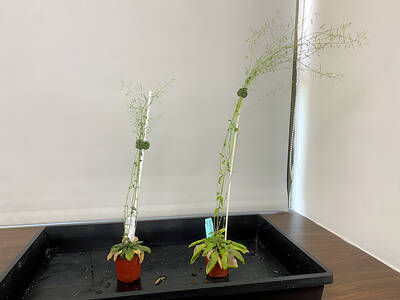
Taiwanese scientists have engineered plants that can capture about 50 percent more carbon dioxide and produce more than twice as many seeds as unmodified plants, a breakthrough they hope could one day help mitigate global warming and grow more food staples such as rice. If applied to major food crops, the new system could cut carbon emissions and raise yields “without additional equipment or labor costs,” Academia Sinica researcher and lead author the study Lu Kuan-jen (呂冠箴) said. Academia Sinica president James Liao (廖俊智) said that as humans emit 9.6 billion tonnes of carbon dioxide compared with the 220 billion tonnes absorbed
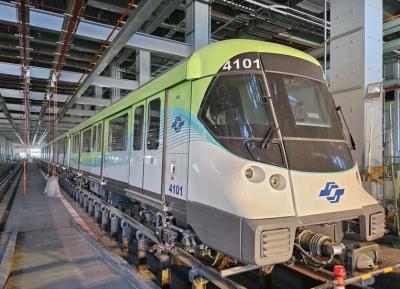
The Taipei Mass Rapid Transit (MRT) Wanda-Zhonghe Line is 81.7 percent complete, with public opening targeted for the end of 2027, New Taipei City Mayor Hou You-yi (侯友宜) said today. Surrounding roads are to be open to the public by the end of next year, Hou said during an inspection of construction progress. The 9.5km line, featuring nine underground stations and one depot, is expected to connect Chiang Kai-shek Memorial Hall Station to Chukuang Station in New Taipei City’s Jhonghe District (中和). All 18 tunnels for the line are complete, while the main structures of the stations and depot are mostly finished, he
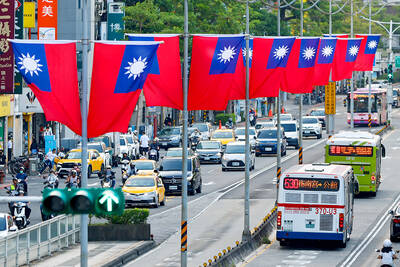
Taipei is to implement widespread road closures around Taipei 101 on Friday to make way for large crowds during the Double Ten National Day celebration, the Taipei Department of Transportation said. A four-minute fireworks display is to be launched from the skyscraper, along with a performance by 500 drones flying in formation above the nearby Nanshan A21 site, starting at 10pm. Vehicle restrictions would occur in phases, they said. From 5pm to 9pm, inner lanes of Songshou Road between Taipei City Hall and Taipei 101 are to be closed, with only the outer lanes remaining open. Between 9pm and 9:40pm, the section is
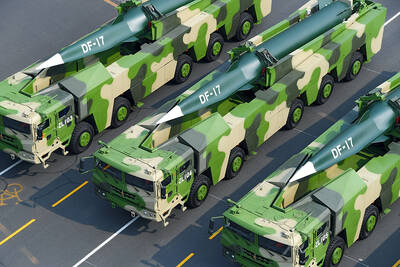
China’s plan to deploy a new hypersonic ballistic missile at a Chinese People’s Liberation Army Rocket Force (PLARF) base near Taiwan likely targets US airbases and ships in the western Pacific, but it would also present new threats to Taiwan, defense experts said. The New York Times — citing a US Department of Defense report from last year on China’s military power — on Monday reported in an article titled “The missiles threatening Taiwan” that China has stockpiled 3,500 missiles, 1.5 times more than four years earlier. Although it is unclear how many of those missiles were targeting Taiwan, the newspaper reported


 RSS
RSS