


Residents in Nantou County’s Yuchi Township (魚池) are calling on the county government to eradicate giant snakehead fish from Sun Moon Lake (日月潭) while they are still juveniles, as their population is set to explode this year.
The giant snakehead, or Channa micropeltes, is a carnivorous fish that can grow longer than 1.3m and weigh up to 24kg.
It is the most aggressive in the snakehead family, often swarming to prey on other fish, crustaceans, amphibians, small reptiles and even small birds and mammals.
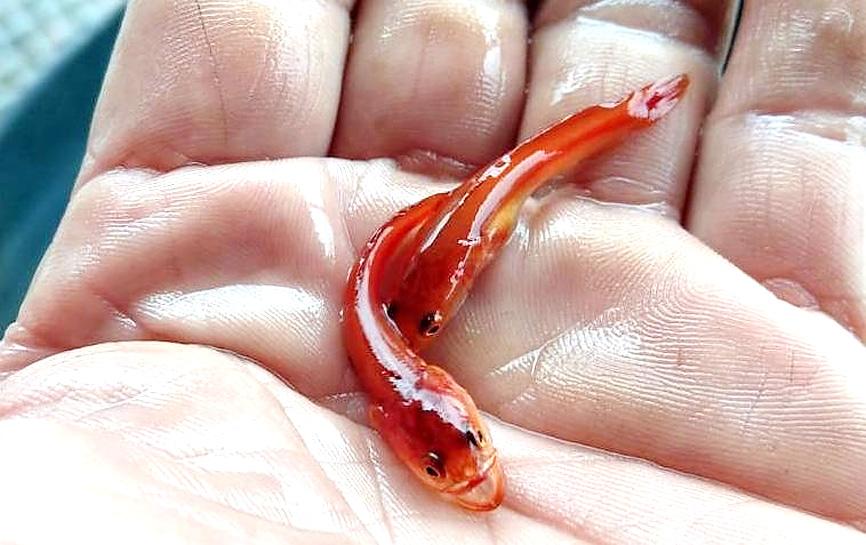
Photo: Hsieh Chieh-yu, Taipei Times
Their numbers have grown rapidly since being introduced to Sun Moon Lake, threatening many indigenous species of fish and shrimp, and are expected to reach as many as 2,000 this year.
As opposed to the gray-black appearance of mature members of the species, juveniles are bright red-orange and clump together in large balls that float near the surface of the water.
The Nantou County Bureau of Agricultural Affairs last year cooperated with National Tsing Hua University on using electrofishing to catch the “fish balls.”
After being informed by fishers about juveniles appearing on the lake, the bureau on Saturday said that it sent personnel to round them up using the same method.
They were not as successful as last year, likely due to increased vigilance by the adults, it said.
They are hiding in deeper waters with more cover from aquatic plants and fallen branches, making it difficult for boats to approach and use electrofishing methods to nab them, it said.
The bureau said that it has asked fishers to wait until the fish move to more open waters.
Many people keep juvenile giant snakeheads due to their color, but release them into the wild after they become adults, where they become the “ecological assassins” of Sun Moon Lake, the bureau said, urging people not to release pets into the wild, regardless of the species.

Considering that most countries issue more than five denominations of banknotes, the central bank has decided to redesign all five denominations, the bank said as it prepares for the first major overhaul of the banknotes in more than 24 years. Central bank Governor Yang Chin-lung (楊金龍) is expected to report to the Legislative Yuan today on the bank’s operations and the redesign’s progress. The bank in a report sent to the legislature ahead of today’s meeting said it had commissioned a survey on the public’s preferences. Survey results showed that NT$100 and NT$1,000 banknotes are the most commonly used, while NT$200 and NT$2,000

The Centers for Disease Control (CDC) yesterday reported the first case of a new COVID-19 subvariant — BA.3.2 — in a 10-year-old Singaporean girl who had a fever upon arrival in Taiwan and tested positive for the disease. The girl left Taiwan on March 20 and the case did not have a direct impact on the local community, it said. The WHO added the BA.3.2 strain to its list of Variants Under Monitoring in December last year, but this was the first imported case of the COVID-19 variant in Taiwan, CDC Deputy Director-General Lin Ming-cheng (林明誠) said. The girl arrived in Taiwan on

South Korea is planning to revise its controversial electronic arrival card, a step Taiwanese officials said prompted them to hold off on planned retaliatory measures, a South Korean media report said yesterday. A Yonhap News Agency report said that the South Korean Ministry of Foreign Affairs is planning to remove the “previous departure place” and “next destination” fields from its e-arrival card system. The plan, reached after interagency consultations, is under review and aims to simplify entry procedures and align the electronic form with the paper version, a South Korean ministry official said. The fields — which appeared only on the electronic form

The Ministry of Foreign Affairs (MOFA) is suspending retaliation measures against South Korea that were set to take effect tomorrow, after Seoul said it is updating its e-arrival system, MOFA said today. The measures were to be a new round of retaliation after Taiwan on March 1 changed South Korea's designation on government-issued alien resident certificates held by South Korean nationals to "South Korea” from the "Republic of Korea," the country’s official name. The move came after months of protests to Seoul over its listing of Taiwan as "China (Taiwan)" in dropdown menus on its new online immigration entry system. MOFA last week


 RSS
RSS