


COVID-19 vaccination data show low inoculation rates in cities and counties governed by the Chinese Nationalist Party (KMT), the Democratic Progressive Party (DPP) legislative caucus said yesterday.
The government’s inoculation efforts are a race to end the COVID-19 outbreak, with all local governments doing their best to vaccinate their residents, DPP caucus secretary-general Lo Chih-cheng (羅致政) told an online news conference.
Among the six special municipalities, Taoyuan led in inoculations of people aged 65 or older at 67.39 percent, followed by Kaohsiung with 57.78 percent, Tainan with 57.31 percent, New Taipei City with 55.49 percent, Taipei with 55.03 percent and Taichung with 54.88 percent, Lo said, citing data as of 10am on Wednesday.
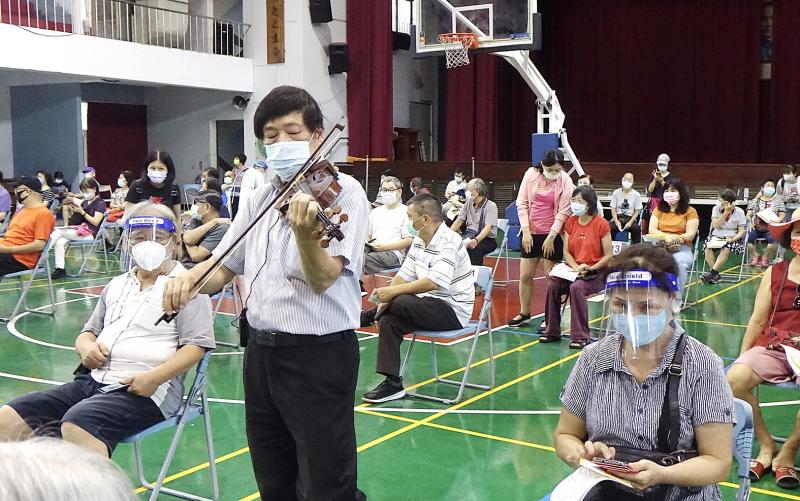
Photo: Liao Huei-tung, Taipei Times
Among cities and counties, the top five were Hsinchu City with 72.15 percent, Pingtung County with 70.99 percent, Changhua County with 63.2 percent, Keelung with 59.08 percent and Chiayi City with 58.1 percent, he said.
The bottom five were Taitung County at 52.43 percent, Yilan County at 51.72 percent, Hsinchu County at 46.61 percent, Hualien County at 46.52 percent and Nantou County at 39.79 percent, he added.
Meanwhile, KMT Chairman Johnny Chiang (江啟臣) said the KMT and the Hualien, Nantou, Taitung and Yunlin county governments are looking to collaborate with a pharmaceutical company to obtain an additional 5 million doses of the Pfizer-BioNTech vaccine.
The move follows a model used by Taiwan Semiconductor Manufacturing Co, the Hon Hai Precision Industry Co-related Yonglin Foundation and the Buddhist Compassion Relief Tzu Chi Foundation.
The three have obtained Executive Yuan approval to procure 5 million doses each of the Pfizer-BioNTech vaccine.
The Executive Yuan on Wednesday said it would not accept additional vaccine procurement applications at this time.
No country would authorize local governments to purchase vaccines, as this would affect the national epidemic prevention policy and the principle of equality, Lo said yesterday.
How the counties intend to fund their efforts to purchase vaccines and whether the vaccines would go to the central government for general distribution or the counties directly are questions that must be answered, he said.
The local vaccine procurement endeavor comes as the KMT chairperson election looms, the DPP said.
DPP caucus director-general Liu Shyh-fang (劉世芳) said that she hoped to see local governments step up the pace of inoculation without sacrificing the quality of medical care, adding that the KMT’s attempt to tie its party chairperson election with the vaccine issue was not a good sign.
The KMT had scheduled its next chairperson election on Saturday next week, but postponed it due to the outbreak, with a new date yet to be announced.

The Centers for Disease Control (CDC) yesterday reported the first case of a new COVID-19 subvariant — BA.3.2 — in a 10-year-old Singaporean girl who had a fever upon arrival in Taiwan and tested positive for the disease. The girl left Taiwan on March 20 and the case did not have a direct impact on the local community, it said. The WHO added the BA.3.2 strain to its list of Variants Under Monitoring in December last year, but this was the first imported case of the COVID-19 variant in Taiwan, CDC Deputy Director-General Lin Ming-cheng (林明誠) said. The girl arrived in Taiwan on

South Korea is planning to revise its controversial electronic arrival card, a step Taiwanese officials said prompted them to hold off on planned retaliatory measures, a South Korean media report said yesterday. A Yonhap News Agency report said that the South Korean Ministry of Foreign Affairs is planning to remove the “previous departure place” and “next destination” fields from its e-arrival card system. The plan, reached after interagency consultations, is under review and aims to simplify entry procedures and align the electronic form with the paper version, a South Korean ministry official said. The fields — which appeared only on the electronic form

A bipartisan group of US senators has introduced a bill to enhance cooperation with Taiwan on drone development and to reduce reliance on supply chains linked to China. The proposed Blue Skies for Taiwan Act of 2026 was introduced by Republican US senators Ted Cruz and John Curtis, and Democratic US senators Jeff Merkley and Andy Kim. The legislation seeks to ease constraints on Taiwan-US cooperation in uncrewed aerial systems (UAS), including dependence on China-sourced components, limited access to capital and regulatory barriers under US export controls, a news release issued by Cruz on Wednesday said. The bill would establish a "Blue UAS

The Ministry of Foreign Affairs (MOFA) is suspending retaliation measures against South Korea that were set to take effect tomorrow, after Seoul said it is updating its e-arrival system, MOFA said today. The measures were to be a new round of retaliation after Taiwan on March 1 changed South Korea's designation on government-issued alien resident certificates held by South Korean nationals to "South Korea” from the "Republic of Korea," the country’s official name. The move came after months of protests to Seoul over its listing of Taiwan as "China (Taiwan)" in dropdown menus on its new online immigration entry system. MOFA last week


 RSS
RSS