


Multiple tropical systems could form in the northwest Pacific Ocean in the next two weeks as a result of a large low-pressure system, the Central Weather Bureau (CWB) said yesterday.
Spanning from the South China Sea to the Pacific Ocean, the low-pressure system became the dominant meteorological force after a Pacific high-pressure system weakened and receded eastward on Wednesday, the bureau said.
“In the next two weeks, Taiwan would be under the influence of the low-pressure system, which could cause multiple tropical systems to form,” bureau forecaster Hsieh Pei-yun (謝佩芸) said.
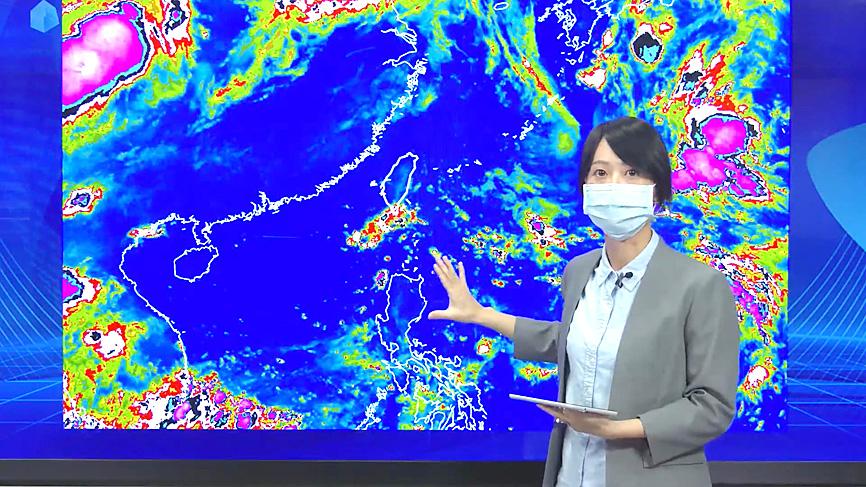
Photo: Chen Hsin-yu, Taipei Times
“Regardless of whether these systems affect Taiwan directly, the low-pressure system would increase humidity on the east coast and cause afternoon thundershowers nationwide,” she said.
From today to Sunday, showers are forecast for the east coast, the Hengchun Peninsula and coastal areas in central and southern Taiwan, the bureau said.
Cloudy skies are forecast for the rest of the nation, with a high chance of heavy to extremely heavy rainfall in the afternoons in central and southern Taiwan, as well as in mountainous areas, it said, adding that people should beware of possible damage caused by short bursts of intense rainfall, thunderstorms and strong winds.
Former CWB Weather Forecast Center director Daniel Wu (吳德榮), who is an adjunct associate professor of atmospheric sciences at National Central University, said that European Center for Medium-Range Weather Forecasts simulations showed that tropical systems have emerged in the South China Sea, off the east coast of the Philippines and near Taiwan.
Meteorologists were divided about how a tropical disturbance east of the Ryukyu Islands would develop next week, Wu said.
The US National Weather Service’s Global Forecast System said that it could be upgraded to a tropical storm by Sunday and would move northwest toward the East China Sea, while the European center forecast that it would spin from the southeast of the Ryukyu Islands before moving northeast away from Taiwan.
“How the system would evolve requires further observation,” Wu added.

The Centers for Disease Control (CDC) yesterday reported the first case of a new COVID-19 subvariant — BA.3.2 — in a 10-year-old Singaporean girl who had a fever upon arrival in Taiwan and tested positive for the disease. The girl left Taiwan on March 20 and the case did not have a direct impact on the local community, it said. The WHO added the BA.3.2 strain to its list of Variants Under Monitoring in December last year, but this was the first imported case of the COVID-19 variant in Taiwan, CDC Deputy Director-General Lin Ming-cheng (林明誠) said. The girl arrived in Taiwan on

South Korea is planning to revise its controversial electronic arrival card, a step Taiwanese officials said prompted them to hold off on planned retaliatory measures, a South Korean media report said yesterday. A Yonhap News Agency report said that the South Korean Ministry of Foreign Affairs is planning to remove the “previous departure place” and “next destination” fields from its e-arrival card system. The plan, reached after interagency consultations, is under review and aims to simplify entry procedures and align the electronic form with the paper version, a South Korean ministry official said. The fields — which appeared only on the electronic form

A bipartisan group of US senators has introduced a bill to enhance cooperation with Taiwan on drone development and to reduce reliance on supply chains linked to China. The proposed Blue Skies for Taiwan Act of 2026 was introduced by Republican US senators Ted Cruz and John Curtis, and Democratic US senators Jeff Merkley and Andy Kim. The legislation seeks to ease constraints on Taiwan-US cooperation in uncrewed aerial systems (UAS), including dependence on China-sourced components, limited access to capital and regulatory barriers under US export controls, a news release issued by Cruz on Wednesday said. The bill would establish a "Blue UAS

The Ministry of Foreign Affairs (MOFA) is suspending retaliation measures against South Korea that were set to take effect tomorrow, after Seoul said it is updating its e-arrival system, MOFA said today. The measures were to be a new round of retaliation after Taiwan on March 1 changed South Korea's designation on government-issued alien resident certificates held by South Korean nationals to "South Korea” from the "Republic of Korea," the country’s official name. The move came after months of protests to Seoul over its listing of Taiwan as "China (Taiwan)" in dropdown menus on its new online immigration entry system. MOFA last week


 RSS
RSS