


Sandra Oudkirk yesterday took over as director of the American Institute in Taiwan (AIT) as the country bid farewell to her predecessor, Brent Christensen, who departed for the US.
Oudkirk was seen arriving at Taiwan Taoyuan International Airport on Monday with a mask bearing the greeting, “Hello Taiwan.”
The AIT in a statement yesterday described Oudkirk as a 30-year veteran of the US Foreign Service with a deep understanding of East Asia and Pacific affairs.
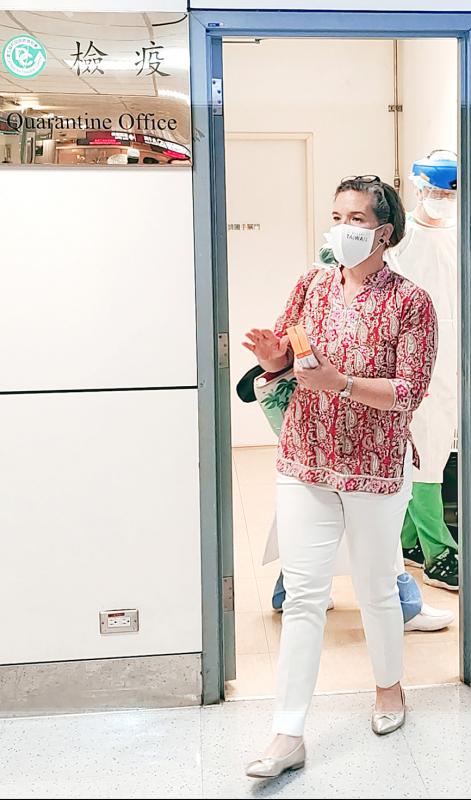
Photo: Tony Yao, Taipei Times
She is expected to start in her new role after completing 14 days of quarantine and seven days of self-health management in accordance with Taiwan’s COVID-19 protocols, the AIT said.
Oudkirk “looks forward to building on the successes of her predecessors and to further advancing the US-Taiwan relationship,” it said.
Christensen, who had been the de facto US representative in Taiwan since 2018, arrived at the airport with Taiwanese officials at about 8:30am.
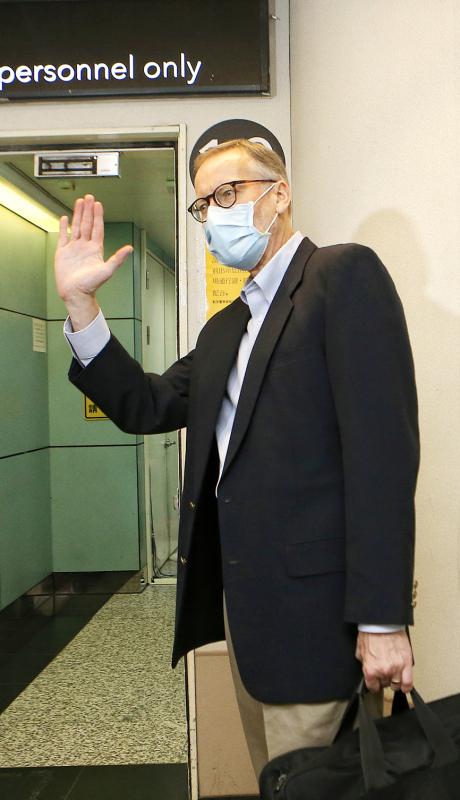
Photo: Tony Yao, Taipei Times
Christensen told reporters that he would “absolutely” return to visit Taiwan.
He was seen waving to reporters as he entered customs to board a US-bound United Airlines flight.
“The first time I left my hometown at age 19, it was to come to Taiwan,” Christensen wrote in a farewell letter released by the AIT on Friday last week.
“From that early age, Taiwan became synonymous for me with the ideas of exchange and understanding, exploration and adventure,” he wrote.
“I may be leaving Taiwan, but Taiwan will never leave me,” he added.
Christensen received a warm send-off from Democratic Progressive Party politicians, who hailed his tenure as a period of significant breakthroughs in Taiwan-US relations.
On June 25, President Tsai Ing-wen (蔡英文) awarded Christensen the Order of the Brilliant Star with Grand Cordon in commendation of his efforts in advancing bilateral relations, including facilitating the delivery of 2.5 million doses of the Moderna COVID-19 vaccine from the US.
Vice President William Lai (賴清德), Kaohsiung Mayor Chen Chi-mai (陳其邁) and Tainan Mayor Huang Wei-che (黃偉哲) also thanked Christensen for his contributions to Taiwan.
When asked about his gift of Aiwen mangoes to Christensen, Huang said the fruit was originally imported from Florida and to him it symbolized the friendship between the two countries.
“I hope Christensen was able to enjoy the sweetness of this famous Tainan produce, to show my thanks for the fruitfulness of the bilateral relationship that has prospered under his watch over the past years,” Huang said.

The Centers for Disease Control (CDC) yesterday reported the first case of a new COVID-19 subvariant — BA.3.2 — in a 10-year-old Singaporean girl who had a fever upon arrival in Taiwan and tested positive for the disease. The girl left Taiwan on March 20 and the case did not have a direct impact on the local community, it said. The WHO added the BA.3.2 strain to its list of Variants Under Monitoring in December last year, but this was the first imported case of the COVID-19 variant in Taiwan, CDC Deputy Director-General Lin Ming-cheng (林明誠) said. The girl arrived in Taiwan on

South Korea is planning to revise its controversial electronic arrival card, a step Taiwanese officials said prompted them to hold off on planned retaliatory measures, a South Korean media report said yesterday. A Yonhap News Agency report said that the South Korean Ministry of Foreign Affairs is planning to remove the “previous departure place” and “next destination” fields from its e-arrival card system. The plan, reached after interagency consultations, is under review and aims to simplify entry procedures and align the electronic form with the paper version, a South Korean ministry official said. The fields — which appeared only on the electronic form

The Ministry of Foreign Affairs (MOFA) is suspending retaliation measures against South Korea that were set to take effect tomorrow, after Seoul said it is updating its e-arrival system, MOFA said today. The measures were to be a new round of retaliation after Taiwan on March 1 changed South Korea's designation on government-issued alien resident certificates held by South Korean nationals to "South Korea” from the "Republic of Korea," the country’s official name. The move came after months of protests to Seoul over its listing of Taiwan as "China (Taiwan)" in dropdown menus on its new online immigration entry system. MOFA last week

A bipartisan group of US senators has introduced a bill to enhance cooperation with Taiwan on drone development and to reduce reliance on supply chains linked to China. The proposed Blue Skies for Taiwan Act of 2026 was introduced by Republican US senators Ted Cruz and John Curtis, and Democratic US senators Jeff Merkley and Andy Kim. The legislation seeks to ease constraints on Taiwan-US cooperation in uncrewed aerial systems (UAS), including dependence on China-sourced components, limited access to capital and regulatory barriers under US export controls, a news release issued by Cruz on Wednesday said. The bill would establish a "Blue UAS


 RSS
RSS