


Scientific data suggest that a gradual lifting of a nationwide level 3 COVID-19 alert can be considered, National Taiwan University College of Public Health professor Tony Chen (陳秀熙) said yesterday.
The nation has been under the level 3 alert since May 19.
With the nation’s daily number of local infections dropping, a case can be made for downgrading the level 3 alert, Chen told an online news conference on YouTube with other faculty members.
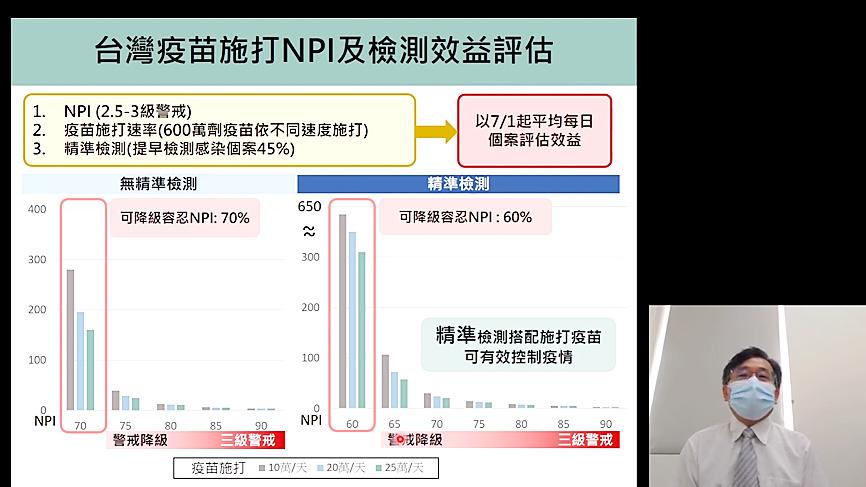
Photo: Screen grab from YouTube
Despite the prevalence of SARS-CoV-2 variants across the globe, increased vaccination rates have curbed the number of new infections and deaths, as observed in Europe and the Americas, he said, adding that Taiwan’s inoculation rate is expected to reach 20 percent by the end of this month as it receives more vaccines.
It has been one month since the nation’s effective reproduction number, or Rt, has dropped below one, Chen said.
A cluster infection caused by the Delta variant of SARS-CoV-2 in Pingtung County has been stopped from spreading to other municipalities, while other cluster infections have also been kept under control, he said.
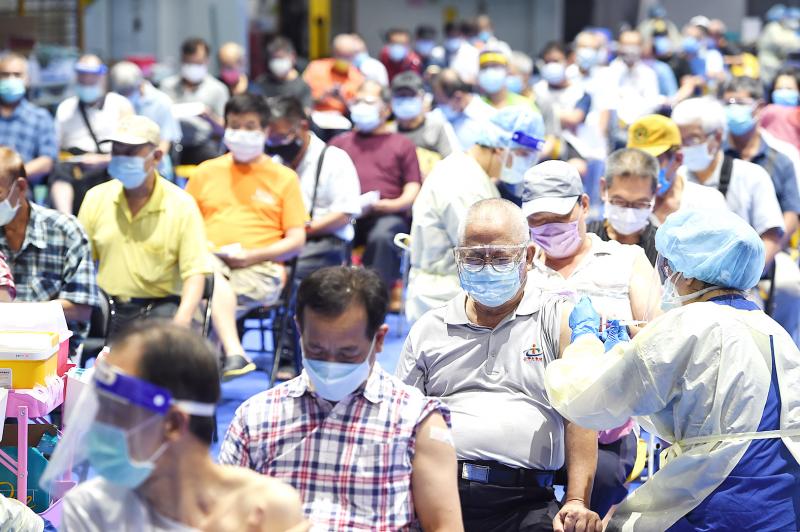
Photo: Liu Hsin-de, Taipei Times
As people arriving from abroad are required to undergo three COVID-19 tests — upon arrival, during quarantine and upon ending quarantine — this strategy can curb virus transmission from abroad, he added.
The college in late May introduced an index for evaluating whether the level 3 alert should be eased, he said.
The index is based on the following formula: the number of confirmed cases divided by the number of recovered cases, with the quotient multiplied by one minus the nation’s COVID-19 death rate, and the product minus one to arrive at the final figure.
The government can consider lowering the alert level when the index falls below 0.5, he said, adding that the index is now at 0.32.
Chen also assessed the effectiveness of nonpharmaceutical intervention (NPI) measures, such as wearing masks and social distancing, as well as vaccination and virus testing rates.
If the government continues to boost COVID-19 vaccination rates while promoting high-precision virus tests, the alert level can be downgraded, he said.
However, Chen said his team is opposed to promoting universal screening on local communities.
The government should categorize public facilities based on their virus transmission risks, he said.
When proper NPI measures are in place, only employees of public facilities should undergo regular high-precision virus tests, but when there are no NPI measures, both employees and visitors should undergo tests, he said.
Minister of Health and Welfare Chen Shih-chung (陳時中), who heads the Central Epidemic Command Center, said later yesterday that there are many ways to calculate the Rt value, adding that based on the center’s calculations, the Rt number has dropped below 1 for a few weeks, and is currently at 0.69.
Additional reporting by Lee I-chia

Considering that most countries issue more than five denominations of banknotes, the central bank has decided to redesign all five denominations, the bank said as it prepares for the first major overhaul of the banknotes in more than 24 years. Central bank Governor Yang Chin-lung (楊金龍) is expected to report to the Legislative Yuan today on the bank’s operations and the redesign’s progress. The bank in a report sent to the legislature ahead of today’s meeting said it had commissioned a survey on the public’s preferences. Survey results showed that NT$100 and NT$1,000 banknotes are the most commonly used, while NT$200 and NT$2,000

The Centers for Disease Control (CDC) yesterday reported the first case of a new COVID-19 subvariant — BA.3.2 — in a 10-year-old Singaporean girl who had a fever upon arrival in Taiwan and tested positive for the disease. The girl left Taiwan on March 20 and the case did not have a direct impact on the local community, it said. The WHO added the BA.3.2 strain to its list of Variants Under Monitoring in December last year, but this was the first imported case of the COVID-19 variant in Taiwan, CDC Deputy Director-General Lin Ming-cheng (林明誠) said. The girl arrived in Taiwan on

South Korea is planning to revise its controversial electronic arrival card, a step Taiwanese officials said prompted them to hold off on planned retaliatory measures, a South Korean media report said yesterday. A Yonhap News Agency report said that the South Korean Ministry of Foreign Affairs is planning to remove the “previous departure place” and “next destination” fields from its e-arrival card system. The plan, reached after interagency consultations, is under review and aims to simplify entry procedures and align the electronic form with the paper version, a South Korean ministry official said. The fields — which appeared only on the electronic form

The Ministry of Foreign Affairs (MOFA) is suspending retaliation measures against South Korea that were set to take effect tomorrow, after Seoul said it is updating its e-arrival system, MOFA said today. The measures were to be a new round of retaliation after Taiwan on March 1 changed South Korea's designation on government-issued alien resident certificates held by South Korean nationals to "South Korea” from the "Republic of Korea," the country’s official name. The move came after months of protests to Seoul over its listing of Taiwan as "China (Taiwan)" in dropdown menus on its new online immigration entry system. MOFA last week


 RSS
RSS