


Supply chain resilience must be boosted for the semiconductor and other industries, representatives said at a virtual forum on tech supply chain partnerships yesterday, which was attended by delegations from the EU, the US and Japan.
More than 700 people signed up for the event, including government, academic and industrial representatives, said the European Economic and Trade Office in Taiwan (EETO), which coorganized the event.
The global supply chain was established to maximize production and supply efficiency, but that ideal has been challenged amid the COVID-19 pandemic, EETO Head of Office Filip Grzegorzewski said in opening remarks.
The EU hopes to increase the proportion it contributes to global semiconductor production, especially in advanced manufacturing technology of 5 nanometer chips or smaller, an area in which Taiwan plays a dominant role, Grzegorzewski said.
While the EU maintains strategic partnerships in its international trade ties, it aims to improve its autonomy of production in strategic industries and work with reliable partners to achieve the goal, he said.
American Institute in Taiwan Director Brent Christensen said that the pandemic has made it even more clear how important Taiwan is to the world economy.
“From the silicon wafers to the semiconductors to the installed components in the latest consumer electronics, Taiwan is truly the central node for global trade in ICT [information and communications technology] products. And Taiwan’s semiconductor industry is the envy of the world,” Christensen said.
“Whether as a provider of trusted medical equipment or as a supplier of semiconductors for automotive assembly lines, Taiwan is an indispensable partner,” he said.
US Department of State Bureau of Economic and Business Affairs Deputy Assistant Secretary Matt Murray joined the forum, showing the importance that Washington places on Taiwan’s role as a critical economic and security partner, Christensen said.
Japan-Taiwan Exchange Association Chief Deputy Representative Mitsuaki Hoshino said that diversification of the production of strategic goods is a national security issue.
For example, in the automotive industry, the US, Japan and Europe have asked Taiwan to supply more chips, placing it under the spotlight, Hoshino said.
However, overcentralization of some goods can pose a national security risk, so Japan this month launched a new strategy to bolster its supply and technical management of semiconductors from different sources, he said, adding that Japan would work with Taiwan, the US and Europe to achieve its goals.
Minister of Economic Affairs Wang Mei-hua (王美花) thanked Japan and the US for donating millions of vaccines to Taiwan, and Europe for sharing vaccines through the COVAX global vaccine sharing program.
A local COVID-19 outbreak has stabilized, while cluster infections at electronics plants in Miaoli County’s Jhunan Township (竹南) have been brought under control, preventing further effects on the global semiconductor supply chain, Wang said.
There are several areas of collaboration Taiwan has with the US, Japan and Europe, ranging from semiconductor research and development and smart manufacturing to offshore wind farm energy, she said, adding that the nation would bolster supply chain security with its partners.

FUKUOKA SITUATION: Japanese media reported that the pathogen is expected to be identified by the summer, while the CDC downplayed the idea that it was hMPV A “mysterious cold-like illness” reported in Japan’s Fukuoka Prefecture does not seem to be a new disease, but Japanese authorities have been asked about the situation, the Centers for Disease Control (CDC) said yesterday. The Fukuoka Prefectural Medical Association on Wednesday told a news conference that a “mystery cold” that has become a hot topic on social media is “highly likely to be caused by some kind of viral infection,” Japan’s KBC News reported. “Many people are experiencing symptoms starting with a sore throat, followed by a runny nose, phlegm and a severe cough,” KBC News reported, citing association officials. Health authorities are

Nvidia Corp CEO Jensen Huang (黃仁勳) arrived in Taiwan yesterday ahead of upcoming AI and technology events, saying he plans to meet with clients and Taiwan Semiconductor Manufacturing Co Chairman C.C. Wei (魏哲家) during his visit. After landing at Taipei Songshan Airport, Huang posed for photos with fans and handed out Yakult drinks to reporters and supporters waiting at the scene, saying he has “a lot to do” during the trip. Asked about reports that Nvidia’s planned headquarters site in Taipei’s Beitou Shilin Technology Park could break ground on May 27, Huang said that if the company holds an event, he would

Carrefour Taiwan is to begin using a new name from the start of July, but it cannot divulge the name until then, the chairman of the supermarket chain's parent company said today. President Chain Store Co chairman Lo Chih-hsien (羅智先) was asked by reporters after a shareholders' meeting to confirm whether the company has settled on a new name for the supermarket brand. In March, the government-registered name of two Carrefour Taiwan branches was quietly changed to "Le Chia Kang" (樂家康) in Chinese, raising speculation that has been selected as the name. Lo said that because of local regulations and contractual obligations, the
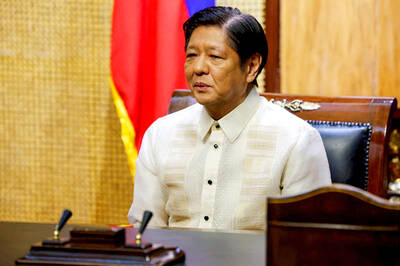
The Philippines would likely be involved in any conflict over Taiwan due to its proximity to the democracy claimed by China, President Ferdinand Marcos Jr said, reiterating a stance that risks angering Beijing. “In the Philippines, we do not have a choice because Taiwan is so close to the Philippines and we have almost 200,000 Filipino nationals living and working in Taiwan,” Marcos said in an interview with Japanese media in Manila on Monday. The Philippine leader’s comments come ahead of a state visit to Japan next week, where he is to meet with Japanese Prime Minister Sanae Takaichi to discuss security


 RSS
RSS