


The Ministry of Foreign Affairs yesterday welcomed a US pledge to donate 750,000 COVID-19 vaccines to Taiwan, saying it sends a strong and clear message of support for the nation.
The size of the pledge was confirmed during a brief visit yesterday morning by US senators Tammy Duckworth, Dan Sullivan and Christopher Coons, and is part of Washington’s plan to share at least 80 million vaccine doses globally by the end of the month.
Taiwan is the first country for which the US has officially announced the specific number of vaccine doses it would receive after saying it would share its vaccine reserve, the ministry said in a statement.
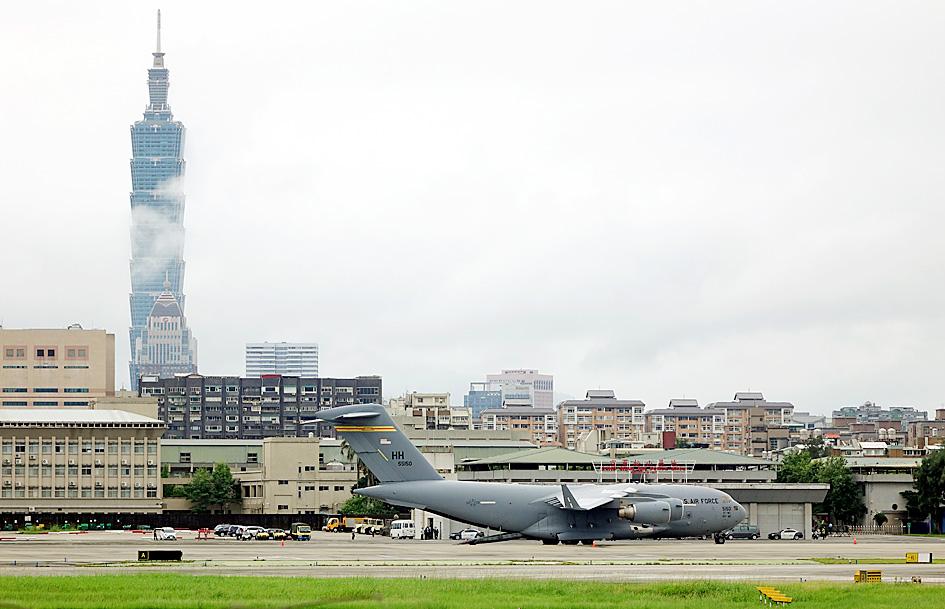
Photo: Lin Cheng-kun, Taipei Times
The White House on Thursday said that of the first 25 million vaccine doses, 19 million would be distributed through the COVAX program. Of those, 7 million doses would go to Asia, including Taiwan, Afghanistan, Bangladesh, India, Indonesia, Laos, Malaysia, the Maldives, Nepal, the Pacific Islands, Pakistan, Papua New Guinea, the Philippines, Sri Lanka, Thailand and Vietnam.
The White House statement did not specify how many doses each country would receive or when they would be delivered.
In response to yesterday’s announcement, the Democratic Progressive Party (DPP) and the Chinese Nationalist Party (KMT) expressed gratitude for the US support amid a surge in COVID-19 cases in Taiwan.
DPP Legislator Wang Ting-yu (王定宇) said that donations from the US and Japan have shown that democratic countries stand by Taiwan, as pressure from Beijing has made it difficult for Taipei to buy vaccines.
Japan donated 1.24 million doses of the AstraZeneca vaccine, which arrived on Friday.
“We hope that, if possible, could there be more?” KMT Chairman Johnny Chiang (江啟臣) asked during a Facebook livestream.
“This is also what President Tsai Ing-wen (蔡英文) should strive for at this stage,” he said, adding that even with Japan’s donation and the 860,000 doses the government has already received through other channels, Taiwan still has less than one-10th of the 30 million doses it needs to achieve herd immunity.
Lin Wen-cheng (林文程), a professor at the Institute of China and Asia-Pacific Studies at National Sun Yat-sen University, said that the donations are meant to counter Beijing’s “vaccine diplomacy,” which is aimed at expanding its influence in the Asia-Pacific region and divide Taiwan.
Wang said it was significant that the US senators arrived in Taiwan aboard a US Air Force C-17 Globemaster III freighter.
The use of the C-17, which transported the US senators to the Maldives, Japan and South Korea before arriving in Taiwan, is significant in strategic and defense terms because it links all important US allies in the region, Wang said.
Lin Ying-yu (林穎佑), an assistant professor at National Chung Cheng University, said the US’ use of a military aircraft was a way for Washington to showcase its emergency military transport and ability to land at a Taiwanese airport in times of need.
Additional reporting by Sherry Hsiao

The Centers for Disease Control (CDC) yesterday reported the first case of a new COVID-19 subvariant — BA.3.2 — in a 10-year-old Singaporean girl who had a fever upon arrival in Taiwan and tested positive for the disease. The girl left Taiwan on March 20 and the case did not have a direct impact on the local community, it said. The WHO added the BA.3.2 strain to its list of Variants Under Monitoring in December last year, but this was the first imported case of the COVID-19 variant in Taiwan, CDC Deputy Director-General Lin Ming-cheng (林明誠) said. The girl arrived in Taiwan on

South Korea is planning to revise its controversial electronic arrival card, a step Taiwanese officials said prompted them to hold off on planned retaliatory measures, a South Korean media report said yesterday. A Yonhap News Agency report said that the South Korean Ministry of Foreign Affairs is planning to remove the “previous departure place” and “next destination” fields from its e-arrival card system. The plan, reached after interagency consultations, is under review and aims to simplify entry procedures and align the electronic form with the paper version, a South Korean ministry official said. The fields — which appeared only on the electronic form
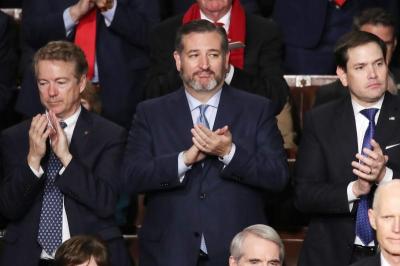
A bipartisan group of US senators has introduced a bill to enhance cooperation with Taiwan on drone development and to reduce reliance on supply chains linked to China. The proposed Blue Skies for Taiwan Act of 2026 was introduced by Republican US senators Ted Cruz and John Curtis, and Democratic US senators Jeff Merkley and Andy Kim. The legislation seeks to ease constraints on Taiwan-US cooperation in uncrewed aerial systems (UAS), including dependence on China-sourced components, limited access to capital and regulatory barriers under US export controls, a news release issued by Cruz on Wednesday said. The bill would establish a "Blue UAS

The Ministry of Foreign Affairs (MOFA) is suspending retaliation measures against South Korea that were set to take effect tomorrow, after Seoul said it is updating its e-arrival system, MOFA said today. The measures were to be a new round of retaliation after Taiwan on March 1 changed South Korea's designation on government-issued alien resident certificates held by South Korean nationals to "South Korea” from the "Republic of Korea," the country’s official name. The move came after months of protests to Seoul over its listing of Taiwan as "China (Taiwan)" in dropdown menus on its new online immigration entry system. MOFA last week


 RSS
RSS