


The Democratic Progressive Party (DPP) caucus yesterday condemned a knife attack that injured three nurses at a New Taipei City hospital by a COVID-19 patient on Monday, while vowing to support amendments proposed by the Ministry of Health and Welfare to provide financial compensation to medical personnel in such cases.
Shung Ho Hospital vice president Cherng Yih-giun (程毅君) on Wednesday said that a nurse was cut in her belly, another was stabbed in the back and a third was wounded on her right palm.
The nurses, all in their 20s, were also traumatized, Cherng said, adding that the hospital would improve security.
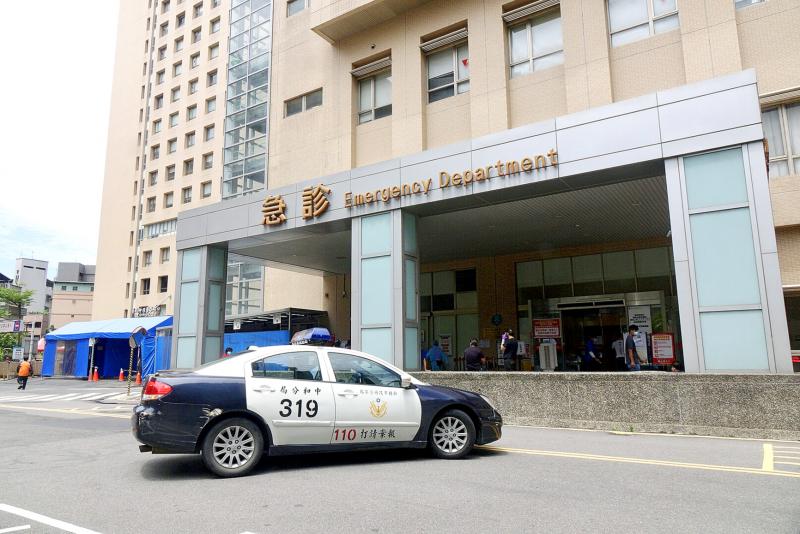
Photo: Peter Lo, Taipei Times
The alleged assailant, a 62-year-old man surnamed Hung (洪), was transferred to the Armed Forces Hospital in Hsinchu City.
People were disheartened by the attack, DPP caucus director-general Liu Shyh-fang (劉世芳) told a news conference in Taipei.
“These medical professionals are on the front lines, working diligently to contain the pandemic. They need better protection and deserve financial compensation for being attacked and injured in the line of duty,” Liu said.
DPP legislators fully support the ministry’s proposed amendments, and would pass special budget items required for them, Liu said.
After the attack, ministry officials introduced amendments to the Communicable Disease Control Act (傳染病防治法) to provide compensation for health workers who are injured, contract an illness or die while implementing disease control measures related to category 5 communicable diseases.
The proposals would provide financial compensation to health workers injured on the job, including paying their wages while undergoing treatment or during recuperation.
Article 74 of the act provides the basis for such compensation, DPP Legislator Huang Shih-chieh (黃世杰) said.
“In reacting to the extreme case of violence against three nurses, ministry officials are working on amendments to reinforce the protection of healthcare workers, and to provide more coverage for compensating them for medical expenditures and lost wages, along with providing subsidies for their children’s education costs,” Huang said.
The legislature in 2017 amended the Medical Care Act (醫療法) to impose more severe punishments for people who use violence, coercion or intimidation to cause serious injury to medical personnel, he said.
“This attack against these nurses is now under judicial investigation, and we request that it be completed as soon as possible,” he added.
A special division under the Ministry of Justice has been tasked to handle violence cases against medical personnel, and has already assigned a prosecutor to the New Taipei City case, while the National Police Agency has ordered police across the nation to enhance local patrols, Liu said.
“Police offices are mandated to be ready to swiftly respond to emergency calls. We must not permit violence to spread, to undermine our society’s safety net, held together by medical personnel,” Liu said.
Additional reporting by CNA


South Korea is planning to revise its controversial electronic arrival card, a step Taiwanese officials said prompted them to hold off on planned retaliatory measures, a South Korean media report said yesterday. A Yonhap News Agency report said that the South Korean Ministry of Foreign Affairs is planning to remove the “previous departure place” and “next destination” fields from its e-arrival card system. The plan, reached after interagency consultations, is under review and aims to simplify entry procedures and align the electronic form with the paper version, a South Korean ministry official said. The fields — which appeared only on the electronic form
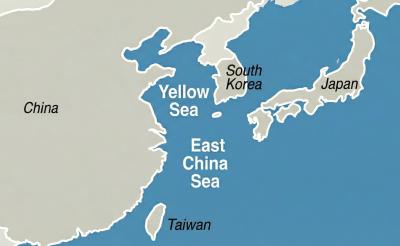
China has reserved offshore airspace in the Yellow Sea and East China Sea from March 27 to May 6, issuing alerts usually used to warn of military exercises, although no such exercises have been announced, the Wall Street Journal (WSJ) reported yesterday. Reserving such a large area for 40 days without explanation is an “unusual step,” as military exercises normally only last a few days, the paper said. These alerts, known as Notice to Air Missions (Notams), “are intended to inform pilots and aviation authorities of temporary airspace hazards or restrictions,” the article said. The airspace reserved in the alert is

A bipartisan group of US senators has introduced a bill to enhance cooperation with Taiwan on drone development and to reduce reliance on supply chains linked to China. The proposed Blue Skies for Taiwan Act of 2026 was introduced by Republican US senators Ted Cruz and John Curtis, and Democratic US senators Jeff Merkley and Andy Kim. The legislation seeks to ease constraints on Taiwan-US cooperation in uncrewed aerial systems (UAS), including dependence on China-sourced components, limited access to capital and regulatory barriers under US export controls, a news release issued by Cruz on Wednesday said. The bill would establish a "Blue UAS

More than 6,000 Taiwanese students have participated in exchange programs in China over the past two years, despite the Mainland Affairs Council’s (MAC) “orange light” travel advisory, government records showed. The MAC’s publicly available registry showed that Taiwanese college and university students who went on exchange programs across the Strait numbered 3,592 and 2,966 people respectively. The National Immigration Agency data revealed that 2,296 and 2,551 Chinese students visited Taiwan for study in the same two years. A review of the Web sites of publicly-run universities and colleges showed that Taiwanese higher education institutions continued to recruit students for Chinese educational programs without


 RSS
RSS