


The Central Epidemic Command Center (CECC) is considering advising hemodialysis centers, especially in Taipei and New Taipei City, to perform regular COVID-19 testing on their patients, it said yesterday, amid concerns about cluster infections at similar facilities with senior patients.
The frequency of the testing would be about once every one to two weeks, Centers for Disease Control (CDC) Deputy Director-General Philip Lo (羅一鈞), who is deputy head of the CECC’s medical response division, said at the center’s daily briefing in Taipei.
The CECC also wants special “buffer zones” or waiting areas to be designed to prevent people who are accompanying patients to their hemodialysis appointments from entering the treatment area and risking cross-infections, he said.
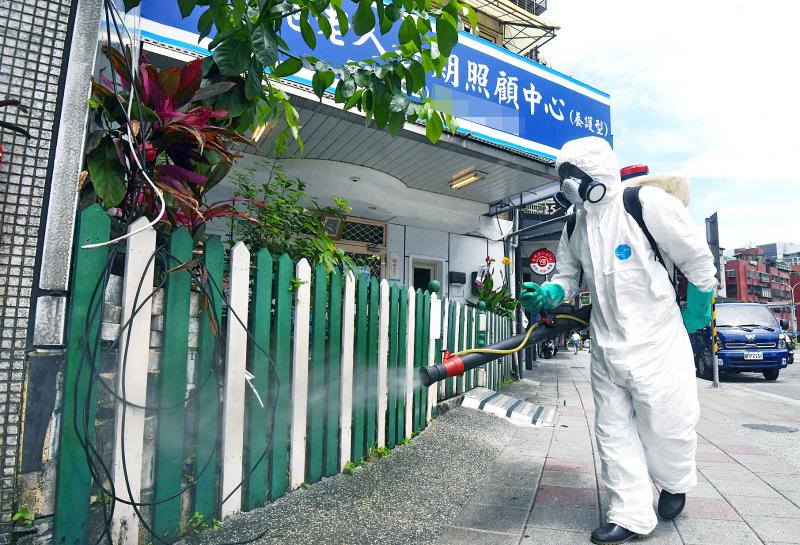
Photo: Liao Chen-huei, Taipei Times
Experts have discussed recommending that hemodialysis patients in Taipei and New Taipei City undergo a rapid COVID-19 test once a week, CECC expert advisory panel convener Chang Shan-chwen (張上淳) said.
They have finished discussing the relevant procedures and are waiting for the proposal to be approved, he said.
If someone must accompany the patient into a center because the patient requires assistance, the other person should also be tested, he said.
However, patients with independent mobility would be advised against having someone accompany them to the clinics, he said.
Meanwhile, 180 people — including 47 staff members and 133 others — at various health and welfare facilities across the nation have been confirmed to have COVID-19, Lo said.
The cases are spread across 60 residential and nonresidential facilities, including 37 long-term care facilities, five nursing facilities, three psychiatric care or rehabilitation facilities and 15 social welfare facilities, he said.
Asked whether the CECC would consider raising the nationwide COVID-19 alert to level 4, Minister of Health and Welfare Chen Shih-chung (陳時中), who heads the center, said he believed it was too early to discuss the move.
Imposing overly strict social restrictions might cause public fatigue to start too soon, and affect overall economic activity, he said, but added that the CECC would continue to discuss the alert level with experts.
A nationwide level 3 COVID-19 alert started on May 19 is in effect until June 14.
On Wednesday, a total of 56,157 doses of COVID-19 vaccines were administered, said CDC Deputy Director-General Chuang Jen-hsiang (莊人祥), who is the CECC’s spokesman.
As of Wednesday, 562,029 vaccine doses have been given since the nation began vaccinating people against the virus on March 22, center data showed.

The Centers for Disease Control (CDC) yesterday reported the first case of a new COVID-19 subvariant — BA.3.2 — in a 10-year-old Singaporean girl who had a fever upon arrival in Taiwan and tested positive for the disease. The girl left Taiwan on March 20 and the case did not have a direct impact on the local community, it said. The WHO added the BA.3.2 strain to its list of Variants Under Monitoring in December last year, but this was the first imported case of the COVID-19 variant in Taiwan, CDC Deputy Director-General Lin Ming-cheng (林明誠) said. The girl arrived in Taiwan on

South Korea is planning to revise its controversial electronic arrival card, a step Taiwanese officials said prompted them to hold off on planned retaliatory measures, a South Korean media report said yesterday. A Yonhap News Agency report said that the South Korean Ministry of Foreign Affairs is planning to remove the “previous departure place” and “next destination” fields from its e-arrival card system. The plan, reached after interagency consultations, is under review and aims to simplify entry procedures and align the electronic form with the paper version, a South Korean ministry official said. The fields — which appeared only on the electronic form

A bipartisan group of US senators has introduced a bill to enhance cooperation with Taiwan on drone development and to reduce reliance on supply chains linked to China. The proposed Blue Skies for Taiwan Act of 2026 was introduced by Republican US senators Ted Cruz and John Curtis, and Democratic US senators Jeff Merkley and Andy Kim. The legislation seeks to ease constraints on Taiwan-US cooperation in uncrewed aerial systems (UAS), including dependence on China-sourced components, limited access to capital and regulatory barriers under US export controls, a news release issued by Cruz on Wednesday said. The bill would establish a "Blue UAS

The Ministry of Foreign Affairs (MOFA) is suspending retaliation measures against South Korea that were set to take effect tomorrow, after Seoul said it is updating its e-arrival system, MOFA said today. The measures were to be a new round of retaliation after Taiwan on March 1 changed South Korea's designation on government-issued alien resident certificates held by South Korean nationals to "South Korea” from the "Republic of Korea," the country’s official name. The move came after months of protests to Seoul over its listing of Taiwan as "China (Taiwan)" in dropdown menus on its new online immigration entry system. MOFA last week


 RSS
RSS