


Heavy rainfall over the past few days has eased Taiwan’s water shortage that led to rationing, but Premier Su Tseng-chang (蘇貞昌) on Tuesday said that alerts are still in effect and urged the public to continue conserving water.
A weather front that arrived in Taiwan late last week ended a long dry spell that had persisted for many months, including for most of last month, which is normally when the seasonal plum rains arrive.
The front brought thundershowers to most parts of the nation, especially in the afternoon, providing some respite to reservoirs.
As a result, water authorities have held off on a plan that was supposed to take effect on Tuesday to extend water rationing for an additional eight hours in Taichung and other areas, where households have been without water two days per week since April.
At the same time, a plan to expand rotating water rationing measures in Hsinchu has also been dropped, and the situation in Tainan and Kaohsiung has become less strained, Su wrote on Facebook.
However, because of the lack of rain for many months, the government will not be able to cancel the alert any time soon, Su wrote, calling on the public to cut down on water consumption.
The Water Resources Agency (WRA) has described the shortage, which affected central and southern Taiwan the most, as the worst in more than half a century.
The rainfall from Friday last week to Tuesday allowed reservoirs across Taiwan to accumulate about 136 million cubic meters of water, WRA Deputy Director-General Wang Yi-feng (王藝峰) said on Tuesday, an amount equal to 10 days supply for the nation.
Reservoirs in central Taiwan, including those in Taichung and Nantou County, benefited the most, collecting 71.9 million cubic meters of water, or 53 percent of the total, the WRA said.
Among all the reservoirs, the Shihmen Reservoir (石門水庫) in Taoyuan’s Dasi District (大溪), which supplies most of the water to Taoyuan and surrounding areas, benefited the most, collecting 17.6 million cubic meters of water over the past four days, the WRA said.
Even with the heavy rainfall, most reservoirs still have low reserves relative to their capacities.
As of noon yesterday, Shihmen Reservoir was filled to only 15.8 percent of capacity, while Techi Reservoir (德基水庫) in Taichung’s Heping District (和平), the biggest in central Taiwan and the main source of water in the municipality, was at only 6.2 percent of capacity as of 7am, WRA data showed.
Tsou Han-kuei (鄒漢貴), an official from the WRA’s Southern Region Water Resources Office, said that the recent rainfall would bring Tainan’s reservoirs about 13 million cubic meters of water, enough to supply Tainan for two weeks.
Nonetheless, two of southern Taiwan’s biggest reservoirs — Zengwen Reservoir (曾文水庫) in Chiayi County’s Dapu Township (大埔) and Nanhua Reservoir (南化水庫) in Tainan’s Nanhua District — were at only 4.49 percent and 14.8 percent of capacity respectively.
The water supply in Chiayi County and Tainan has been on an “orange” alert, signaling that household and industrial consumers should reduce their water consumption.
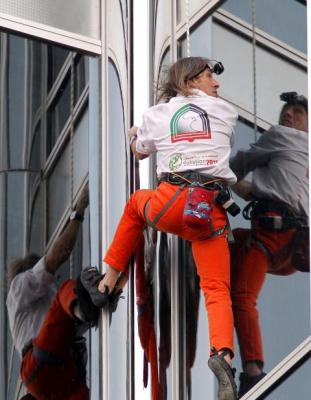
Alain Robert, known as the "French Spider-Man," praised Alex Honnold as exceptionally well-prepared after the US climber completed a free solo ascent of Taipei 101 yesterday. Robert said Honnold's ascent of the 508m-tall skyscraper in just more than one-and-a-half hours without using safety ropes or equipment was a remarkable achievement. "This is my life," he said in an interview conducted in French, adding that he liked the feeling of being "on the edge of danger." The 63-year-old Frenchman climbed Taipei 101 using ropes in December 2004, taking about four hours to reach the top. On a one-to-10 scale of difficulty, Robert said Taipei 101
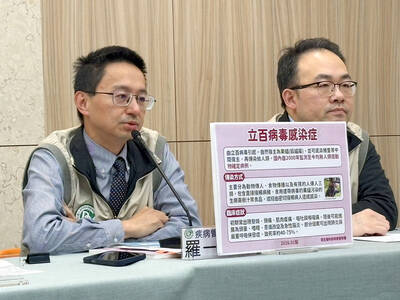
Nipah virus infection is to be officially listed as a category 5 notifiable infectious disease in Taiwan in March, while clinical treatment guidelines are being formulated, the Centers for Disease Control (CDC) said yesterday. With Nipah infections being reported in other countries and considering its relatively high fatality rate, the centers on Jan. 16 announced that it would be listed as a notifiable infectious disease to bolster the nation’s systematic early warning system and increase public awareness, the CDC said. Bangladesh reported four fatal cases last year in separate districts, with three linked to raw date palm sap consumption, CDC Epidemic Intelligence
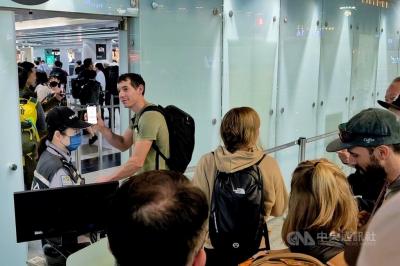
US climber Alex Honnold left Taiwan this morning a day after completing a free-solo ascent of Taipei 101, a feat that drew cheers from onlookers and gained widespread international attention. Honnold yesterday scaled the 101-story skyscraper without a rope or safety harness. The climb — the highest urban free-solo ascent ever attempted — took just more than 90 minutes and was streamed live on Netflix. It was covered by major international news outlets including CNN, the New York Times, the Guardian and the Wall Street Journal. As Honnold prepared to leave Taiwan today, he attracted a crowd when he and his wife, Sanni,

Taiwanese and US defense groups are collaborating to introduce deployable, semi-autonomous manufacturing systems for drones and components in a boost to the nation’s supply chain resilience. Taiwan’s G-Tech Optroelectronics Corp subsidiary GTOC and the US’ Aerkomm Inc on Friday announced an agreement with fellow US-based Firestorm Lab to adopt the latter’s xCell, a technology featuring 3D printers fitted in 6.1m container units. The systems enable aerial platforms and parts to be produced in high volumes from dispersed nodes capable of rapid redeployment, to minimize the risk of enemy strikes and to meet field requirements, they said. Firestorm chief technology officer Ian Muceus said


 RSS
RSS