


Taoyuan Mayor Cheng Wen-tsan (鄭文燦) yesterday said that all beauty salons in the city must close from Friday to Thursday next week or face a fine, in the latest restriction imposed by the city to contain the spread of COVID-19.
The call came after Taoyuan recorded 29 locally transmitted COVID-19 cases on Monday, bringing the total number of confirmed cases in the city to 475.
The city has the third-highest number of confirmed cases in Taiwan, following New Taipei City and Taipei.
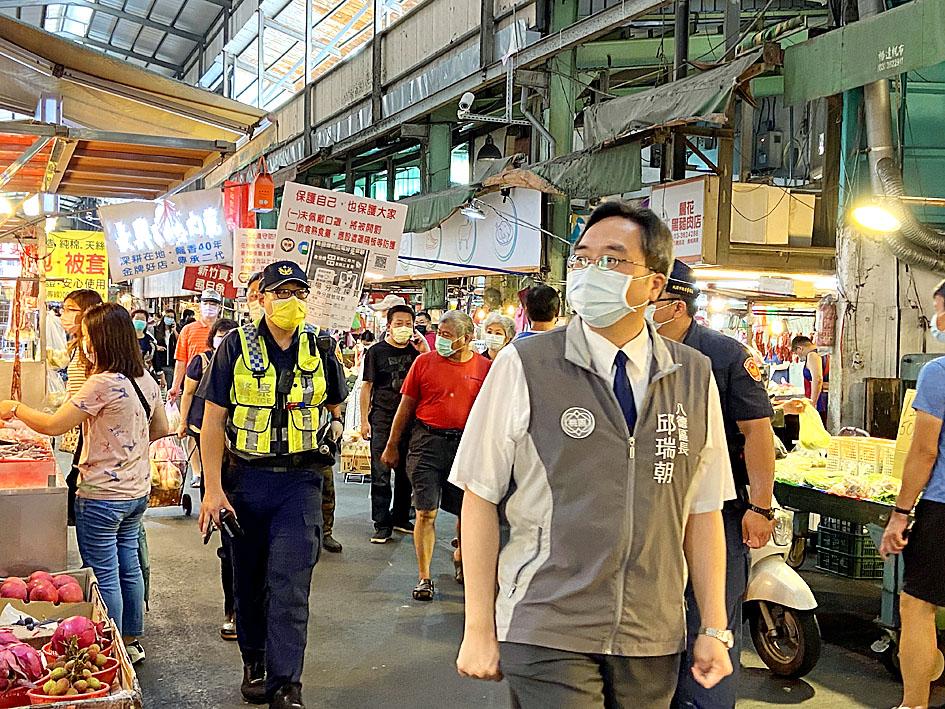
Photo copied by Chen En-hui, Taipei Times
Taoyuan is the first municipality to order the closure of beauty salons, which Cheng described as establishments that provide hairdressing, and nail and eyelash treatments.
There is a three-day grace period from yesterday through tomorrow before the policy takes effect on Friday.
Violators would face a fine of NT$3,000 to NT$15,000, Cheng said.
He also said that the number of COVID-19 screening sites in the city would be expanded from 14 to 18 — 11 at hospitals and seven in communities.
All of the stations provide polymerase chain reaction tests and can process a combined 5,200 samples per day, he said.
The city is planning to set up at least two large vaccination sites and some smaller sites once the central government has received more vaccines and is ready to launch a large-scale rollout, he added.
The Taoyuan City Government has also urged city residents to follow a voluntary ID number-based rotation system to reduce crowding at traditional markets.
The markets have been identified as hotspots for virus transmission because of their cramped conditions and poor ventilation.
Under the rotation system, people whose ID numbers end with an even digit are advised to limit visits to traditional markets to Tuesdays, Thursdays and Saturdays, while those with an odd number in the last digit of their ID cards should visit on Wednesdays, Fridays and Sundays.

The Centers for Disease Control (CDC) yesterday reported the first case of a new COVID-19 subvariant — BA.3.2 — in a 10-year-old Singaporean girl who had a fever upon arrival in Taiwan and tested positive for the disease. The girl left Taiwan on March 20 and the case did not have a direct impact on the local community, it said. The WHO added the BA.3.2 strain to its list of Variants Under Monitoring in December last year, but this was the first imported case of the COVID-19 variant in Taiwan, CDC Deputy Director-General Lin Ming-cheng (林明誠) said. The girl arrived in Taiwan on

South Korea is planning to revise its controversial electronic arrival card, a step Taiwanese officials said prompted them to hold off on planned retaliatory measures, a South Korean media report said yesterday. A Yonhap News Agency report said that the South Korean Ministry of Foreign Affairs is planning to remove the “previous departure place” and “next destination” fields from its e-arrival card system. The plan, reached after interagency consultations, is under review and aims to simplify entry procedures and align the electronic form with the paper version, a South Korean ministry official said. The fields — which appeared only on the electronic form

A bipartisan group of US senators has introduced a bill to enhance cooperation with Taiwan on drone development and to reduce reliance on supply chains linked to China. The proposed Blue Skies for Taiwan Act of 2026 was introduced by Republican US senators Ted Cruz and John Curtis, and Democratic US senators Jeff Merkley and Andy Kim. The legislation seeks to ease constraints on Taiwan-US cooperation in uncrewed aerial systems (UAS), including dependence on China-sourced components, limited access to capital and regulatory barriers under US export controls, a news release issued by Cruz on Wednesday said. The bill would establish a "Blue UAS

The Ministry of Foreign Affairs (MOFA) is suspending retaliation measures against South Korea that were set to take effect tomorrow, after Seoul said it is updating its e-arrival system, MOFA said today. The measures were to be a new round of retaliation after Taiwan on March 1 changed South Korea's designation on government-issued alien resident certificates held by South Korean nationals to "South Korea” from the "Republic of Korea," the country’s official name. The move came after months of protests to Seoul over its listing of Taiwan as "China (Taiwan)" in dropdown menus on its new online immigration entry system. MOFA last week


 RSS
RSS