

Facing Taiwan’s largest COVID-19 outbreak since the pandemic began and looking for rapid virus test kits, Taipei Mayor Ko Wen-je (柯文哲) did what anyone might do: He searched for it online.
“If you don’t know, and you try to know something, please check Google,” Ko told reporters.
Praised for its success at keeping COVID-19 at bay for more than a year, the nation had until last month recorded just 1,128 cases and 12 deaths.
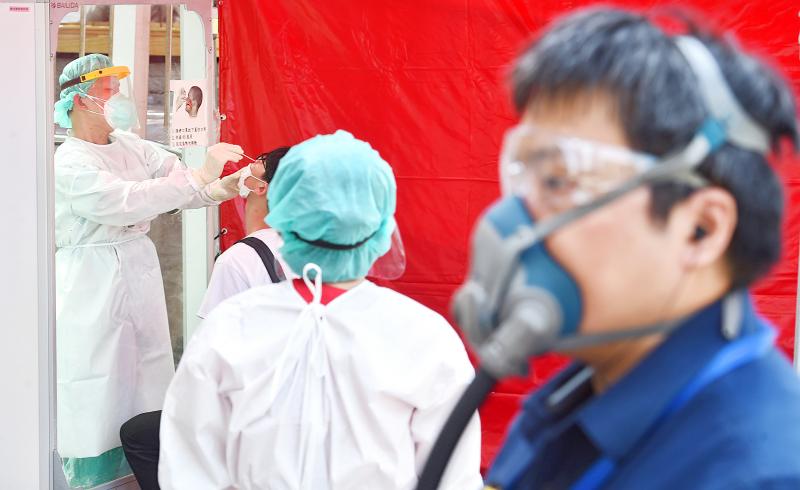
Photo: Liu Hsin-de, Taipei Times
However, the number of locally transmitted cases earlier this month started growing, and it soon became clear that the government was ill prepared not only to contain the virus, but to even detect it on a large scale due to a lack of investment in rapid testing.
That left officials like Ko scrambling to catch up as the number of new infections climbed to some 300 a day.
Ko’s search put him in contact with six local companies who make rapid tests and the city government was soon able to set up four rapid testing sites in Wanhua District (萬華), which had emerged as a virus hot spot.
Experts say that rapid tests are a critical tool in catching the virus in its early days.
The alternative that Taiwan has been relying on — tests that have to be sent to a laboratory for processing — has led to backlogs that might be obscuring the true extent of the outbreak.
“You want to identify those infected cases as soon as possible,” to contain the spread, said Ruby Huang (黃韻如), a professor at National Taiwan University’s (NTU) School of Medicine. “You’re basically running against time.”
With so few cases, Taiwan had been a bubble of normalcy for most of the pandemic. Schools stayed open, people went to bars and restaurants, and the nation’s economy was among the few globally that grew last year.
Its success was built largely on strict border controls that primarily allowed in only Taiwanese and long-term residents, who then faced mandatory two-week quarantines.
From time to time, Taiwan found small clusters of infections and stamped them out through contact tracing and quarantines.
Last month, authorities found a cluster involving pilots from state-owned China Airlines.
This time, stopping the virus would prove difficult, in part because pilots were only required to quarantine for three days and did not need a negative COVID-19 test to get out of quarantine.
Soon employees at a quarantine hotel where China Airlines flight crew stayed started getting sick — and so did their family members.
COVID-19 had escaped quarantine and was spreading locally, mostly in the northern part of the nation, which had vaccinated only about 1 percent of its population.
The central government responded by ordering a partial lockdown, closing schools and switching offices to remote work or rotating shifts.
Contact tracers identified 600,000 people that needed to quarantine or practice self-health management.
The biggest roadblock has been testing.
Taiwan’s policy throughout the pandemic has been to rely on polymerase chain reaction (PCR) tests, which are seen as the gold standard for diagnosis, but must be processed using special machines in a laboratory.
The government has not encouraged rapid tests, which are quicker and cheaper, but potentially less accurate.
In and around Taipei, laboratories have for weeks been working overtime, but are still struggling to process all the samples.
The Central Epidemic Command Center said in a statement that all 141 government-designated laboratories have a combined capacity to process 30,000 PCR tests a day.
However, it declined to provide the actual number of tests being processed.
Throughout the pandemic, the government has maintained that there are few benefits to mass testing, with Minister of Health and Welfare Chen Shih-chung (陳時中) saying last year that public funds and medical resources could be better used elsewhere.
The government has instead emphasized a strategy of contact tracing and isolation, and only testing those with symptoms and direct contact with someone infected.
Experts say that such a strategy might have been appropriate when case numbers were low, but needed to change as infections spread.
“You should have a two-pronged approach. You do the quarantine, but you should do massive widespread testing,” said Arnold Chan (陳建煒), an expert on drug and medical products regulation at NTU. “For whatever reason the government is completely unprepared.”
Taiwanese companies developed rapid tests for COVID-19 early last year, but the majority of their sales have been overseas.
The Centers for Disease Control “didn’t support rapid tests, and there was no epidemic,” said Edward Ting, a spokesperson for Panion and BF Biotech, which has had its own test since March last year. “We tried to sell, but it wasn’t possible.”
The government finally appears to be coming around, with Chen last week asking local governments to set up rapid testing sites.
Ko said that the Taipei City Government has purchased 250,000 rapid test kits.
Although the city is still relying on PCR tests to confirm cases, Ko said that the rapid tests better allow him to monitor the situation on the ground.
Ko, a former surgeon, said it was important to be open to change.
“There’s a phrase in Chinese: One thrives in times of calamity and perishes in soft times. Because when you’re very successful you are not forced to improve. Only when you fail, then are you forced to improve,” Ko said. “We were too successful in the past year.”
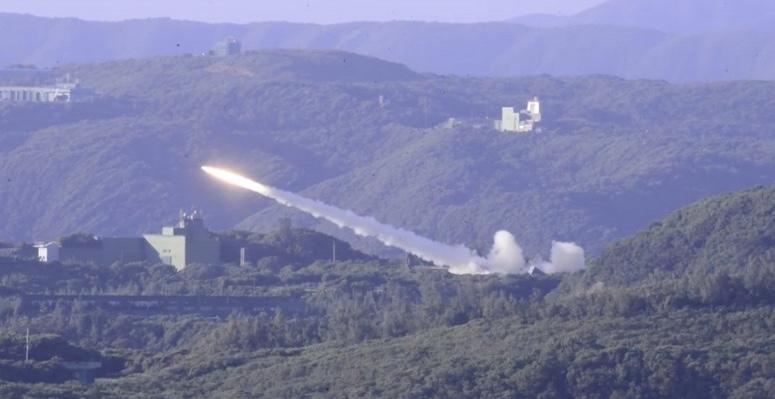
A Chinese military drone was spotted conducting reconnaissance off Taitung County as President William Lai (賴清德) visited Pingtung County this morning to inspect a drill of the armed forces’ precision-strike capabilities, prompting the military to closely monitor its actions. Today was the final day of a three-day military exercise at Jioupeng Base (九鵬基地) to test the joint combat capabilities of the armed forces and coast guard. The exercise began on Wednesday simulating air defense interception and yesterday tested long-range strike capabilities and new air defense weapons. This morning, the military conducted a final exercise involving air defense, anti-ship and drone operations. Military sources said

OCT. 31: The antiviral drugs Tamiflu and Eraflu have been distributed to about 4,000 medical facilities nationwide for people in seven groups who develop flu-like symptoms As the domestic influenza epidemic enters its peak season and continues to escalate, the Centers for Disease Control (CDC) yesterday announced that publicly funded influenza antiviral drugs for seven eligible groups have been extended to Oct. 31, allowing those who develop flu-like symptoms to receive the medication without undergoing a rapid influenza test. The CDC has extended the expanded use of flu antiviral drugs to seven groups: healthcare and influenza-prevention personnel; residents and staff at nursing homes, long-term care facilities and similar institutions; kindergarten and daycare workers and home-based caregivers; students from kindergarten through high school, vocational high school and the
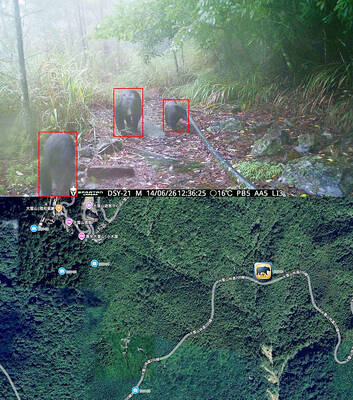
RARE PEEK: The footage released showed one of the bears staying in a cave for as long as 70 days, providing the first record of Formosan black bear’s overwintering The Forestry and Nature Conservation Agency yesterday released tracking records of released Formosan black bears for the first time, showing that they get much closer to human settlements than previously thought. The agency said it had captured two bears, Da Qu-ali (達古阿里) and Aziman (阿里曼), in indigenous villages in Hualien County and began to track them with a camera-mounted satellite collar after releasing them back into the wild. The results confirmed that the bears have moved from deep mountain areas into lowland hills closer to human communities, leading to an increase in human-bear conflicts, it said. The agency has introduced artificial intelligence-assisted early

Taiwanese Tsai Chin-shu (蔡金樹), who had been imprisoned in China for engaging in activity that “endangers national security,” said on Facebook on Friday that he has returned to Taiwan. Tsai, chairman of the Southern Taiwan Union of Cross-strait Relations Associations, had traveled frequently between Taiwan and China for years, and at one time ran a trading company in China’s Pingtan. In July 2018, he traveled to Quanzhou, Fujian Province, to attend a cross-strait food trade fair and stayed at a hotel in Xiamen. He checked out the following day and then disappeared. His family had made repeated appeals to the authorities


 RSS
RSS