


Arts and cultural institutions and schools have changed plans after the Central Epidemic Command Center (CECC) on Tuesday extended the nationwide level 3 COVID-19 alert to June 14.
The ceremony for the 32nd Golden Melody Awards, originally scheduled to be held at the Taipei Arena on June 26, has been postponed, the Ministry of Culture said yesterday.
Details, including when and how the ceremony would be held, are to be announced at a later date, it said.

Photo: Chen Yi-chuan, Taipei Times
The ministry has planned several possible solutions, it said, adding that it would settle on a new time and format that would comply with the CECC’s latest guidelines following discussions with the organizers.
Preventing the spread of COVID-19 is the nation’s most important task at this stage, Minister of Culture Lee Yung-te (李永得) said.
“Only by working together to protect Taiwan can we allow all arts and cultural groups to return to the stage as soon as possible,” he said.
National Taiwan University yesterday said that it has canceled its commencement ceremony originally scheduled to take place at the university’s sports center in Taipei on Saturday next week.
Instead, a pre-recorded video would be broadcast online on June 26, the university said.
Details about the video presentation would be announced at a later date, while the commencement speaker would not be announced until the day of the virtual event, it said.
The Ministry of Education on Tuesday said that schools at all levels across the nation would continue suspending in-person instruction until June 14.
All schools have also been asked to either cancel their graduation ceremonies or hold them online, the education ministry said.
Indoor gatherings of more than five people and outdoor gatherings of more than 10 people are prohibited under level 3 restrictions.
Exhibition and sports venues, including theaters, auditoriums, stadiums, concert halls, performance halls, museums, memorial halls, activity centers, indoor swimming pools and amusement parks, are also closed when a level 3 COVID-19 alert is in place.
With more people using videoconferencing to study or work from home, the National Palace Museum yesterday said it has released six background images for people to download and use during their video conferences.
The images, which are available on its Web site, depict the museum’s buildings in Taipei and Chiayi County, as well as works of art in its collection.


South Korea is planning to revise its controversial electronic arrival card, a step Taiwanese officials said prompted them to hold off on planned retaliatory measures, a South Korean media report said yesterday. A Yonhap News Agency report said that the South Korean Ministry of Foreign Affairs is planning to remove the “previous departure place” and “next destination” fields from its e-arrival card system. The plan, reached after interagency consultations, is under review and aims to simplify entry procedures and align the electronic form with the paper version, a South Korean ministry official said. The fields — which appeared only on the electronic form
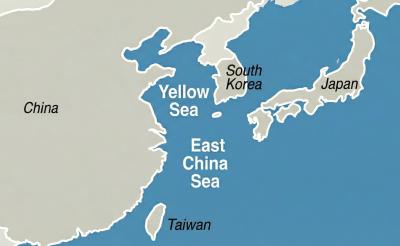
China has reserved offshore airspace in the Yellow Sea and East China Sea from March 27 to May 6, issuing alerts usually used to warn of military exercises, although no such exercises have been announced, the Wall Street Journal (WSJ) reported yesterday. Reserving such a large area for 40 days without explanation is an “unusual step,” as military exercises normally only last a few days, the paper said. These alerts, known as Notice to Air Missions (Notams), “are intended to inform pilots and aviation authorities of temporary airspace hazards or restrictions,” the article said. The airspace reserved in the alert is

A bipartisan group of US senators has introduced a bill to enhance cooperation with Taiwan on drone development and to reduce reliance on supply chains linked to China. The proposed Blue Skies for Taiwan Act of 2026 was introduced by Republican US senators Ted Cruz and John Curtis, and Democratic US senators Jeff Merkley and Andy Kim. The legislation seeks to ease constraints on Taiwan-US cooperation in uncrewed aerial systems (UAS), including dependence on China-sourced components, limited access to capital and regulatory barriers under US export controls, a news release issued by Cruz on Wednesday said. The bill would establish a "Blue UAS

More than 6,000 Taiwanese students have participated in exchange programs in China over the past two years, despite the Mainland Affairs Council’s (MAC) “orange light” travel advisory, government records showed. The MAC’s publicly available registry showed that Taiwanese college and university students who went on exchange programs across the Strait numbered 3,592 and 2,966 people respectively. The National Immigration Agency data revealed that 2,296 and 2,551 Chinese students visited Taiwan for study in the same two years. A review of the Web sites of publicly-run universities and colleges showed that Taiwanese higher education institutions continued to recruit students for Chinese educational programs without


 RSS
RSS