


The National Federation of Teachers’ Unions yesterday urged education authorities to pay attention to the quality of online classes offered to students with disabilities.
The quality of learning for students with disabilities, specifically those with visual impairments, should not be compromised because of the COVID-19 situation in Taiwan, the union said.
As with in-person learning, students with visual impairments need audio descriptions when learning online, it said.
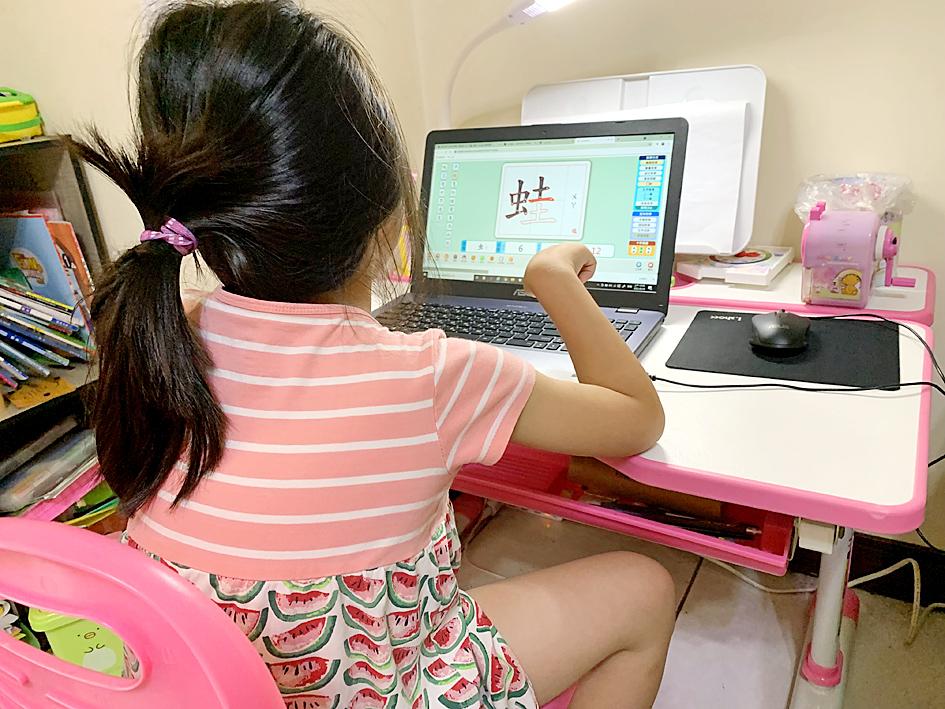
Photo: Su Ching-feng, Taipei Times
If the dialog boxes or images that pop up on the screen during a livestream do not come with any descriptions, the information that students with visual impairments receive would be fragmented and incoherent, it said.
This would affect the students’ understanding of the class material, the union added.
Someone needs to describe the images in the livestream in spoken language so that students with visual impairments can understand them, it said.
Schools could give special education assistants permission to access from their homes the online classes that the students they serve are enrolled in, the union said.
The assistants could then communicate with students with visual impairments through a separate platform, such as the Line messaging app, and provide them with the descriptions of images in real time, it said.
Separately, the National Federation of Education Unions said in a statement that it has received reports that many schools have adopted synchronous online teaching across the board regardless of the subject that is being taught.
This means that students must follow their schools’ original class schedule and stare at their screens until the evening, it said.
An increasing number of students have been reporting eye discomfort from looking at the computer screen all day, it said, adding that some parents are also worried that their children’s eyesight would worsen.
The Ministry of Education should require schools to reduce the impact of long-term use of electronic devices on students’ eyesight while carrying out online teaching, it said.


South Korea is planning to revise its controversial electronic arrival card, a step Taiwanese officials said prompted them to hold off on planned retaliatory measures, a South Korean media report said yesterday. A Yonhap News Agency report said that the South Korean Ministry of Foreign Affairs is planning to remove the “previous departure place” and “next destination” fields from its e-arrival card system. The plan, reached after interagency consultations, is under review and aims to simplify entry procedures and align the electronic form with the paper version, a South Korean ministry official said. The fields — which appeared only on the electronic form
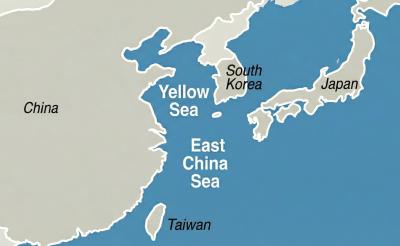
China has reserved offshore airspace in the Yellow Sea and East China Sea from March 27 to May 6, issuing alerts usually used to warn of military exercises, although no such exercises have been announced, the Wall Street Journal (WSJ) reported yesterday. Reserving such a large area for 40 days without explanation is an “unusual step,” as military exercises normally only last a few days, the paper said. These alerts, known as Notice to Air Missions (Notams), “are intended to inform pilots and aviation authorities of temporary airspace hazards or restrictions,” the article said. The airspace reserved in the alert is

A bipartisan group of US senators has introduced a bill to enhance cooperation with Taiwan on drone development and to reduce reliance on supply chains linked to China. The proposed Blue Skies for Taiwan Act of 2026 was introduced by Republican US senators Ted Cruz and John Curtis, and Democratic US senators Jeff Merkley and Andy Kim. The legislation seeks to ease constraints on Taiwan-US cooperation in uncrewed aerial systems (UAS), including dependence on China-sourced components, limited access to capital and regulatory barriers under US export controls, a news release issued by Cruz on Wednesday said. The bill would establish a "Blue UAS

More than 6,000 Taiwanese students have participated in exchange programs in China over the past two years, despite the Mainland Affairs Council’s (MAC) “orange light” travel advisory, government records showed. The MAC’s publicly available registry showed that Taiwanese college and university students who went on exchange programs across the Strait numbered 3,592 and 2,966 people respectively. The National Immigration Agency data revealed that 2,296 and 2,551 Chinese students visited Taiwan for study in the same two years. A review of the Web sites of publicly-run universities and colleges showed that Taiwanese higher education institutions continued to recruit students for Chinese educational programs without


 RSS
RSS