


An obstetrician last week delivered the baby of a woman with COVID-19, reportedly the first procedure of its kind in Taiwan, saying that while the surgery was a success, it was also a “war-like struggle.”
On Wednesday last week, the 31-year-old woman underwent a caesarean section, giving birth to a healthy girl, said Wang Le-ming (王樂明), the woman’s attending physician at Taipei Municipal Wanfang Hospital.
The woman, who was 37 weeks pregnant, was confirmed as having contracted COVID-19 on Monday last week, after her mother and husband were infected, Wang said.
The team decided to conduct a caesarean section as the child had reached full-term, Wang said, adding that the procedure was the best way to minimize the risk of vertical transmission.
A big challenge was deciding how to best reduce the mother’s pain during childbirth while protecting the surgical team, he said.
Without anesthesia, she might scream, spreading droplets in the air, but general anesthesia was risky because intubation could lead to the virus being spread, Wang said.
The woman was given local anesthesia and remained conscious throughout the surgery, which took less than an hour, he said.
The team had to wear thick personal protective equipment (PPE) in an operating room with no air-conditioning, due to concerns over virus transmission, Wang said.
The woman was more anxious when she did not recognize the staff in their PPE, Wang said.
“Don’t be afraid,” Wang told the mother. “We will protect you and your child.”
“I explained the surgery to her before getting started — and looking at her mask, I thought: ‘I’m only 20cm to 30cm away from COVID-19,’” he said.
The priority for the surgery, other than keeping the mother and child safe, was to be quick, because there was a risk that the child could be infected by being exposed to the air, Wang said, adding that the team was under extreme pressure.
“My vision was blocked so much due to the sweat and heat in my goggles that I could barely staunch the bleeding,” Wang said.
The surgery went smoothly and the baby tested negative for COVID-19, the hospital said.
“I took off my PPEs one by one and then took a shower, finishing this war-like struggle,” Wang said.
Although the mother is isolated from her child, she videochats daily with those taking care of the baby so that she can see her child online.
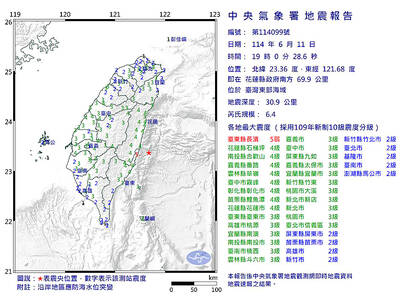
A magnitude 6.4 earthquake struck off the coast of Hualien County in eastern Taiwan at 7pm yesterday, the Central Weather Administration (CWA) said. The epicenter of the temblor was at sea, about 69.9km south of Hualien County Hall, at a depth of 30.9km, it said. There were no immediate reports of damage resulting from the quake. The earthquake’s intensity, which gauges the actual effect of a temblor, was highest in Taitung County’s Changbin Township (長濱), where it measured 5 on Taiwan’s seven-tier intensity scale. The quake also measured an intensity of 4 in Hualien, Nantou, Chiayi, Yunlin, Changhua and Miaoli counties, as well as

Credit departments of farmers’ and fishers’ associations blocked a total of more than NT$180 million (US$6.01 million) from being lost to scams last year, National Police Agency (NPA) data showed. The Agricultural Finance Agency (AFA) said last week that staff of farmers’ and fishers’ associations’ credit departments are required to implement fraud prevention measures when they serve clients at the counter. They would ask clients about personal financial management activities whenever they suspect there might be a fraud situation, and would immediately report the incident to local authorities, which would send police officers to the site to help, it said. NPA data showed

ENERGY RESILIENCE: Although Alaska is open for investments, Taiwan is sourcing its gas from the Middle East, and the sea routes carry risks, Ho Cheng-hui said US government officials’ high-profile reception of a Taiwanese representative at the Alaska Sustainable Energy Conference indicated the emergence of an Indo-Pacific energy resilience alliance, an academic said. Presidential Office Secretary-General Pan Men-an (潘孟安) attended the conference in Alaska on Thursday last week at the invitation of the US government. Pan visited oil and gas facilities with senior US officials, including US Secretary of the Interior Doug Burgum, US Secretary of Energy Chris Wright, Alaska Governor Mike Dunleavy and US Senator Daniel Sullivan. Pan attending the conference on behalf of President William Lai (賴清德) shows a significant elevation in diplomatic representation,
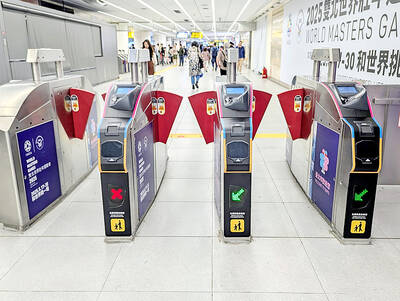
The Taipei MRT is to begin accepting mobile payment services in the fall, Taipei Rapid Transit Corp said on Saturday. When the company finishes the installation of new payment units at ticketing gates in October, MRT passengers can use credit cards, Apple Pay, Google Pay and Samsung Pay, the operator said. In addition, the MRT would also provide QR payment codes — which would be compatible with Line Pay, Jkopay, iPass Money, PXPay Plus, EasyWallet, iCash Pay, Taiwan Pay and Taishin Pay — to access the railway system. Currently, passengers can access the Taipei MRT by buying a single-journey token or using EasyCard,


 RSS
RSS