


People can get COVID-19 rapid screening results via the National Health Insurance Express App, the Central Epidemic Command Center (CECC) said yesterday as it stressed the importance of not taking public transportation and staying away from public places within three days after being tested.
Minister of Health and Welfare Chen Shih-chung (陳時中), who heads the center, made the remarks at the CECC’s daily briefing.
The CECC and the National Health Insurance Administration have updated the app to allow people to access their COVID-19 rapid screening results, which should help make the process less stressful, he said, adding that those with a positive result will also be informed by phone as before.
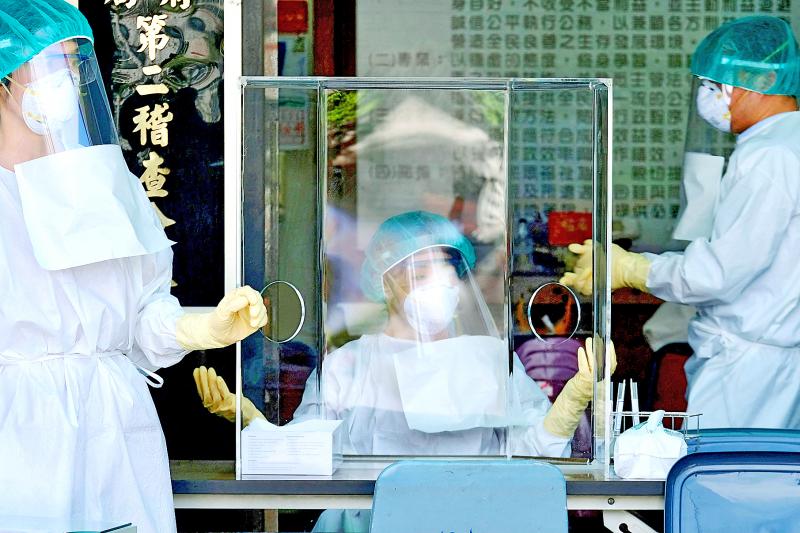
Photo: Sam Yeh, AFP
Centers for Disease Control (CDC) Deputy Director-General Chuang Jen-hsiang (莊人祥), the CECC’s spokesman, said people should refrain from using public transportation, wear a mask indoors and avoid public places within three days after being tested.
The instructions are typically given to people by the hospital that performs the screening, Chuang said in response to reports that a Keelung resident, who later tested positive for COVID-19, had taken a train to Hualien two days after being screened, but before receiving the result.
Chuang said that the Keelung resident was tested on Tuesday, meaning they should not have used public transportation until yesterday.
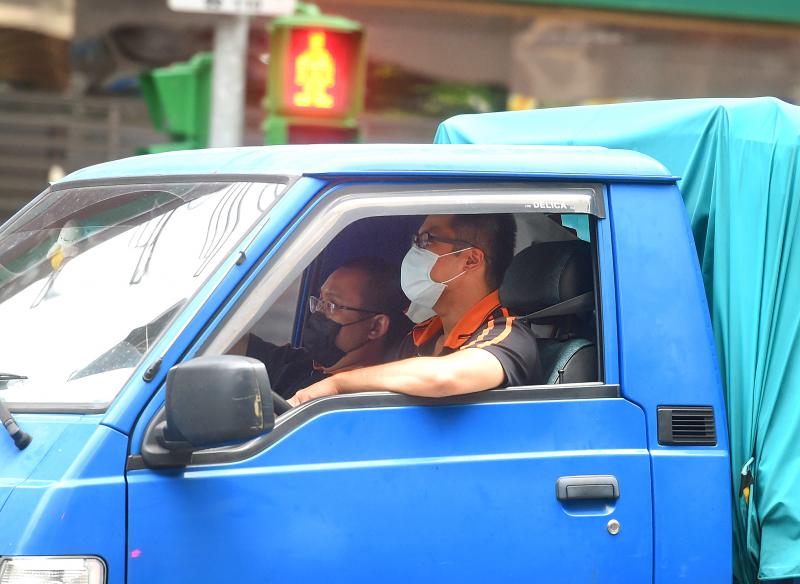
Photo: Fang Pin-chao, Taipei Times
The Taiwan Railways Administration is to contact people who were in the two cars that the Keelung resident had entered and ask them to practice self-health management, he said.
Meanwhile, under the national level 3 COVID-19 alert issued on Wednesday, people are required to wear a mask at all times outside their homes or face a fine of NT$3,000 to NT$15,000.
However, questions have been raised about how the rules should be enforced, particularly over activities such as driving and eating.
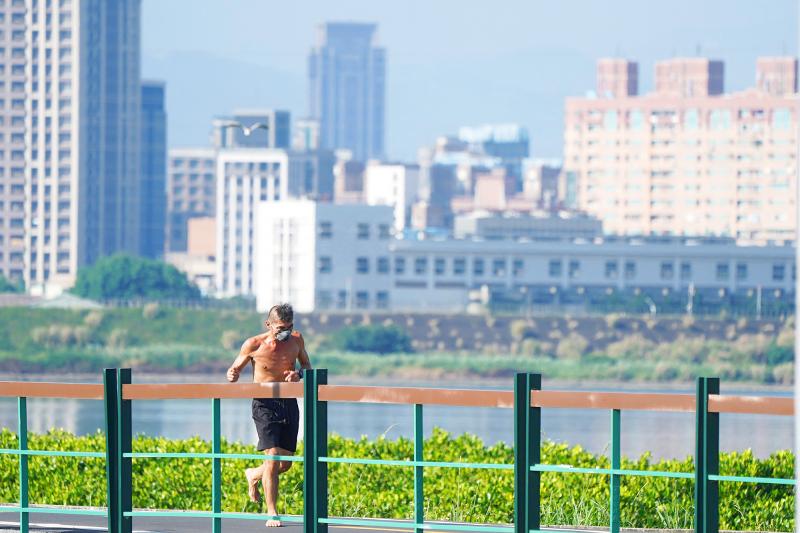
Photo: Fang Pin-chao, Taipei Times
Deputy Minister of the Interior Chen Tsung-yen (陳宗彥), deputy head of the CECC, said that masks are required when two or more people are in a vehicle.
The CECC and local governments agreed that a driver alone in an enclosed vehicle does not need to wear a mask, as they pose little risk of transmission, but masks are required as soon as a second person is aboard, Chen Tsung-yen said.
Workers on construction sites may eat or drink unmasked in a socially distanced area onsite, which employers must provide, he said.
While people are allowed to lower their mask to drink, the CECC has banned smoking in public areas during the level 3 alert.
Repeated breaches of masking rules — including using a drink as an excuse to not be masked — is punishable by a fine, the CECC said.
Additional reporting by Wu Liang-yi, Yang Mien-chieh and CNA

The Centers for Disease Control (CDC) yesterday reported the first case of a new COVID-19 subvariant — BA.3.2 — in a 10-year-old Singaporean girl who had a fever upon arrival in Taiwan and tested positive for the disease. The girl left Taiwan on March 20 and the case did not have a direct impact on the local community, it said. The WHO added the BA.3.2 strain to its list of Variants Under Monitoring in December last year, but this was the first imported case of the COVID-19 variant in Taiwan, CDC Deputy Director-General Lin Ming-cheng (林明誠) said. The girl arrived in Taiwan on

South Korea is planning to revise its controversial electronic arrival card, a step Taiwanese officials said prompted them to hold off on planned retaliatory measures, a South Korean media report said yesterday. A Yonhap News Agency report said that the South Korean Ministry of Foreign Affairs is planning to remove the “previous departure place” and “next destination” fields from its e-arrival card system. The plan, reached after interagency consultations, is under review and aims to simplify entry procedures and align the electronic form with the paper version, a South Korean ministry official said. The fields — which appeared only on the electronic form

A bipartisan group of US senators has introduced a bill to enhance cooperation with Taiwan on drone development and to reduce reliance on supply chains linked to China. The proposed Blue Skies for Taiwan Act of 2026 was introduced by Republican US senators Ted Cruz and John Curtis, and Democratic US senators Jeff Merkley and Andy Kim. The legislation seeks to ease constraints on Taiwan-US cooperation in uncrewed aerial systems (UAS), including dependence on China-sourced components, limited access to capital and regulatory barriers under US export controls, a news release issued by Cruz on Wednesday said. The bill would establish a "Blue UAS

The Ministry of Foreign Affairs (MOFA) is suspending retaliation measures against South Korea that were set to take effect tomorrow, after Seoul said it is updating its e-arrival system, MOFA said today. The measures were to be a new round of retaliation after Taiwan on March 1 changed South Korea's designation on government-issued alien resident certificates held by South Korean nationals to "South Korea” from the "Republic of Korea," the country’s official name. The move came after months of protests to Seoul over its listing of Taiwan as "China (Taiwan)" in dropdown menus on its new online immigration entry system. MOFA last week


 RSS
RSS