


A pediatrician has offered some tips on preventing the spread of COVID-19 while commuting.
Although a number of companies have asked their employees to work from home after the government on Saturday last week issued a level 3 COVID-19 alert for Taipei and New Taipei City, some employees are still having to commute to the office.
Pediatrician Ou Shu-chuan (歐淑娟) of Your Doctor Clinic wrote on Facebook on Sunday that one of the steps she takes before leaving home for work is to take her temperature.
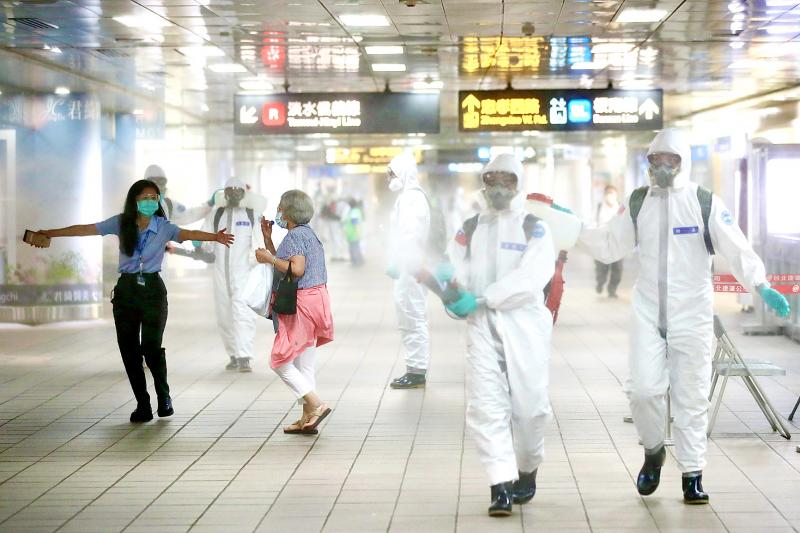
Photo: Ritchie B. Tongo, EPA-EFE
When possible, Ou said she finishes breakfast at home and leaves for work 30 minutes earlier than usual to avoid the crowds.
In addition to carrying spare masks, Ou said she also takes a small bottle of alcohol-based hand sanitizer with her.
She keeps her mask on throughout the entire commute, Ou wrote, adding that people with smaller faces should tie knots in the strings as the more close-fitting a mask is, the better protection it offers.
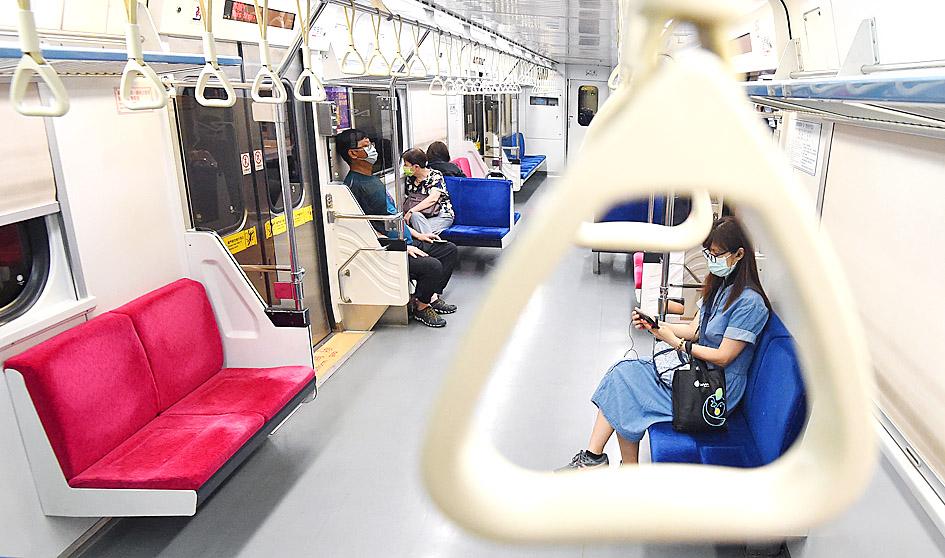
Photo: Liao Chen-huei, Taipei Times
People should use hand sanitizer after touching any surfaces on public transportation, and clean their hands again once they arrive at work, she said, adding that they should also clean the surface of their phone with an alcohol-based disinfectant.
After arriving home from work, Ou takes off her shoes at the entrance and disinfects her keys, as well as any clothing she would not be washing the same day.
She takes off and disposes of her mask, disinfects her phone, washes her hands, changes out of her clothes and takes a shower, Ou wrote.
Ou changes her mask every day and she advised people, including those who have received two doses of a COVID-19 vaccine, to follow the same routine and to stay at home as much as possible on their days off.
Separately, dietitian Kao Min-min (高敏敏) also wrote on Facebook measures people can take to help prevent the spread of COVID-19.
The measures included washing the hands correctly, avoiding handshakes, maintaining social distance and wearing a mask in confined spaces.
People should cook their own meals or order takeout as much as possible, Kao wrote.
They should eat fresh fruit and vegetables on a daily basis, drink water and stay active, she wrote.
Phones, wallets and other personal items should be disinfected regularly, while people should take a shower, and wash their hair and clothes every day, she added.
Avoid taking public transportation during peak hours to reduce contact with crowds, maintain good indoor ventilation and reduce to a minimum visits to public places, Kao said.

The Centers for Disease Control (CDC) yesterday reported the first case of a new COVID-19 subvariant — BA.3.2 — in a 10-year-old Singaporean girl who had a fever upon arrival in Taiwan and tested positive for the disease. The girl left Taiwan on March 20 and the case did not have a direct impact on the local community, it said. The WHO added the BA.3.2 strain to its list of Variants Under Monitoring in December last year, but this was the first imported case of the COVID-19 variant in Taiwan, CDC Deputy Director-General Lin Ming-cheng (林明誠) said. The girl arrived in Taiwan on

South Korea is planning to revise its controversial electronic arrival card, a step Taiwanese officials said prompted them to hold off on planned retaliatory measures, a South Korean media report said yesterday. A Yonhap News Agency report said that the South Korean Ministry of Foreign Affairs is planning to remove the “previous departure place” and “next destination” fields from its e-arrival card system. The plan, reached after interagency consultations, is under review and aims to simplify entry procedures and align the electronic form with the paper version, a South Korean ministry official said. The fields — which appeared only on the electronic form
A bipartisan group of US senators has introduced a bill to enhance cooperation with Taiwan on drone development and to reduce reliance on supply chains linked to China. The proposed Blue Skies for Taiwan Act of 2026 was introduced by Republican US senators Ted Cruz and John Curtis, and Democratic US senators Jeff Merkley and Andy Kim. The legislation seeks to ease constraints on Taiwan-US cooperation in uncrewed aerial systems (UAS), including dependence on China-sourced components, limited access to capital and regulatory barriers under US export controls, a news release issued by Cruz on Wednesday said. The bill would establish a "Blue UAS

The Ministry of Foreign Affairs (MOFA) is suspending retaliation measures against South Korea that were set to take effect tomorrow, after Seoul said it is updating its e-arrival system, MOFA said today. The measures were to be a new round of retaliation after Taiwan on March 1 changed South Korea's designation on government-issued alien resident certificates held by South Korean nationals to "South Korea” from the "Republic of Korea," the country’s official name. The move came after months of protests to Seoul over its listing of Taiwan as "China (Taiwan)" in dropdown menus on its new online immigration entry system. MOFA last week


 RSS
RSS