


Kaohsiung yesterday further tightened its COVID-19 restrictions after a local hospital reported a second confirmed infection.
Indoor gatherings of more than five people and outdoor gatherings of more than 10 people have been banned, and all places of worship, including temples, churches and mosques, are to be closed until June 8, Kaohsiung Mayor Chen Chi-mai (陳其邁) said.
Movie theaters would also be closed until Friday next week, Chen said.
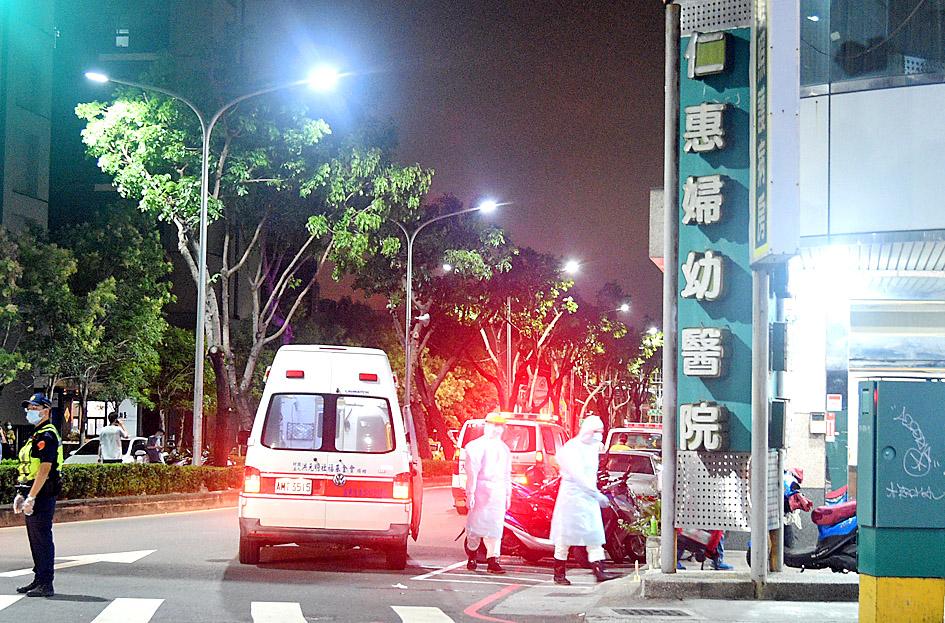
Photo: Chang Chung-yi, Taipei Times
The latest measures add to the previous round of controls city officials announced last week that shut down adult entertainment venues, including bars, KTV parlors, night clubs and massage parlors, until Friday next week.
All public facilities, such as sports centers, community centers, libraries, exhibition centers and amusement parks, have also been shut down for the same period.
Yesterday’s announcement came after Renhui Women’s and Children’s Hospital in Fongshan District (鳳山) reported its second confirmed COVID-19 case early in the day following a screening of all of its patients and employees.
The new confirmed case, a nurse, was among the 94 people tested after a hospital administrator tested positive a day earlier, prompting the hospital to move all of its patients to other locations.
The administrator on May 8 visited Taipei’s Wanhua District (萬華), the epicenter of a COVID-19 surge that has gripped Taiwan in the past week, and underwent a COVID-19 test only after having nursed a sore throat for more than a week, the Kaohsiung Department of Health said.
He continued working at the hospital during the period and often visited different floors of the complex, meaning there is a high possibility that he might have infected others, the department said.
Following the test result, the hospital on Monday night called in all 55 of its employees to conduct COVID-19 tests before sending them to quarantine hotels to be quarantined for 14 days, the department added.
All 39 patients hospitalized in the facility have also been screened for COVID-19 and were scheduled to be relocated to 12 other hospitals in the city that have negative pressure isolation wards, it said.
The removal of patients was scheduled to be completed yesterday, after which the hospital complex would be fully disinfected and locked down, the department said.
The hospital would not be reopened until the first half of next month after all of its employees clear their second COVID-19 tests to be conducted on Saturday next week at the conclusion of their two-week quarantine to ensure that they are not infected, it said.
The administrator, a man in his 60s, traveled from Taipei to Kaohsiung’s Fongshan Railway Station by high-speed rail and Taiwan Railways Administration trains, before riding a scooter to his home, the department said.
He stayed at home on May 9 and developed a sore throat the next day.
He visited a nearby clinic on Thursday last week for his sore throat, and rested at home on Saturday and Sunday, it added.
He returned to the hospital on Monday, even though his sore throat persisted, the department said.
Because of the sore throat and his travel history to Wanhua, the hospital tested him for COVID-19 and the result came back positive the same day, it said.
His test had a cycle threshold value of 21, which is relatively low, indicating a recent infection, the department said.

The Centers for Disease Control (CDC) yesterday reported the first case of a new COVID-19 subvariant — BA.3.2 — in a 10-year-old Singaporean girl who had a fever upon arrival in Taiwan and tested positive for the disease. The girl left Taiwan on March 20 and the case did not have a direct impact on the local community, it said. The WHO added the BA.3.2 strain to its list of Variants Under Monitoring in December last year, but this was the first imported case of the COVID-19 variant in Taiwan, CDC Deputy Director-General Lin Ming-cheng (林明誠) said. The girl arrived in Taiwan on

South Korea is planning to revise its controversial electronic arrival card, a step Taiwanese officials said prompted them to hold off on planned retaliatory measures, a South Korean media report said yesterday. A Yonhap News Agency report said that the South Korean Ministry of Foreign Affairs is planning to remove the “previous departure place” and “next destination” fields from its e-arrival card system. The plan, reached after interagency consultations, is under review and aims to simplify entry procedures and align the electronic form with the paper version, a South Korean ministry official said. The fields — which appeared only on the electronic form

A bipartisan group of US senators has introduced a bill to enhance cooperation with Taiwan on drone development and to reduce reliance on supply chains linked to China. The proposed Blue Skies for Taiwan Act of 2026 was introduced by Republican US senators Ted Cruz and John Curtis, and Democratic US senators Jeff Merkley and Andy Kim. The legislation seeks to ease constraints on Taiwan-US cooperation in uncrewed aerial systems (UAS), including dependence on China-sourced components, limited access to capital and regulatory barriers under US export controls, a news release issued by Cruz on Wednesday said. The bill would establish a "Blue UAS

The Ministry of Foreign Affairs (MOFA) is suspending retaliation measures against South Korea that were set to take effect tomorrow, after Seoul said it is updating its e-arrival system, MOFA said today. The measures were to be a new round of retaliation after Taiwan on March 1 changed South Korea's designation on government-issued alien resident certificates held by South Korean nationals to "South Korea” from the "Republic of Korea," the country’s official name. The move came after months of protests to Seoul over its listing of Taiwan as "China (Taiwan)" in dropdown menus on its new online immigration entry system. MOFA last week


 RSS
RSS