


Five hikers are the main suspects in a forest fire that, as of press time last night, continued to burn in Yushan National Park.
The fire started on Sunday morning at Dujyuan Campground, near Dashueikushan (大水窟山), the Yushan National Park Administration said, citing reports from forest rangers and hikers in the area.
The campground is accessed by the Batongguan Historic Trail (八通關古道), to the east of Yushan (玉山), or Jade Mountain, which is the nation’s highest peak at 3,952m.
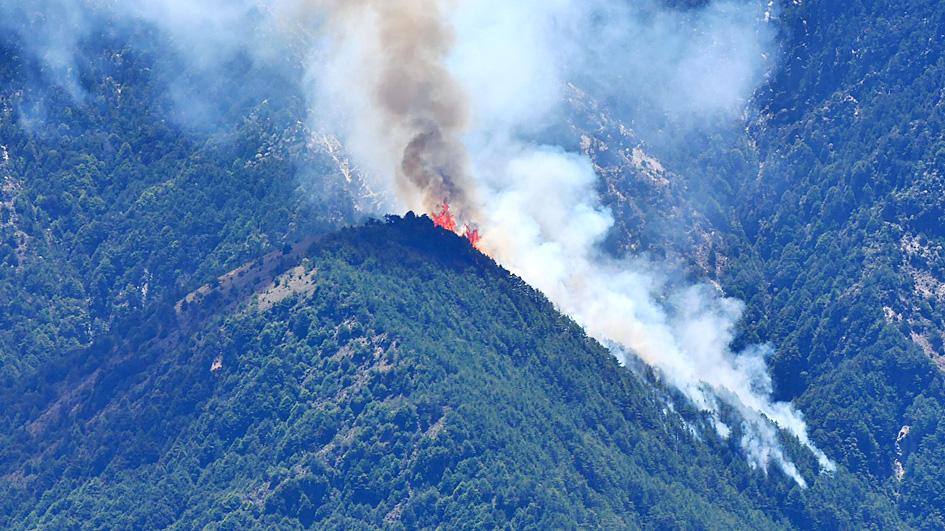
Photo: Liu Pin-chuan, Taipei Times
Based on the reports, officials identified a group of five hikers as the most likely suspects.
The five had reportedly been cooking at the campground when a fire began burning out of control. The forest fire was first reported at about 5am on Sunday.
Efforts to contain the fire continued yesterday, Chiayi Forest District Office deputy director Lee Ting-chung (李定忠) said, adding that the fire had separated into pockets.
The mountainous location required helicopters to make numerous trips to land firefighters at the sites of the fires.
Situated within the high mountains, Yushan National Park covers the administrative districts of Nantou, Chiayi and Hualien counties, and parts of Kaohsiung.
The five hikers allegedly fled pursuit along mountain trails, but police caught up with them at about 3:30pm yesterday, when they reached an entry onto the Batongguang Historic Trail, Lee said.
Prosecutors have been notified of the incident and are to investigate, Lee said, adding that the hikers could be fined for breaches of the National Park Act (國家公園法) and the Forestry Act (森林法).
Article 53 of the Forestry Act stipulates that people who cause a forest fire can be fined up to NT$300,000 or jailed for up to two years.
The fire had as of yesterday burned more than 1.5 hectares, Lee said, adding that firefighters were working diligently to contain it, and helicopters continued to fly in personnel and equipment.

The Centers for Disease Control (CDC) yesterday reported the first case of a new COVID-19 subvariant — BA.3.2 — in a 10-year-old Singaporean girl who had a fever upon arrival in Taiwan and tested positive for the disease. The girl left Taiwan on March 20 and the case did not have a direct impact on the local community, it said. The WHO added the BA.3.2 strain to its list of Variants Under Monitoring in December last year, but this was the first imported case of the COVID-19 variant in Taiwan, CDC Deputy Director-General Lin Ming-cheng (林明誠) said. The girl arrived in Taiwan on

South Korea is planning to revise its controversial electronic arrival card, a step Taiwanese officials said prompted them to hold off on planned retaliatory measures, a South Korean media report said yesterday. A Yonhap News Agency report said that the South Korean Ministry of Foreign Affairs is planning to remove the “previous departure place” and “next destination” fields from its e-arrival card system. The plan, reached after interagency consultations, is under review and aims to simplify entry procedures and align the electronic form with the paper version, a South Korean ministry official said. The fields — which appeared only on the electronic form

A bipartisan group of US senators has introduced a bill to enhance cooperation with Taiwan on drone development and to reduce reliance on supply chains linked to China. The proposed Blue Skies for Taiwan Act of 2026 was introduced by Republican US senators Ted Cruz and John Curtis, and Democratic US senators Jeff Merkley and Andy Kim. The legislation seeks to ease constraints on Taiwan-US cooperation in uncrewed aerial systems (UAS), including dependence on China-sourced components, limited access to capital and regulatory barriers under US export controls, a news release issued by Cruz on Wednesday said. The bill would establish a "Blue UAS

The Ministry of Foreign Affairs (MOFA) is suspending retaliation measures against South Korea that were set to take effect tomorrow, after Seoul said it is updating its e-arrival system, MOFA said today. The measures were to be a new round of retaliation after Taiwan on March 1 changed South Korea's designation on government-issued alien resident certificates held by South Korean nationals to "South Korea” from the "Republic of Korea," the country’s official name. The move came after months of protests to Seoul over its listing of Taiwan as "China (Taiwan)" in dropdown menus on its new online immigration entry system. MOFA last week


 RSS
RSS