


Feeding wild animals in Taipei’s parks would be prohibited from June 1, with offenders to face fines of NT$1,200 to NT$6,000, the Taipei City Government said.
The frequent feeding of squirrels and pigeons has disrupted the ecological balance and food chain in the city’s parks, but many people continue to feed them even after being asked to stop, the Taipei Parks and Street Lights Office said.
The firefly restoration ecological pond in Taipei’s Daan Forest Park is being invaded by an exotic species, the many-rayed sailfin sucker catfish, while Neihu District’s (內湖) Bihu Park is being invaded by the invasive marbled crayfish, causing ecological balance issues, the office said.
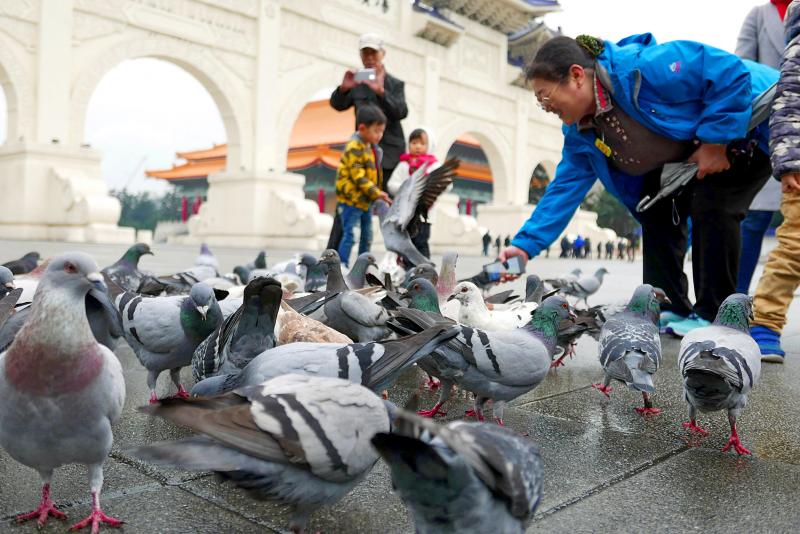
Photo: CNA
Taipei Youth Park Management Office Director Wang Shu-ya (王淑雅) said that people often feed squirrels in Daan Forest Park, and the squirrels have become accustomed to eating human food, which can affect their digestive systems.
The squirrels also become less willing to find their own food, leading some to strip the bark from trees to eat, which can cause fungal infections in the tree, she said.
Sometimes, park security guards are scolded by people they tell to stop feeding squirrels, she added.
Another problem is photographers putting food out to lure wild birds into the open to get a shot of them, the Parks and Street Lights Office said.
Although feeding wild animals was not prohibited, park security usually try to persuade people to stop when they see it occur, it said.
However, the office is to start making announcements and giving out flyers urging people to stop feeding wild animals in parks, it said, adding that borough offices and related agencies would be informed of the policy.
Starting from June 1, people who feed wild animals in the city’s parks and refuse to stop after being asked to by park security will face fines from NT$1,200 to NT$6,000, the office said.
If an offender refuses to provide identifying information, park security can contact local police to issue a ticket, it said.
People can also record the behavior as evidence and report it to the office or park security, so that they can handle the issue, but no cash reward would be given for reporting feeding incidents, Wang said.
According to the Wildlife Protection Act (野生動物保育法), wild animals are any animals living in a natural habitat, including mammals, birds, reptiles, amphibians, fish, insects and others, so they cannot be fed in the parks, she said.
However, feeding stray dogs and cats would not be considered feeding wild animals, so people who feed them would be fined, she added.

Three batches of banana sauce imported from the Philippines were intercepted at the border after they were found to contain the banned industrial dye Orange G, the Food and Drug Administration (FDA) said yesterday. From today through Sept. 2 next year, all seasoning sauces from the Philippines are to be subject to the FDA’s strictest border inspection, meaning 100 percent testing for illegal dyes before entry is allowed, it said in a statement. Orange G is an industrial coloring agent that is not permitted for food use in Taiwan or internationally, said Cheng Wei-chih (鄭維智), head of the FDA’s Northern Center for

The Chinese military has built landing bridge ships designed to expand its amphibious options for a potential assault on Taiwan, but their combat effectiveness is limited due to their high vulnerability, a defense expert said in an analysis published on Monday. Shen Ming-shih (沈明室), a research fellow at the Institute for National Defense and Security Research, said that the deployment of such vessels as part of the Chinese People’s Liberation Army (PLA) Navy’s East Sea Fleet signals a strong focus on Taiwan. However, the ships are highly vulnerable to precision strikes, which means they could be destroyed before they achieve their intended

LOOKING NORTH: The base would enhance the military’s awareness of activities in the Bashi Channel, which China Coast Guard ships have been frequenting, an expert said The Philippine Navy on Thursday last week inaugurated a forward operating base in the country’s northern most province of Batanes, which at 185km from Taiwan would be strategically important in a military conflict in the Taiwan Strait. The Philippine Daily Inquirer quoted Northern Luzon Command Commander Lieutenant General Fernyl Buca as saying that the base in Mahatao would bolster the country’s northern defenses and response capabilities. The base is also a response to the “irregular presence this month of armed” of China Coast Guard vessels frequenting the Bashi Channel in the Luzon Strait just south of Taiwan, the paper reported, citing a

About 4.2 million tourist arrivals were recorded in the first half of this year, a 10 percent increase from the same period last year, the Tourism Administration said yesterday. The growth continues to be consistent, with the fourth quarter of this year expected to be the peak in Taiwan, the agency said, adding that it plans to promote Taiwan overseas via partnerships and major events. From January to June, 9.14 million international departures were recorded from Taiwan, an 11 percent increase from the same period last year, with 3.3 million headed for Japan, 1.52 million for China and 832,962 to South Korea,


 RSS
RSS