


Sports leagues have lost money playing without fans to comply with Central Epidemic Command Center restrictions on large gatherings, with the Super Basketball League (SBL) and its rival P.League+ especially affected during their championship series.
Surges in local COVID-19 infections have prompted the center to impose new prevention measures until June 8, which include restricting outdoor gatherings and crowds at sporting events to fewer than 500 people and indoor gatherings to fewer than 100.
Following meetings by baseball teams and league officials, the CPBL said that its baseball games would be played in empty ballparks, without fans, while the basketball leagues on Wednesday also said they would hold post-season games without spectators.
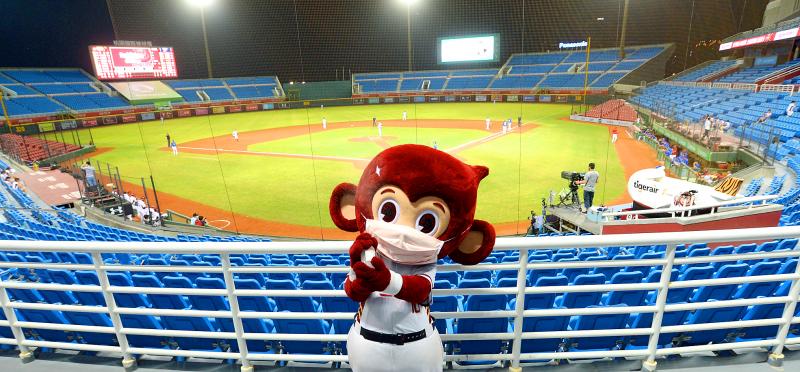
Photo: Lin Cheng-kung, Taipei Times
The restrictions are a blow to league finances, especially for the SBL and P.League+, as their championship finals are under way, leaving them unable to earn revenue from ticket sales.
P.League+ commissioner Chen Chien-chou (陳建州) said that the first two games of the finals were at capacity with 7,000 people attending at Taipei Heping Basketball Gymnasium, with total revenue of NT$17.2 million (US$614,023) from NT$14 million in ticket sales and NT$3.2 million from merchandise.
Starting with Thursday’s Game 3, the league and teams will lose nearly NT$10 million in revenue per game, Chen said.
CPBL officials said that each of the five teams have about 10 home games through June 8, and based on ballpark figures this season, they estimate ticket sale losses of NT$15 million per game.
The Formosa Taishin Dreamers are to try to even up the P.League+ final series today, again hosting the game at the Changhua County Stadium, but would have no home crowd to cheer them on.
In Game 3, the Fubon Braves took a 2-1 lead in the series, in a hard-fought overtime win against the Dreamers.
The SBL championship finals start today, with Taiwan Beer taking on the Yulon Dinos, with Game 2 tomorrow.
The new measures forced the SBL to move the games to the smaller Hao Yu Sports Center in New Taipei City’s Sinjhuang District (新莊).
The first-round playoffs ended on Saturday last week, with the Dinos taking down Bank of Taiwan by three wins to advance, while Taiwan Beer swept Jeoutai Technology.
Taiwan Beer and the Dinos finished first and second in the standings respectively, wrapping up the season last month.
Taiwan Beer nailed down the top position early, with 31 wins against 9 defeats, while the Dinos chalked up a 26-14 record.


South Korea is planning to revise its controversial electronic arrival card, a step Taiwanese officials said prompted them to hold off on planned retaliatory measures, a South Korean media report said yesterday. A Yonhap News Agency report said that the South Korean Ministry of Foreign Affairs is planning to remove the “previous departure place” and “next destination” fields from its e-arrival card system. The plan, reached after interagency consultations, is under review and aims to simplify entry procedures and align the electronic form with the paper version, a South Korean ministry official said. The fields — which appeared only on the electronic form
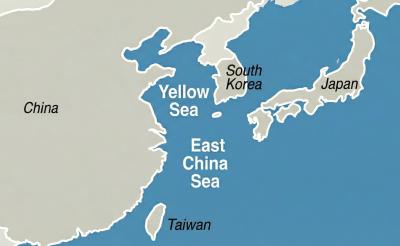
China has reserved offshore airspace in the Yellow Sea and East China Sea from March 27 to May 6, issuing alerts usually used to warn of military exercises, although no such exercises have been announced, the Wall Street Journal (WSJ) reported yesterday. Reserving such a large area for 40 days without explanation is an “unusual step,” as military exercises normally only last a few days, the paper said. These alerts, known as Notice to Air Missions (Notams), “are intended to inform pilots and aviation authorities of temporary airspace hazards or restrictions,” the article said. The airspace reserved in the alert is

A bipartisan group of US senators has introduced a bill to enhance cooperation with Taiwan on drone development and to reduce reliance on supply chains linked to China. The proposed Blue Skies for Taiwan Act of 2026 was introduced by Republican US senators Ted Cruz and John Curtis, and Democratic US senators Jeff Merkley and Andy Kim. The legislation seeks to ease constraints on Taiwan-US cooperation in uncrewed aerial systems (UAS), including dependence on China-sourced components, limited access to capital and regulatory barriers under US export controls, a news release issued by Cruz on Wednesday said. The bill would establish a "Blue UAS
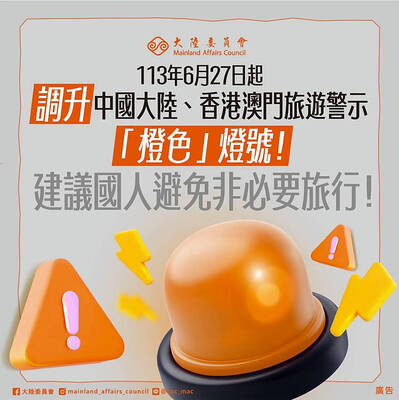
More than 6,000 Taiwanese students have participated in exchange programs in China over the past two years, despite the Mainland Affairs Council’s (MAC) “orange light” travel advisory, government records showed. The MAC’s publicly available registry showed that Taiwanese college and university students who went on exchange programs across the Strait numbered 3,592 and 2,966 people respectively. The National Immigration Agency data revealed that 2,296 and 2,551 Chinese students visited Taiwan for study in the same two years. A review of the Web sites of publicly-run universities and colleges showed that Taiwanese higher education institutions continued to recruit students for Chinese educational programs without


 RSS
RSS