


The lack of an approved launch site in the nation has forced Taiwan Innovative Space Inc to turn to Australia to launch a research rocket, sources familiar with the matter have said.
Some Taiwan Innovative Space employees departed for Australia in February to complete quarantine and preparatory procedures prior to trial launches this month, a person said on condition of anonymity.
Australian space company Southern Launch would help Taiwan Innovative Space launch its sounding rocket at a site near Adelaide, South Australia, another person with knowledge of the matter said.
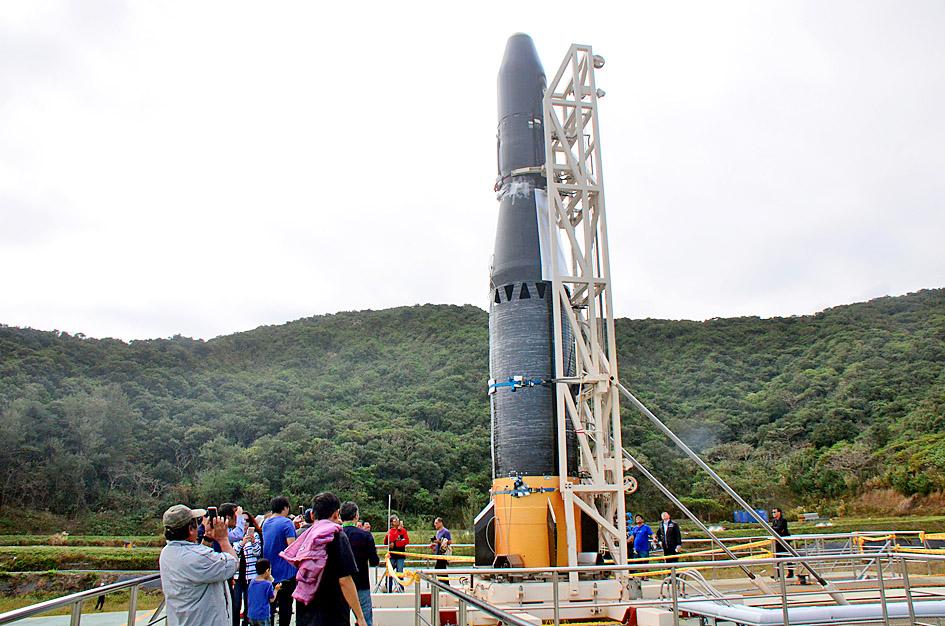
Photo: CNA
“On 25 March, the Australian government announced the first ever license for a space launch facility, legally permitting rockets to fly into space from Australian territory,” Southern Launch said in a news release last month.
“With domestic launch sites for commercial use, no more will Australia send money and give away jobs to the launch industries of New Zealand, the United States, Europe or India,” it said.
Taiwan Innovative Space had not responded to the Taipei Times’ requests for comment as of press time last night.
Founded in 2016, the company aims to become Taiwan’s first commercial rocket supplier for microsatellite launch services, but it has yet to prove its capabilities with flight data.
On Feb. 13 last year, it attempted to launch its Hapith-I rocket at a site in Taitung County, but the mission was terminated due to inclement weather.
The company wrote on Twitter at the time that “the process of ignition was completed.”
Subsequent activity at the site was thwarted amid controversy over whether the site was being used illegally.
Taiwan Innovative Space chairman Chen Yen-sen (陳彥升) had said that the firm might launch the Hapith-I in Alaska.
However, the situation might be “a turning point” for the company, as overseas firms and investors have noticed that there is a rocket supplier in Taiwan, one of the sources said.
Its Australia launch plan, apart from proving its capabilities, is aimed at fulfilling a contract with the National Space Organization (NSPO), which commissioned it to launch a scientific payload with a hybrid rocket at a cost of nearly NT$50 million (US$1.79 million).
Completing the mission abroad is a result of a “compromise,” due to the lack of an approved launch site in Taiwan, schedule pressure and pressure from some lawmakers, NSPO Acting Director-General Yu Shiann-jeng (余憲政) said on Monday.
The NSPO and Taiwan Innovative Space revised their contract, requiring the company to launch the payload at an approved overseas site by the end of July, Yu said.
The NSPO requires the company to launch the payload to an altitude of 150km or higher, but did not designate where the launch should take place, he said.
The company pays for its overseas expenses, while its negotiations with launch service providers do not pass through the NSPO, he said.
From 1997 to 2014, the NSPO commissioned 10 sounding rocket projects.
Some of the solid-propellant rockets carrying scientific payloads, such as ionosphere probes, reached 300km, without entering orbit.
Hybrid rockets developed by Taiwan Innovative Space or local academics have not yet reached 150km, so the mission is a challenge, Yu said.
Whether the company would use Hapith-I, which was unveiled in 2019, to launch the payload is unknown, as it has made several similar models, he said.
Asked if NSPO personnel would fly to Australia to observe the mission, he said that it would make a decision after the company clarifies the situation.
Yu said that “it is hard to predict at the moment” what the impact would be if Taiwan Innovative Space were forced to go abroad every time it has to launch a rocket.
“Establishing a rocket launch site is a whole new issue for Taiwan, so there are many things to consider, such as the opinions of the public and different government agencies,” he said. “Whether there is room for commercial services also needs deliberation.”
A draft space development bill that last week passed preliminary review at the legislature would designate the Ministry of Science and Technology, which oversees the NSPO, to establish a national rocket launch site.
A local launch site would make scientific endeavors easier to plan.
The altered launch site for the Taiwan Innovative Space mission means that the data its payload is to deliver might affect the scope of the project.
The mission is to carry an ionosphere scintillation package developed by National Central University (NCU).
Their Australian collaborators have asked them to share the data, as those experiments have never been conducted over Australia, NCU Department of Space Science and Engineering director Chao Chi-kuang (趙吉光) said.
While the sounding rocket’s flight is projected to last only about 10 minutes, it would allow researchers to test the functionality and stability of the instruments in a space setting.
Australian researchers can use ground-based radar stations to observe the ionosphere, but the probe can measure ionospheric structures with greater precision, as experiments using Taiwan’s sounding rockets have shown, Chao said.
It is not known whether there are significant differences between the ionosphere over Taiwan and over Australia, so the mission is an opportunity for new cooperation, he said.
Chao said that he and other researchers might visit Australia for the mission, but they are waiting for NSPO funding for travel expenses.
Former Australian representative to Taiwan Gary Cowan in November last year met with Chen at a hydrogen energy seminar, the Australian Office in Taipei wrote on Facebook at the time.
Chen is a member of the Taiwan Hydrogen Industrial Development Alliance.
Asked if it is helping Taiwan Innovative Space in Adelaide, or whether Cowan and Chen had exchanged opinions about launches, the office on Tuesday said it had no comment.

Actor Darren Wang (王大陸) was sentenced to six months in prison, commutable to a fine, by the New Taipei District Court today for contravening the Personal Data Protection Act (個人資料保護法) in a case linked to an alleged draft-dodging scheme. Wang allegedly paid NT$3.6 million (US$114,380) to an illegal group to help him evade mandatory military service through falsified medical documents, prosecutors said. He transferred the funds to Chen Chih-ming (陳志明), the alleged mastermind of a draft-evasion ring, although he lost contact with him as he was already in detention on fraud charges, they said. Chen is accused of helping a

SECURITY: Starlink owner Elon Musk has taken pro-Beijing positions, and allowing pro-China companies to control Taiwan’s critical infrastructure is risky, a legislator said Starlink was reluctant to offer services in Taiwan because of the nation’s extremely high penetration rates in 4G and 5G services, the Ministry of Digital Affairs said yesterday. The ministry made the comments at a meeting of the legislature’s Transportation Committee, which reviewed amendments to Article 36 of the Telecommunications Management Act (電信管理法). Article 36 bans foreigners from holding more than 49 percent of shares in public telecommunications networks, while shares foreigners directly and indirectly hold are also capped at 60 percent of the total, unless specified otherwise by law. The amendments, sponsored by Chinese Nationalist Party (KMT) Legislator Ko

‘SAME OLD TRICK’: Even if Beijing resumes individual travel to Taiwan, it would only benefit Chinese tourism companies, the Economic Democracy Union convener said China’s 10 new “incentives” are “sugar-coated poison,” an official said yesterday, adding that Taiwanese businesses see them clearly for what they are, but that Beijing would inevitably find some local collaborators to try to drums up support. The official, speaking on condition of anonymity, made the remark ahead of a news conference the General Chamber of Commerce is to hold today. The event, titled “Industry Perspectives on China’s Recent Pro-Taiwan Policies,” is expected to include representatives from industry associations — such as those in travel, hotels, food and agriculture — to request the government cooperate with China’s new measures, people familiar with
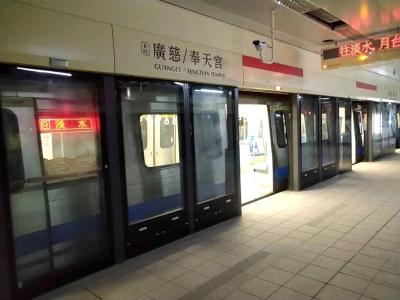
The eastern extension of the Taipei MRT Red Line could begin operations as early as late June, the Taipei Department of Rapid Transit Systems said yesterday. Taipei Rapid Transit Corp said it is considering offering one month of free rides on the new section to mark its opening. Construction progress on the 1.4km extension, which is to run from the current terminal Xiangshan Station to a new eastern terminal, Guangci/Fengtian Temple Station, was 90.6 percent complete by the end of last month, the department said in a report to the Taipei City Council's Transportation Committee. While construction began in October 2016 with an


 RSS
RSS