


President Tsai Ing-wen (蔡英文), as chairperson of the Democratic Progressive Party (DPP), should apologize to the public for a scandal involving former DPP member Chao Chieh-yu (趙介佑), the Chinese Nationalist Party (KMT) said yesterday.
Chao, who is being investigated for alleged fraud and drug offenses, was expelled from the DPP on Saturday through a motion passed by the review committee of the party’s Taipei chapter.
In 2016, he served as an adviser to Tsai’s presidential campaign office in Taipei.
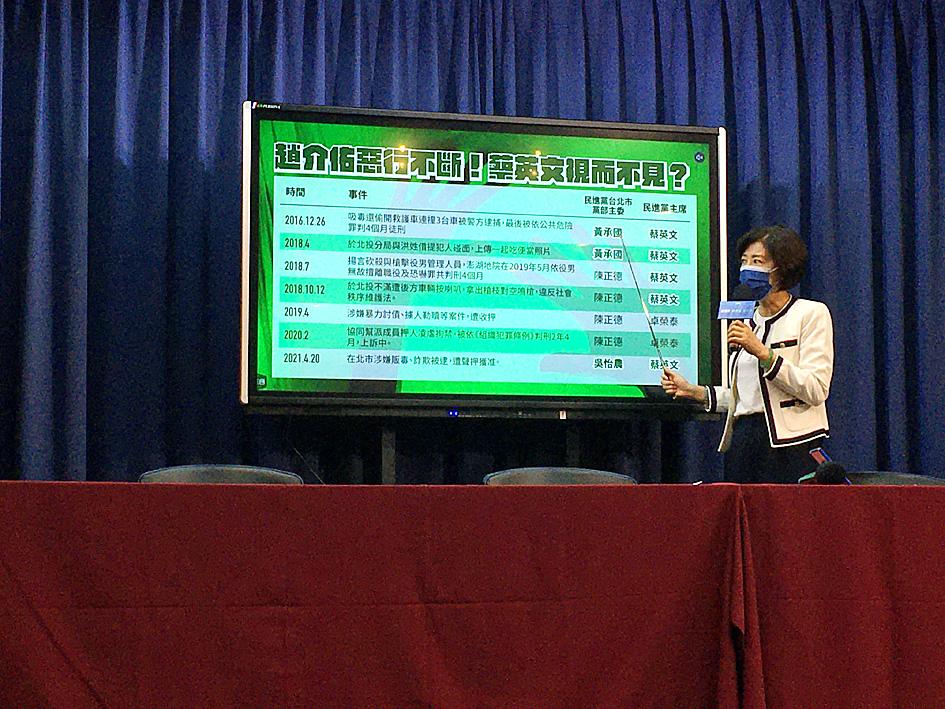
Photo: Lin Liang-sheng, Taipei Times
The committee on Saturday also selected a new convener, Lin Wan-he (林萬賀), following the resignation of Chao’s father, Chao Ying-kuang (趙映光), from the position.
At a news conference in Taipei yesterday, KMT Culture and Communications Committee director-general Alicia Wang (王育敏) said the DPP’s expulsion of Chao Chieh-yu was merely an attempt to stop the scandal spreading.
The alleged misconduct by Chao Chieh-yu “did not start today,” Wang said, adding that controversy over his activities date back to December 2016, when he was sentenced to four months in jail after being arrested by police for drug use, and stealing and driving an ambulance.
Tsai was DPP chairperson at the time and should have been upset by Chao Chieh-yu’s controversies “long ago,” Wang said.
Wang asked whether Tsai would have “continued to condone” Chao Chieh-yu’s behavior if the media had not reported the story.
The DPP has shown people that as long as a person possesses a DPP membership card, they can “do anything,” Wang said, adding that the incident involving Chao Chieh-yu is “just the tip of the iceberg” and the result of Tsai’s permissiveness as chairperson of the DPP.
As DPP chairperson, Tsai should apologize to the public for the disturbance caused by a member of her party, Wang said.
Being chairperson of the ruling party and the president, Tsai is “the most powerful person in Taiwan,” and has a responsibility to rectify public safety issues in the nation, she added.
The KMT in a statement accused Tsai of wanting to distance the DPP from the scandal.
“People’s eyes are sharp,” the KMT wrote, adding that the DPP’s handling of Chao Chieh-yu was not enough to “stop people’s mistrust of the ruling party.”
Additional reporting by CNA

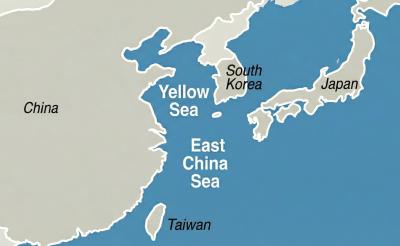
China has reserved offshore airspace in the Yellow Sea and East China Sea from March 27 to May 6, issuing alerts usually used to warn of military exercises, although no such exercises have been announced, the Wall Street Journal (WSJ) reported yesterday. Reserving such a large area for 40 days without explanation is an “unusual step,” as military exercises normally only last a few days, the paper said. These alerts, known as Notice to Air Missions (Notams), “are intended to inform pilots and aviation authorities of temporary airspace hazards or restrictions,” the article said. The airspace reserved in the alert is

South Korea is planning to revise its controversial electronic arrival card, a step Taiwanese officials said prompted them to hold off on planned retaliatory measures, a South Korean media report said yesterday. A Yonhap News Agency report said that the South Korean Ministry of Foreign Affairs is planning to remove the “previous departure place” and “next destination” fields from its e-arrival card system. The plan, reached after interagency consultations, is under review and aims to simplify entry procedures and align the electronic form with the paper version, a South Korean ministry official said. The fields — which appeared only on the electronic form

More than 6,000 Taiwanese students have participated in exchange programs in China over the past two years, despite the Mainland Affairs Council’s (MAC) “orange light” travel advisory, government records showed. The MAC’s publicly available registry showed that Taiwanese college and university students who went on exchange programs across the Strait numbered 3,592 and 2,966 people respectively. The National Immigration Agency data revealed that 2,296 and 2,551 Chinese students visited Taiwan for study in the same two years. A review of the Web sites of publicly-run universities and colleges showed that Taiwanese higher education institutions continued to recruit students for Chinese educational programs without

A bipartisan group of US senators has introduced a bill to enhance cooperation with Taiwan on drone development and to reduce reliance on supply chains linked to China. The proposed Blue Skies for Taiwan Act of 2026 was introduced by Republican US senators Ted Cruz and John Curtis, and Democratic US senators Jeff Merkley and Andy Kim. The legislation seeks to ease constraints on Taiwan-US cooperation in uncrewed aerial systems (UAS), including dependence on China-sourced components, limited access to capital and regulatory barriers under US export controls, a news release issued by Cruz on Wednesday said. The bill would establish a "Blue UAS


 RSS
RSS