


Labor groups yesterday marked International Workers’ Day with a march through Taipei, while groups focused on pushing a higher minimum wage and guaranteed worker pension plans.
Participants congregated along Ketagalan Boulevard in front of the Presidential Office Building, before marching past the Legislative Yuan — where they unfurled large banners with slogans asking for legislators’ support.
A teachers’ group later held a sit-in protest in front of the Executive Yuan, while brief scuffles broke out with police in front of the Control Yuan.
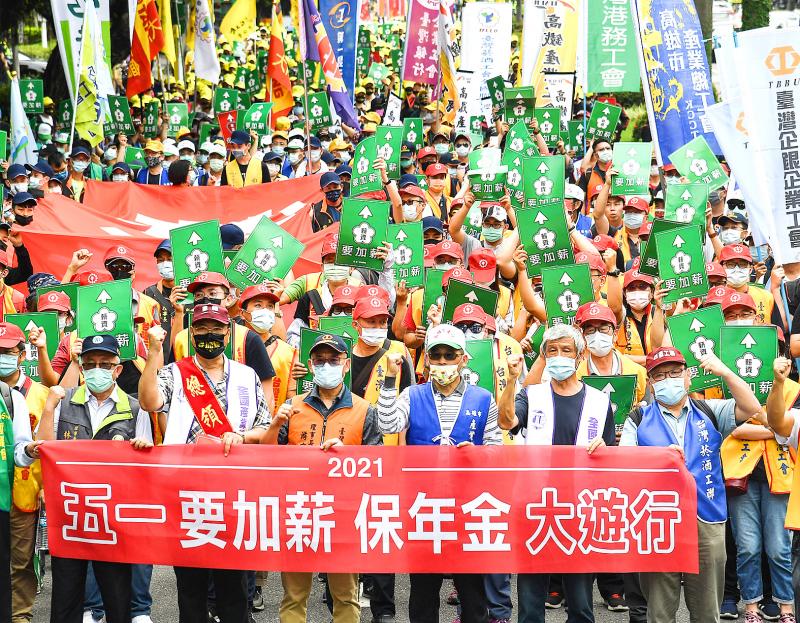
Photo: CNA
Taiwan Confederation of Trade Unions director Chiang Chien-hsin (江健興) led attendees in chanting slogans on a stage with participants waving flags and banners representing workers’ groups from various industries, as well as migrant workers from Southeast Asian countries.
Taiwan has done well in the fight against COVID-19, compared with most countries that had repeated lockdowns and business closures, the confederation said in a statement.
Taiwan’s GDP grew 3.11 percent last year, with new highs in the stock market and the GDP forecast to grow 4.64 percent this year after already reaching 8.16 percent last quarter, it said, citing government data.
The prosperity at the top is the result of workers’ blood, sweat and tears, Chiang said.
“Taiwan’s workers made the main contributions to last year’s ‘economic miracle,’ but did not receive their fair share of the benefits. Wage increases lagged far behind economic growth and corporate profits,” he said.
“The government keeps touting Taiwan’s economic performance, yet it is only willing to offer a monthly minimum wage increase of NT$200,” he said, referring to an increase that took effect in January that raised the monthly minimum wage from NT$23,800 to NT$24,000 and the hourly minimum wage from NT$158 to NT$160.
Chiang said that the increases were insignificant, and called for the monthly minimum wage to be raised to NT$30,000.
He also urged the government to increase salaries for state enterprises, teachers and civil servants.
Another problem facing workers is pension security, as the labor pension system is projected to go bankrupt by 2026, the group said.
They urged the government to consult with labor unions in establishing a system similar to the sovereign wealth fund — a state-owned fund supported by revenue from commodity exports, foreign-exchange reserves and other investments — to make sure that the pension scheme does not collapse.
Organizers on stage had food items delivered by Uber Eats and Foodpanda workers to highlight the delegates representing the National Delivery Industrial Union as a new labor force of mostly young people, many of whom were attending the event for the first time.
Arery Chen (陳昱安), an organizer for the National Delivery Industrial Union, said that workers from Lalamove, Gogo X and others were also joining the union.
They have realized the need to band together after the two leading delivery platforms cut pay 10 to 30 percent in March, Chen said, adding that the union is calling for more rights for food delivery workers, as well as improved compensation for drivers injured in traffic accidents on the job.
Additional reporting by CNA
Fast food chain McDonald's is to raise prices by up to NT$5 on some products at its restaurants across Taiwan, starting on Wednesday next week, the company announced today. The prices of all extra value meals and sharing boxes are to increase by NT$5, while breakfast combos and creamy corn soup would go up by NT$3, the company said in a statement. The price of the main items of those meals, if ordered individually, would remain the same. Meanwhile, the price of a medium-sized lemon iced tea and hot cappuccino would rise by NT$3, extra dipping sauces for chicken nuggets would go up

Yangmingshan National Park’s Qingtiangang (擎天崗) nature area has gone viral after a park livestream camera observed a couple in the throes of intimate congress, which was broadcast live on YouTube, drawing large late-night crowds and sparking a backlash over noise, bright lights and disruption to wildlife habitat. The area’s livestream footage appeared to show a couple engaging in sexual activity on a picnic table in the park on Friday last week, with the uncensored footage streamed publicly online. The footage quickly spread across social media, prompting a tide of visitors to travel to the site to “check in” and recreate the

Carrefour Taiwan is to begin using a new name from the start of July, but it cannot divulge the name until then, the chairman of the supermarket chain's parent company said today. President Chain Store Co chairman Lo Chih-hsien (羅智先) was asked by reporters after a shareholders' meeting to confirm whether the company has settled on a new name for the supermarket brand. In March, the government-registered name of two Carrefour Taiwan branches was quietly changed to "Le Chia Kang" (樂家康) in Chinese, raising speculation that has been selected as the name. Lo said that because of local regulations and contractual obligations, the

GROUNDED: A KMT lawmaker proposed eliminating drone development programs and freezing funding for counterdrone systems, despite China’s adoption of the technology China has deployed attack drones at air bases near the Taiwan Strait in a strategy aimed at overwhelming Taiwan’s air defense systems through saturation attacks, the Mainland Affairs Council (MAC) said. The council’s latest quarterly report on China said that satellite imagery and open-source intelligence indicate that the Chinese People’s Liberation Army (PLA) had converted retired J-6 fighter jets into J-6W drones, which the PLA has stationed at six air bases near Taiwan, five in China’s Fujian Province and one in Guangdong Province. The report cited J. Michael Dahm, a senior fellow at the US-based Mitchell Institute, as saying that China has


 RSS
RSS