


The Taiwan High Court on Wednesday acquitted former CTBC Financial Holding Co vice chairman Jeffrey Koo Jr (辜仲諒), reversing guilty decisions in the first and second rulings.
Former Chinatrust Financial chief financial officer Perry Chang (張明田) and former CTBC Bank chief financial manager Lin Hsiang-hsi (林祥曦) were also acquitted of charges related to the Red Fire Development Co financial scandal, a case that has dragged on for 15 years.
The ruling can still be appealed, although the High Prosecutors’ Office said that a decision would be made after it reviews the latest ruling and court documents.
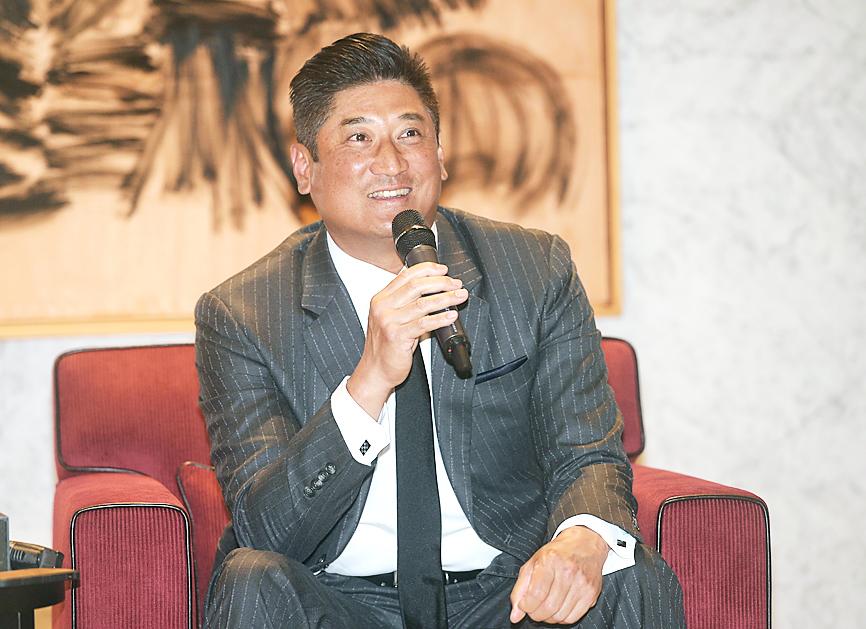
Photo: Chang Chia-ming, Taipei Times
CTBC Financial officials said in a statement that they respect the High Court’s ruling.
“We are thankful that the justice system has investigated and clarified the facts of the case, clearing the names of the people involved, upholding justice and protecting human rights,” the statement said.
Koo in a separate statement released through his lawyer thanked the judges for restoring his good name.
“Koo firmly believes that he and the other defendants did not take any action to harm CTBC Financial,” his statement said. “That was why Koo returned from Japan to be at the trials.”
“The trials have been ongoing for more than 10 years, partly due to a difference in interpretation of the law by the prosecution and the defense,” it said. “The High Court followed the instructions and interpretation of the Supreme Court, and the judges found the defendants not guilty, so we hope the courts would no longer pursue such legal disputes.”
Taipei prosecutors in 2006 indicted Koo, Chang and Lin — as well as former CTBC Financial chief compliance officer Teng Yen-tun (鄧彥敦), who was acquitted in a retrial in 2018 — of making NT$1.3 billion (US$46.51 million at the current exchange rate) in illegal profit.
The four were charged with breach of trust, embezzlement and other contraventions of the Securities and Exchange Act (證券交易法) and the Banking Act (銀行法).
From 2004 to 2007, Koo and the other defendants transferred large amounts of money to Red Fire Development, an offshore shell company, reportedly set up by Koo with an address in Hong Kong and registered in the British Virgin Islands, prosecutors said at the time.
Of those funds, NT$27.5 billion was used to purchase a 9.9 percent stake in Mega Financial Holding Co, but the transactions were not approved by CTBC Financial’s board, prosecutors said.
Koo, who was CTBC Bank chairman and CTBC Financial deputy chairman at the time, was responsible for ordering the transfers, prosecutors said.
In the first ruling in October 2010, the Taipei District Court found the defendants guilty, handing Koo a nine-year prison term, which he appealed.
The High Court in May 2013 handed Koo a heavier term of nine years, eight months, and fined him NT$150 million.
However, while the High Court in a retrial in 2018 found the defendants, apart from Teng, guilty, it reduced Koo’s sentence to three years, six months, while Chang and Lin were sentenced to four years and two years respectively.
Koo — the scion of the Koo family, which controls CTBC Financial — is chairman of the CTBC Charity Foundation, owner of the CTBC Brothers baseball team, and is chairman of baseball’s national body.

FUKUOKA SITUATION: Japanese media reported that the pathogen is expected to be identified by the summer, while the CDC downplayed the idea that it was hMPV A “mysterious cold-like illness” reported in Japan’s Fukuoka Prefecture does not seem to be a new disease, but Japanese authorities have been asked about the situation, the Centers for Disease Control (CDC) said yesterday. The Fukuoka Prefectural Medical Association on Wednesday told a news conference that a “mystery cold” that has become a hot topic on social media is “highly likely to be caused by some kind of viral infection,” Japan’s KBC News reported. “Many people are experiencing symptoms starting with a sore throat, followed by a runny nose, phlegm and a severe cough,” KBC News reported, citing association officials. Health authorities are

Nvidia Corp CEO Jensen Huang (黃仁勳) arrived in Taiwan yesterday ahead of upcoming AI and technology events, saying he plans to meet with clients and Taiwan Semiconductor Manufacturing Co Chairman C.C. Wei (魏哲家) during his visit. After landing at Taipei Songshan Airport, Huang posed for photos with fans and handed out Yakult drinks to reporters and supporters waiting at the scene, saying he has “a lot to do” during the trip. Asked about reports that Nvidia’s planned headquarters site in Taipei’s Beitou Shilin Technology Park could break ground on May 27, Huang said that if the company holds an event, he would
Carrefour Taiwan is to begin using a new name from the start of July, but it cannot divulge the name until then, the chairman of the supermarket chain's parent company said today. President Chain Store Co chairman Lo Chih-hsien (羅智先) was asked by reporters after a shareholders' meeting to confirm whether the company has settled on a new name for the supermarket brand. In March, the government-registered name of two Carrefour Taiwan branches was quietly changed to "Le Chia Kang" (樂家康) in Chinese, raising speculation that has been selected as the name. Lo said that because of local regulations and contractual obligations, the
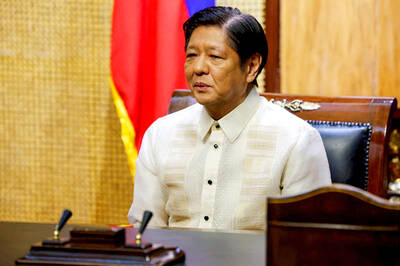
The Philippines would likely be involved in any conflict over Taiwan due to its proximity to the democracy claimed by China, President Ferdinand Marcos Jr said, reiterating a stance that risks angering Beijing. “In the Philippines, we do not have a choice because Taiwan is so close to the Philippines and we have almost 200,000 Filipino nationals living and working in Taiwan,” Marcos said in an interview with Japanese media in Manila on Monday. The Philippine leader’s comments come ahead of a state visit to Japan next week, where he is to meet with Japanese Prime Minister Sanae Takaichi to discuss security


 RSS
RSS